
c. 259 - c. 275·Feast 17 August (Roman Catholic); 2 September (Eastern Orthodox and Maronite); 7 August (Spain); 15 September at Deir Mimas, Lebanon
St. Mammes of Caesarea
Great Martyr of Caesarea in Cappadocia
Overview
Mammes, whose name takes a dozen forms across the Christian East and West, was a child-martyr of the third century put to death at Caesarea in Cappadocia. Born in prison to parents, Theodotus and Rufina, jailed as Christians and afterwards executed, he was orphaned young and raised by a wealthy widow named Ammia, who left him her care until her death in his fifteenth year. The legend that carries his memory tells how he was tortured before the governor of Caesarea and then before the Emperor Aurelian, freed by an angel and sent to hide on a mountain nearby, how he preached to the lions into which he was thrown until the beasts grew gentle and one stayed with him as a companion, and how, led by that lion into the presence of Duke Alexander, he was condemned and killed by a blow of a trident to the stomach, dragging himself to a place near the theatre as angels bore his soul to heaven. His cult moved from Caesarea to Langres in France, where he is chief patron of the diocese, and spread through Lebanon, Cyprus, Greece, Spain, Italy and Portugal, where the cathedral rock of Bilbao's football club still bears his name.
The Complete Life
Early Life
The story of Mammes begins in a prison at Caesarea in Cappadocia, where his parents, Theodotus and Rufina, were held and afterwards put to death for being Christians. The boy born to them there was orphaned by their martyrdom and taken in by Ammia, a wealthy widow of the city, who brought him up in the faith of his parents until her death in his fifteenth year. Whatever history lies behind the tale, its shape is that of the child-martyr legends of the great persecutions: innocence preserved amid blood, providence supplying a guardian where the martyrs of the family had been taken away. An alternative tradition remembered in some places says he was himself devoured by lions, a variant the mainstream legend answers with its gentler picture of the beasts made docile by his voice.
§ Life
Passion
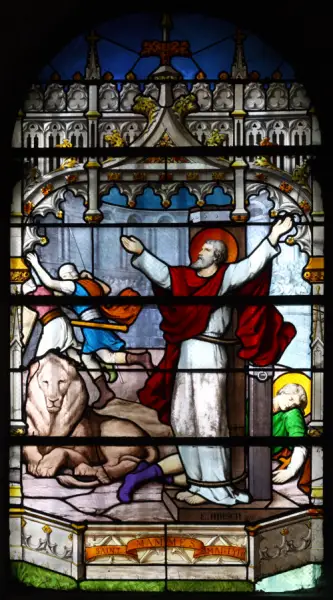
According to the legend, the trial of Mammes began with torture at the order of the governor of Caesarea and continued before the Emperor Aurelian himself, under whose eyes the young confessor was tortured a second time. An angel then released him and commanded him to hide on a mountain near the city, where he lived until the authorities laid hold of him again. Cast to the lions, he is said to have preached to the animals until they grew quiet, and one of them remained at his side like a companion. Accompanied by the lion, he went to Duke Alexander, who sentenced him to death. The executioner's trident pierced his stomach, and the dying martyr dragged himself, bleeding, to a place near the theatre, where angels carried his soul to heaven. Around the year 275 the church of Caesarea numbered him among its martyrs, with his parents Theodotus and Rufina before him.
§ Life
Cult in the West
The centre of Mammes's cult was first Caesarea itself, but it shifted westward when his relics were brought to Langres in France, where the cathedral of Saint-Mammès is dedicated to him and where he stands as chief patron of the diocese. Pilgrims on the road to Santiago de Compostela carried his fame into Spain, where a relic of his cranium is kept in the chapel of the former convent of San Mamés at Bilbao, a statue of the saint with his lion watches over the Casa de la Misericordia, and the stadium of Athletic Bilbao is called San Mamés, its players are called the lions of San Mamés. The parish church of Santa María Magdalena in Zaragoza claims to keep the martyr's head, and at Tábara his name is honoured beside that of St. Blaise. In Portugal, many places from Lisbon to Braga and the Serra de São Mamede preserve his name.
§ Veneration
Cult in the East
In Lebanon Mammes is among the most beloved of saints, with churches and convents bearing his name across the country. At Deir Mimas, his patronal town on the Litani valley, great festivities mark his feast each year on 15 September, served by an Orthodox monastery above the valley and a Melkite church within the village. The Maronite church of Saint Mamas at Ehden dates to 749, one of the oldest in the country, and at Baabdat a church of the saint was built in the sixteenth century, while the monastery of Dayr Mar Mamas at Bechaaleh in Batroun is being restored by the villagers. In Cyprus he is remembered as a poor hermit of Morphou who evaded the tax-collectors, escaped his escorts to rescue a lamb from a lion's jaws and rode the beast into town, winning exemption from taxation; the monastery there is the third holiest place of Greek Orthodox worship on the island. Greece keeps numerous churches and whole villages named Agios Mamas in Chalkidiki, Crete and Laconia, and in Brianza in northern Italy new mothers still sought his help for milk, bringing bread and cheese to his altar in the old rite of the pan di fioeu, the bread of children.
§ Veneration
Timeline
- 259
Born in prison at Caesarea to Theodotus and Rufina, Christians awaiting execution, and left an orphan by their martyrdom
§ Life
- 274
Loses his foster-mother Ammia, the rich widow who raised him, when he is fifteen years old
§ Life
- 275
Suffers torment at the orders of Caesarea's governor for professing Christ, and is taken before the Emperor Aurelian to endure it a second time; an angel then frees him, sending him to hide on a mountain near the city
§ Life
- 275
Thrown to the lions, he preaches to the beasts until they turn docile, and a lion remains with him thereafter as a companion
§ Life
- 275
Condemned to death by Duke Alexander and struck in the stomach with a trident; dying, he drags himself to a spot near the theatre, where angels carry his soul to heaven
§ Life
The Record
- Patron of
- Langres·Babies who are breastfeeding·Sufferers from broken bones and hernias (at Murero, Zaragoza)·Deir Mimas, Lebanon·Athletic Club of Bilbao, whose players are called the lions of San Mamés
- Symbols
- Lion·Trident·Holding a lamb (Cypriot iconography)
- Canonization
- Pre-congregation; venerated as a Great Martyr in the Eastern churches and as a saint in the Latin West
Prayer
Bibliography
Show 8 sources
- "Commemoration of Sts. Mamas, Piliktimon and Simeon Stylite". armenianchurch.ge.
- Vailhé, Siméon. "Caesarea." The Catholic Encyclopedia. Vol. 3. New York: Robert Appleton Company, 1908.
- Kirsch, Johann Peter. "Sts. Rufina." The Catholic Encyclopedia. Vol. 13. New York: Robert Appleton Company, 1912.
- "Martyr Rufina of Caesarea, in Cappadocia", Orthodox Church in America.
- Cousin, Jean the Elder, "St. Mammes and Duke Alexander", Web Gallery of Art.
- "Deir Mimas". pbvlib.org.
- Iskandar, Amine Jules (13 September 2025). "Mar-Méma of Ehden". This is Beirut.
- Pirovano, Franca. "San Mamètt e 'l pan di fioeu", in Momenti di folklore in Brianza, Palermo, Sellerio, 1985, pp. 47-48.
Profile text adapted from the Wikipedia article, licensed CC BY-SA 4.0.
Pray with this saint every day
Save St. Mammes of Caesarea to your favorites, read the full profile, and get feast-day reminders in the Saints app.
Get the Saints AppFree on the App Store for iPhone and iPad