
1st century·Feast 24 May (Roman Catholic Church); 23 May (Eastern Orthodox Church)
St. Manahen
Prophet and Teacher of the Church of Antioch
Overview
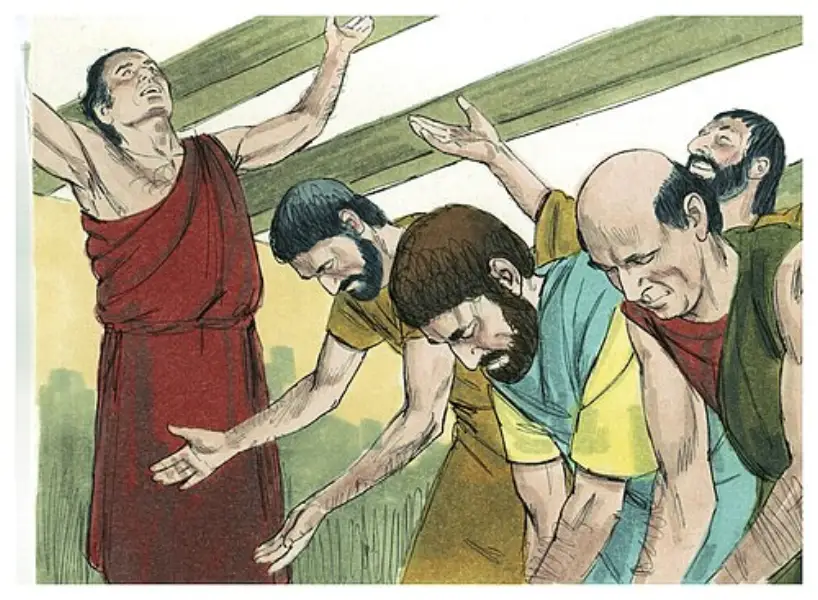
Manahen, whose name is also given as Manaen or Menachem, was a prophet and teacher of the first-century church at Antioch, the man whom Luke lists beside Barnabas, Simeon Niger, Lucius of Cyrene and Saul when the Holy Spirit set apart the two apostles for their first missionary journey. What makes him unforgettable is the single detail Scripture gives: he had been brought up, in Luke's word syntrophos, with Herod Antipas, the tetrarch who beheaded John the Baptist and interrogated Jesus. Reared in the same household as a prince of the Herodian court, he chose instead the company of the persecuted disciples of Jesus, and probably belonged to the circle of Jewish Christians who planted the church of Antioch after the persecution that followed the death of Stephen. Commentators from ancient times have wondered whether this foster-brother of Antipas was one of the eyewitnesses from whom Luke, an Antiochene himself, learned the intimate details of the Herodian family that fill his Gospel. He died at Antioch, the date unknown, and is honoured on 24 May in the Roman Catholic Church and 23 May in the East.
The Complete Life
Biblical Narrative
Little is recorded of Manahen's life, and all of it turns on one phrase. Acts 13:1 names him among the prophets and teachers of Antioch by whom, at the Spirit's prompting, Saul and Barnabas received the laying on of hands and were dispatched on the first of Paul's missionary journeys; the same verse records that he had been brought up, syntrophos in Greek and collactaneus in the Vulgate, with the tetrarch Herod Antipas. Commentators have read the term either as foster-brother or as life-long friend, and either way it places him from childhood within the orbit of the Herodian court. Commentators have suggested that as Luke, the presumed author of Acts, belonged to Antioch, Manahen may have been among the eyewitnesses and ministers of the word from whom that evangelist gathered his intimate notices of Antipas and the Herodian household, and that he may have come to discipleship alongside Joanna, the wife of Herod's steward Chusa.
§ Biblical narrative
The Church of Antioch
When Antipas sailed for Rome in the year 39 to seek the favour of Caligula and received instead a sentence of perpetual exile, the church of Antioch was already taking shape, its founders Jewish believers scattered when Stephen's death set off the persecution, men who had preached the Gospel to the Greeks of the city as well. The convergence of dates and persons has led historians to suppose that Manahen stood among the founders of the Antiochene church, a man of courtly upbringing devoting himself to a community of refugees. There he exercised the double office the lists of Acts assign him, prophet and teacher, until the moment when the Spirit and the laying on of hands sent Paul and Barnabas from that community to the wider world. He is thought to have died at Antioch in Syria; the date of his death is unknown.
§ Early historian references
Veneration
Manahen's name appears in many of the ancient martyrologies, though no acts of his martyrdom survive and some lists count him among the confessors rather than the martyrs. The Roman Catholic Church keeps his feast on 24 May, according to the Roman Martyrology, and the Eastern Orthodox Church honours him on 23 May, where the great Greek synaxarion commemorates the prophet Manaen. He stands first in the long line of believers whom the New Testament records by name but without a story, remembered by the church precisely because at one decisive moment he laid hands on the two men through whom the Gospel went out to the nations.
§ Veneration
Timeline
- 39
Herod Antipas, with whom Manahen was brought up, leaves for Rome to court the favour of Caligula and instead receives an order of perpetual exile
§ Early historian references
- 39
During this period the church of Antioch is founded by Jewish Christians dispersed by the persecution over Stephen, and Manahen is thought likely to have been one of its founders
§ Early historian references
The Record
- Patron of
- Antiochene Christianity
- Symbols
- Book or scroll as teacher of the church
- Canonization
- Pre-congregation; named in Acts 13:1 and in the ancient martyrologies
Prayer
Bibliography
Show 6 sources
- Drum, Walter. "St. Manahen." The Catholic Encyclopedia Vol. 9. New York: Robert Appleton Company, 1910. Public domain.
- Butler, Alban. The Lives of the Fathers, Martyrs, and other principal Saints, Vol. VI, 1866, p. 154.
- English Standard Version (ESV), Acts 13:1.
- "Ὁ Προφήτης Μανὴν". 23 Μαΐου. ΜΕΓΑΣ ΣΥΝΑΞΑΡΙΣΤΗΣ (in Greek).
- "May 24". The Roman Martyrology. Archived 2011-10-12 at the Wayback Machine.
- Easton, Matthew George (1897). "Menahem". Easton's Bible Dictionary (New and revised ed.). T. Nelson and Sons.
Profile text adapted from the Wikipedia article, licensed CC BY-SA 4.0.
Pray with this saint every day
Save St. Manahen to your favorites, read the full profile, and get feast-day reminders in the Saints app.
Get the Saints AppFree on the App Store for iPhone and iPad