
died 664·Feast January 20
St. Manchán of Lemanaghan
Early Irish abbot of Lemanaghan and nature poet
Overview
Manchán mac Silláin, called Manchianus in Latin sources, was an early Irish saint who died in 664 and is venerated as the patron of Liath Mancháin, the monastery he founded at what is now Lemanaghan in County Offaly. Traditions about his family vary, a confusion the sources attribute to the number of early churchmen bearing similar names, but the soundest genealogy gives his father as Sillán and his grandfather as Conall, tracing the line back to Rudraige Mór of Ulster, with Mella as his mother. He must likewise be kept distinct from Manchán or Manchéne, the scholar who led the abbey of Min Droichit in Offaly. His church stood in the kingdom of Delbnae Bethra, founded around 645 on land that tradition says came through St. Ciarán of Clonmacnoise after the high king Diarmuid's victory in battle. Manchán converted the people of the district, built a stone house for his mother nearby, and is remembered for a generous nature, wisdom, and knowledge of sacred scripture. A haunting Irish nature poem beginning 'I wish, O Son of the living God' is attributed to him. He died in the yellow plague of 664, and his relics rest in the Romanesque shrine made at Clonmacnoise in 1130.
The Complete Life
A Pedigree Entangled with Other Mencháns
The traditions surrounding Manchán's origins are uneven, and the sources themselves acknowledge that variant pedigrees circulate, probably because several early churchmen answered to the name Manchán or Mainchín and their stories became entangled over the centuries. The genealogy that modern scholarship treats as most reliable makes him a son of Sillán, grandson of Conall, and a descendant of Rudraige Mór of Ulster, while naming his mother as Mella. He must likewise be distinguished from another figure of the same world: Manchán or Manchéne, the scholar who ruled as abbot of Min Droichit, also in Offaly, whose reputation long risked being merged with his own. In Latin records the Lemanaghan saint appears as Manchianus. Of his childhood and education nothing is recorded directly, but his later reputation for knowledge of sacred scripture and for a wisdom that drew the respect of his contemporaries presupposes a formation within one of the monastic schools of seventh-century Ireland. The landscape of his life was the midlands, where the monastery of Clonmacnoise on the Shannon already stood as a power whose influence reached across the kingdom of Delbnae Bethra where Manchán would one day settle.
§ Introduction
An Island in the Bog
Manchán's monastery owed its existence, in the account local tradition preserves, to a chain of events that began in war. In 644 the high king Diarmuid stopped at Clonmacnoise on his way to fight Guaire, king of Connacht, and asked for the monks' prayers. When he emerged from the battle victorious, he made good on the favor by granting St. Ciarán the land of 'the island in the bog,' the ground now known as Leamonaghan, on one condition alone: a monk of his community must go out to bring the faith to the grant. The choice fell, by Ciarán's word, to Manchán. Around 645 he went out from Clonmacnoise into the bog country of Delbnae Bethra and established the monastery of Liath Mancháin, its remains now lying about two kilometres from Pollagh. There he set about converting the people of the district. The foundation never rivaled its powerful neighbor to the west, for Clonmacnoise overshadowed it from the first, but it rooted the Christian life in a landscape that had known it only lately, and its ruins and graveyard remain on the site to this day.
§ Foundation of the monastery
A House for His Mother, a Well for the People
Close to the monastery, about five hundred meters away, Manchán built a small stone house for his mother Mella, who had evidently come to share his wilderness. Locals call the building Kell, and visitors can still walk among its ruins. A later legend keeps the saint's presence alive in the place through a story of thirst: finding the monastery without water one day, Manchán struck a rock, and a spring bubbled up. The spot is now called St. Manahan's Well, and pilgrims come to it from around the world, often on 24 January; numerous cures of disease are credited to its waters. Two stone bullauns near the holy well complete the ensemble of early survivals at Lemanaghan. The conversion of Delbnae Bethra, the task for which he had been sent, is otherwise recorded only in outline, but his diligence can be measured in what he left behind: a functioning monastery, provision for his mother under his own hand, and a sacred landscape of well and stones that popular devotion has never wholly abandoned. Kell and the spring gave his mission a geography that outlasted the monastery's silence.
§ Foundation of the monastery
The Wish for a Hidden Hut
Manchán's reputation in tradition rests on three things: a generous nature, wisdom, and knowledge of sacred scripture. To these the surviving literature adds a poet's voice. In Gaelic he is credited with a poem describing the desire of Ireland's martyrs, and to him is attributed the Old or Middle Irish nature poem that begins 'I wish, O Son of the living God' and longs for 'a hidden little hut in the wilderness' to be the poet's dwelling. The piece is described as a comad, and its language has been dated by scholars to the late eighth or early ninth century, or even the tenth, so the attribution may preserve a memory of the saint rather than a text from his own hand. Whatever its exact date, the poem's imagination of solitude, hiddenness, and a hut in the wilderness with the Son of the living God as host has shaped the popular picture of Manchán as a man drawn to the eremitical edge of monastic life. Gerard Murphy edited and translated the poem for modern readers, and it remains among the best-loved of early Irish religious lyrics.
§ Foundation of the monastery
The Fast of 664 and the Yellow Plague
The year 664 brought the great catastrophe of early Irish monasticism, the yellow plague, and with it one of the strangest episodes the Irish annals record. Several sources relate that Manchán was among the churchmen who met that year for a communal act of prayer and fasting, in which they demanded of God that a plague be sent upon Ireland, one intended to carry off a great part of the kingdom's humbler people. Féchín of Fore figures in the same story. Whatever the historical core of the account, the sources agree on its outcome for Manchán: he was one of the saints who died in the event, perishing in the yellow plague of 664. He cannot have been young, for his mother had needed a house of her own near the monastery and he had led his community for nearly two decades, but no source records his age at death. The Irish martyrologies fixed his commemoration on 20 January, the feast the calendars have kept ever since. The fast he joined and the plague that took him belong to the same episode, and the annals tell it without embarrassment.
§ Death and veneration
Veneration Before Canonization
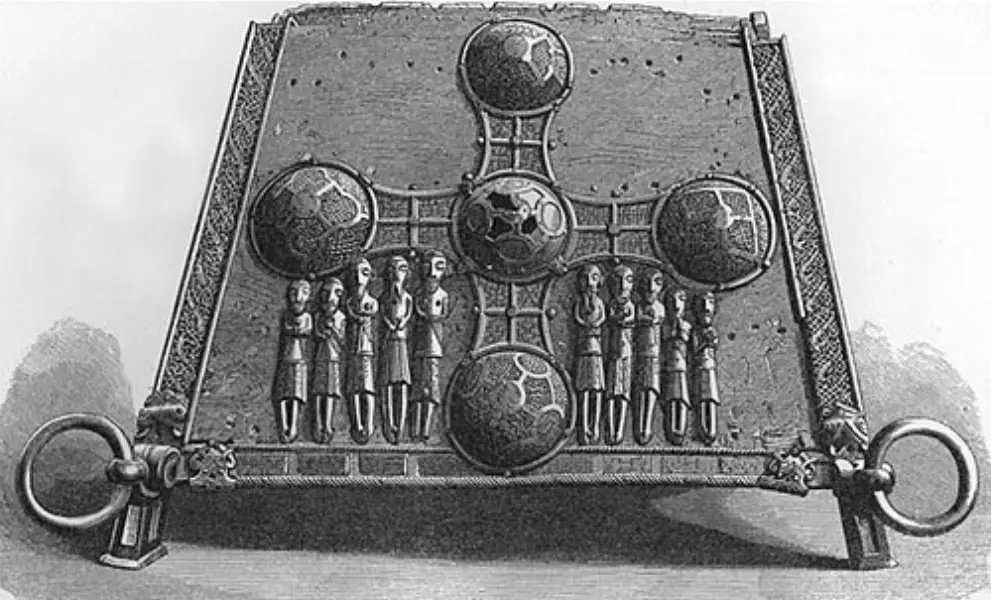
No act of formal canonization stands behind the cult of Manchán; he belongs to the age before such processes existed, when sanctity was recognized by the accumulated judgment of local church tradition and the witness of the calendars. The Irish martyrologies, among them the Félire Óengusso, the Martyrology of Tallaght, the Martyrology of Gorman, and the Martyrology of Donegal, all fix his commemoration on 20 January, and this consistent early witness is the foundation of his standing as a saint. Devotion at his burial place continued long after his death. The decisive medieval gesture of recognition came in 1130, when craftsmen at Clonmacnoise made the great reliquary shrine that still bears his name and, by tradition, still contains some of the saint's remains. A churchman dead for more than four and a half centuries was thus given a vessel of honor of exceptional quality, a public declaration that the community regarded his bones as relics. That judgment has never been reversed: the shrine remains an object of devotion in the Catholic church at Boher, County Offaly. Custody of the bones passed from a bogland grave to a Romanesque casket, and there it has remained.
§ Death and veneration
Ruins, a Well, and a Masterpiece of Metalwork
What survives at Lemanaghan is modest to the eye, monastic ruins and a graveyard, a holy well, and two stone bullauns, yet the site has never lost its hold on devotion. Pilgrims still come to St. Manahan's Well from around the world, commonly on 24 January, and tradition credits the water with cures from disease. The best-known survival, however, is Saint Manchan's Shrine, preserved in the Catholic church at Boher, County Offaly. Made at Clonmacnoise in 1130 and still enshrining some of his bones, it ranks among the masterworks of Romanesque metalwork and has attracted close scholarly attention: James Graves described the church and shrine in 1874, and modern studies by Griffin Murray have examined its art and devotion and even the identity of its figures. The shrine has made the saint a fixture of Irish cultural memory beyond the church, and his attributed poem, translated and anthologized since the nineteenth century, is among the most quoted of early Irish religious lyrics, so that a seventh-century abbot of a small Offaly monastery speaks today through metalwork and through verse alike.
§ St. Manchán's shrine
Timeline
- 644
The high king Diarmuid stops at Clonmacnoise on his way to battle Guaire, king of Connacht, and asks for the monks' prayers
§ Foundation of the monastery
- 645
After Diarmuid's victory, Manchán is sent from Clonmacnoise to Christianize the granted bogland and founds his monastery at Lemanaghan
§ Foundation of the monastery
- 664
Joins an assembly of churchmen in a communal prayer and fast that the sources link with the sending of plague on Ireland
§ Death and veneration
- 664
Dies in the yellow plague that sweeps Ireland, one of the saints to perish in that year
§ Death and veneration
- 1130
Craftsmen at Clonmacnoise create the reliquary shrine that still contains some of his remains
§ St. Manchán's shrine
In Their Own Words
I wish, O son of the living God, ... for a hidden little hut in the wilderness that it might be my dwelling
The Record
- Major works
- Dúthracar, a Maic Dé bí ('I wish, O Son of the living God'), an Old or Middle Irish nature poem attributed to him
- Patron of
- patron saint of Lemanaghan, County Offaly
- Symbols
- Saint Manchan's Shrine·the holy well at Lemanaghan
- Canonization
- Pre-congregation; venerated from the early Irish church, with his feast on 20 January fixed by the Irish martyrologies
Prayer
Bibliography
Show 7 sources
- Breen, Aidan (2010). "Manchán, Manchianus, Manchíne". Dictionary of Irish Biography. Cambridge University Press.
- Graves, James (1874). "The Church and Shrine of St. Manchán". The Journal of the Royal Historical and Archaeological Association of Ireland. 3: 134–150.
- Murray, Griffin. "Lost and Found: The Eleventh Figure on St Manchan's Shrine". The Journal of the Royal Society of Antiquaries of Ireland, volume 133, 2003.
- Harbison, Peter; H. Potterton; J. Sheehy, eds. (1978). Irish Art and Architecture: From Prehistory to the Present. London: Thames and Hudson Ltd.
- Meehan, Cary (2004). Sacred Ireland. Somerset: Gothic Image Publications. p. 408. ISBN 0 906362 43 1.
- Murphy, Gerard (ed. and tr.) (1998) [1956]. "Manchán's Wish". Early Irish Lyrics. pp. 29–31.
- Stalmans, Nathalie and T. M. Charles-Edwards (September 2004). "Meath, saints of (act. c. 400–c. 900)". Oxford Dictionary of National Biography. Oxford University Press.
Profile text adapted from the Wikipedia article, licensed CC BY-SA 4.0.
Pray with this saint every day
Save St. Manchán of Lemanaghan to your favorites, read the full profile, and get feast-day reminders in the Saints app.
Get the Saints AppFree on the App Store for iPhone and iPad