
1913 – 1928·Feast February 4
St. Manche Masemola
South African Pedi teenager martyred for seeking baptism
Overview
Manche Masemola was a Pedi girl from Marishane, a small village near Jane Furse in the Transvaal, who died at the hands of her parents in 1928 because she would not give up preparing for baptism. German and later English missionaries had served the region for decades, and by the early twentieth century a small Christian community had taken root among the Pedi, though most of the tribe regarded it with suspicion and kept the traditional religion. Against her family's wishes Manche began attending baptismal classes with her cousin Lucia under an Anglican mission. Her parents read her commitment as bewitchment, took her to a traditional healer, and beat her until she consumed the prescribed remedy. As the conflict deepened, her mother hid the girl's clothes so that she could not reach the classes. On 4 February 1928 her parents took her to a solitary spot, murdered her there, and laid her body in the earth beside a granite outcrop on an isolated hillside. Before that day she had declared that baptism would reach her in her own blood; she died without ever receiving the sacrament. Within a decade the Church of the Province of Southern Africa declared her a martyr, and forty years later her own mother sought baptism.
The Complete Life
A Village Between Two Faiths
Marishane, the village where Manche Masemola was born in 1913, lies near Jane Furse in the northern Transvaal, in the heart of Pedi country. She grew up in a household that included her parents, two elder brothers, a sister, and a cousin, a family woven into the rhythms of rural life under the ancestral religion of their people. The wider world had been pressing in for some time. German missionaries were the first to labor in the Transvaal Colony, and English missionaries followed them, so that by the opening of the twentieth century several decades of evangelization lay behind the region. Even so, the Christian community that had emerged among the Pedi remained small, and the great majority of the tribe looked on it with deep distrust, continuing in the religion of their fathers. To become a Christian in Marishane was therefore not a private decision but a public rupture with family and custom. Manche's generation grew up between these two worlds, the old faith of the community and the new teaching of the mission, and the tension between them would shape the whole of her short life.
§ Manche's early life
Classes Against Her Parents' Wishes
By 1919 an Anglican mission of the Community of the Resurrection had been planted in Marishane under Fr. Augustine Moeka, and there Manche first received the Christian instruction she would refuse to surrender. She began attending classes in preparation for baptism together with her cousin Lucia, going against the explicit wishes of her parents. Their opposition hardened quickly. Convinced that their daughter's strange new devotion was the work of witchcraft, they took her to a sangoma, an African traditional healer, who prescribed a customary remedy. Her parents forced the girl to drink it, beating her until she complied. The beatings and the medicine changed nothing. As the conflict worsened, her mother hid the girl's clothes so that she would be unable to attend the Christian instructional classes. Manche persevered nonetheless, continuing her preparation in the face of a household arrayed against her. Her determination set the pattern of her final years: each attempt to frighten or force her back to the ancestral religion only confirmed her resolve to be baptized, whatever the price might prove to be. Nothing in the record suggests that she ever wavered from that resolve.
§ Martyrdom
Baptized in Her Own Blood
The crisis came on 4 February 1928. Manche's parents walked the girl out of the village to a solitary place, took her life there, and buried her beside a granite rock on a distant hillside. She was about fourteen or fifteen years old. Before her death she had spoken of the baptism she was preparing for, declaring that it would be given her in her own blood; when the end came she had still not received the sacrament. The words in which she had expressed her longing for the sacrament were remembered by those who survived her, and they gave her death the character of a martyrdom rather than a family tragedy. The granite rock beside which she was buried became the marker of the place where her young life ended. She had held to the classes, to her cousin Lucia's company, and to her intention of baptism through beatings, coerced medicine, confiscation of her clothes, and every other pressure her family could bring, and she did not live to see the water of baptism poured over her. The village that lost her kept, and keeps, the story of why.
§ Martyrdom
A Martyr Recognized Within a Decade
Recognition came with unusual speed. Within less than ten years of her death, the Church of the Province of Southern Africa declared Manche a martyr, an official judgment that her killing for the sake of the faith was a martyr's death. Her commemoration was fixed in the calendar of the Anglican Church of Southern Africa on 4 February, the anniversary of the day she died, and other churches of the Anglican Communion keep the same observance. In the United States she is likewise honored with a Lesser Feast of the Episcopal Church, kept on the same date. For a girl who died unbaptized, unordained, and unknown beyond her village, this recognition placed her among the church's acknowledged martyrs of the twentieth century. No lengthy process or elaborate decree stands behind her title; it rests on the plain witness of a Pedi teenager who, when pressed to choose between her family's religion and the Christian faith she was learning, chose the latter and paid with her life. Every year the anniversary returns as a feast, and the girl whose parents tried to turn her from the mission classes stands in the calendars as an example of unshakable resolve.
§ Commemoration
Stone Above the West Door
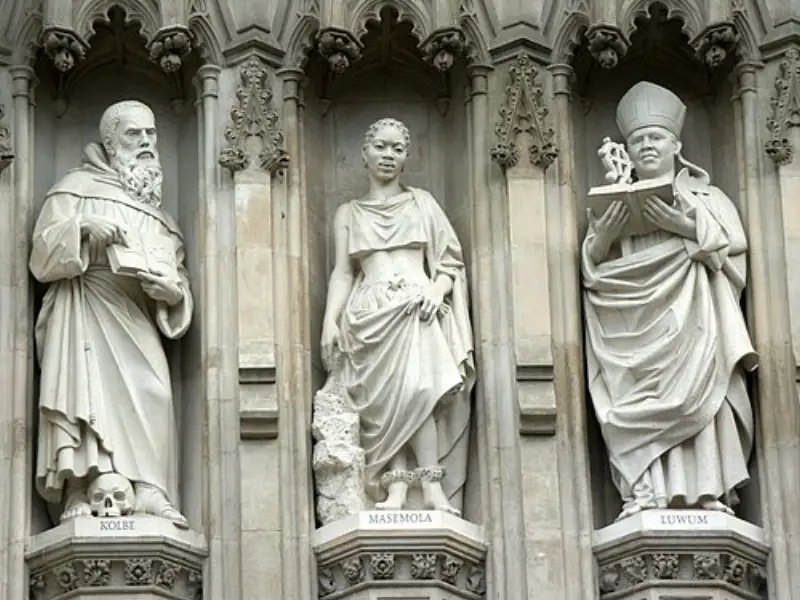
Manche Masemola's memory has traveled far beyond Marishane. She is one of ten twentieth-century martyrs drawn from across the world represented in the statues above the Great West Door of Westminster Abbey in London, an ensemble that sets a Pedi village girl among the century's most prominent witnesses to the faith. Her story has been retold in studies of modern martyrdom and in broadcast documentaries, and the observance of 4 February links the Anglican Church of Southern Africa, other Anglican churches, and the Episcopal Church in the United States in a shared act of remembrance each year. Perhaps the most striking postscript belongs to her own family. The mother who hid her daughter's clothes and fought the classes that cost the girl's life lived to change course: forty years after the murder, in 1969, she converted to Christianity and was baptized. The household that had resisted the mission thus yielded to the faith at its deepest level, and the martyr's blood, in the words she herself had chosen, proved to be her baptism after all. A death meant to extinguish a young convert's faith became, instead, the story by which that faith is remembered on three continents.
§ Commemoration
Timeline
- 1913
Born at Marishane, a small village near Jane Furse in the Transvaal, into a Pedi family
§ Manche's early life
- 1919
An Anglican Community of the Resurrection mission is established in Marishane by Fr. Augustine Moeka
§ Martyrdom
- 4 Feb 1928
Led by her parents to a lonely spot, she is killed and buried beside a granite rock on a remote hillside
§ Martyrdom
- 1969
Her mother, four decades after the killing, converts to Christianity and is baptized
§ Martyrdom
The Record
- Symbols
- depicted among the Modern Martyrs statues of Westminster Abbey
- Canonization
- Declared a martyr by the Church of the Province of Southern Africa within ten years of her death
Prayer
Bibliography
Show 7 sources
- Chandler, Andrew (2007). Exciting Holiness. Norwich: Canterbury Press. ISBN 978-1-85311-806-7.
- Davie, Lucille (4 February 2008). "Alex honours Africa's only saint (sic)". Official website of the City of Johannesburg.
- Goedhals, Mandy (1998). "Imperialism, mission and conversion: Manche Masemola of Sekhukhuneland". In Andrew Chandler (ed.). Terrible Alternative: Christian Martyrdom in the 20th Century. Continuum International Publishing Group. ISBN 978-0-8264-4844-6.
- Presler, Titus (2001). Horizons of Mission. Cowley Publications. p. 85. ISBN 978-1-4616-6060-6.
- Quinn, Frederick (2002). African Saints: Saints, Martyrs, and Holy People from the Continent of Africa. Crossroad. ISBN 978-0-8245-1971-1.
- St. James, Rebecca (2008). Sister Freaks: Stories of Women Who Gave Up Everything for God. FaithWords. ISBN 978-0-446-55016-1.
- "The story of Manche Masemola and her fight for faith" (video). BBC.
Profile text adapted from the Wikipedia article, licensed CC BY-SA 4.0.
Pray with this saint every day
Save St. Manche Masemola to your favorites, read the full profile, and get feast-day reminders in the Saints app.
Get the Saints AppFree on the App Store for iPhone and iPad