
died c. 685·Feast February 19
St. Mansuetus of Milan
Archbishop of Milan who opposed the Monothelites
Overview
Mansuetus was Archbishop of Milan from 676 to 685 and is honored as a saint in the Catholic Church. Very little is recorded of his origins or early life, but his decade as head of the Ambrosian church fell in a decisive moment of the christological controversies that divided East and West. In 679 he gathered his suffragan bishops in a synod at Milan to condemn the Monothelite teaching, and according to Paul the Deacon the assembly sent a letter, drafted by Damian, later bishop of Pavia, directly to Emperor Constantine IV. In 680 Mansuetus and his bishops traveled to Rome for the synod opened by Pope Agatho on 27 March, subscribing its acts; that council prepared the way for the Third Council of Constantinople, which soon after condemned Monothelitism. He died on 19 February, probably in 685, and was buried in the Basilica of Sant'Ambrogio. His remains were later moved to the Basilica of Santo Stefano Maggiore and, in 1987, to the south transept of the Milan Cathedral, where they rest today. He is commemorated on 19 February in the Roman Rite and 2 September in the Ambrosian Rite.
The Complete Life
Successor of Ambrose in a Hard Age
Mansuetus took up the archiepiscopal throne of Milan in 676, succeeding Ampelius, and governed the see until his death probably in 685. He thus stood in a succession reaching back through John the Good and the exiled bishops of the Lombard era to the great Ambrose himself, whose basilica would one day receive his bones. Of his birth, education, and rise through the church's orders the records preserve almost nothing; a late tradition, lacking any historical basis, attached him to the Roman family of the Savelli, but the sources are otherwise silent about his origins. What his brief pontificate reveals is a churchman of doctrine and communion, concerned above all that the Lombard north of Italy should speak with one voice in the great christological debates of the seventh century. The gentleness his name proclaims, mansuetus meaning tame or mild, evidently did not weaken his grip on the faith, for the one episode the sources record of his nine years in office is a resolute public condemnation of a teaching he judged hostile to the gospel. Nine years, one recorded act, and a burial beside Ambrose are the whole of what the sources allow, and the church judged that enough to number him among the saints.
§ Life
Two Synods Against One Will in Christ
The defining work of Mansuetus's episcopate was his opposition to Monothelitism, the doctrine that Christ possessed only a divine will. In 679 he summoned his suffragan bishops to a synod at Milan that condemned the teaching, an act of doctrinal discipline that reached beyond Lombard Italy. According to Paul the Deacon, this Milanese council issued a letter addressed directly to Emperor Constantine IV, written by a certain Damian who would later become bishop of Pavia, carrying the protest of the Italian church to the ruler in Constantinople. The following year Mansuetus and his bishops joined the Roman council which Pope Agatho opened on 27 March 680, setting their names to the acts it published. That assembly was deliberately staged in preparation for the Third Council of Constantinople, which met a few months afterward and condemned Monothelitism, settling the question for the universal church. Mansuetus's two synods thus belong to the chain of councils and letters by which the West helped bring the controversy to its end. A letter to an emperor and two sets of subscribed acts are a small paper trail, but they place a Milanese archbishop inside the events that closed the Monothelite controversy.
§ Life
Death and Many Resting Places
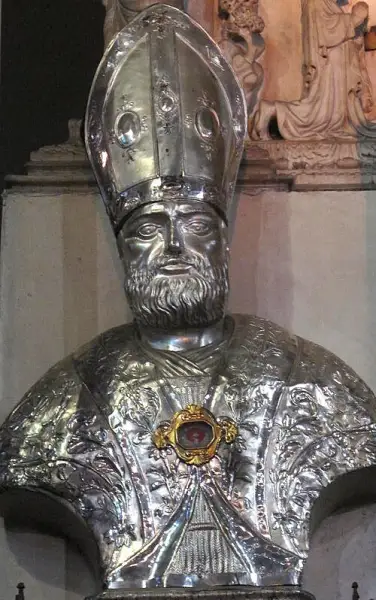
Mansuetus died on 19 February, probably in the year 685, closing a reign of about nine years. His remains were laid to rest in the Basilica of Sant'Ambrogio, the shrine of the church's most illustrious bishop, an honor that itself testifies to the esteem in which he was held. From there his relics undertook a long journey through the sacred topography of Milan: they were translated to the Basilica of Santo Stefano Maggiore, and then, in 1987, to the south transept of the Milan Cathedral, where they remain. The movement of his bones across more than thirteen centuries traces the changing fortunes of the Milanese church itself, from the early medieval basilicas through the building of the great cathedral to the liturgical rearrangements of the late twentieth century. Few bishops of the seventh century can be followed so concretely through the architecture of their city. The saint who governed Milan in a time of doctrinal storm has rested, in succession, beside Ambrose, at the church of Stephen, and now beneath the marble of the Duomo. His cult has never rested on writings: the bones themselves, moved but never lost, are the document Milan has kept.
§ Life
Remembered in Two Rites
Mansuetus is commemorated on 19 February in the Roman Rite, the anniversary of his death, and on 2 September in the Ambrosian Rite, the proper liturgy of the church he governed. The double feast marks the peculiar dignity of a Milanese archbishop, honored both by the universal church and by the distinctive Ambrosian tradition that has preserved its own calendar, chant, and customs since antiquity. His historical footprint is small, a stub of nine years defined by two councils and a letter, yet the church's memory has kept him faithfully: his remains have never been lost, moving from Sant'Ambrogio to Santo Stefano Maggiore and in 1987 into the cathedral itself, where the faithful of Milan can still venerate them. The synods he led helped prepare the Third Council of Constantinople, and the condemnation of Monothelitism that followed stands, at one remove, among his achievements. A late and groundless tradition connected him with the Roman family of the Savelli, a legend that says less about the man than about the desire of noble houses to claim a saint. The Savelli legend apart, everything Milan knows of Mansuetus it knows from acts and stones, and both have kept his name in two calendars.
§ Life
Timeline
- 676
Appointed Archbishop of Milan, succeeding Ampelius
§ Introduction
- 679
Organizes and presides over a synod at Milan with his suffragan bishops to condemn the Monothelite doctrine
§ Life
- 27 Mar 680
Attends with his bishops the Roman synod opened by Pope Agatho and subscribes its acts
§ Life
- 19 Feb 685
Dies and is buried in the Basilica of Sant'Ambrogio
§ Life
- 1987
His remains are translated to the south transept of the Milan Cathedral
§ Life
The Record
- Major works
- Synodal letter of the Church of Milan to Emperor Constantine IV, drafted by Damian, later bishop of Pavia
- Canonization
- Pre-congregation; honored as a saint in the Catholic Church from early times
Prayer
Bibliography
Show 3 sources
- Cazzani, Eugenio (1996). Vescovi e arcivescovi di Milano (in Italian). Milano: Massimo. pp. 56–57. ISBN 88-7030-891-X.
- Magnoli, Claudio, ed. (2010). Celebrazioni dei santi. Messale ambrosiano quotidiano (in Italian). Vol. 4. Milano: Centro Ambrosiano. pp. 740–741. ISBN 978-88-8025-763-9.
- Majo, Angelo (1989). "Mansueto, santo". Dizionario della Chiesa Ambrosiana (in Italian). Vol. 3. Milano: NED. p. 1863. ISBN 88-7023-102-X.
Profile text adapted from the Wikipedia article, licensed CC BY-SA 4.0.
Pray with this saint every day
Save St. Mansuetus of Milan to your favorites, read the full profile, and get feast-day reminders in the Saints app.
Get the Saints AppFree on the App Store for iPhone and iPad