
died 375·Feast September 3
St. Mansuetus of Toul
First Bishop of Toul and Apostle of Lorraine
Overview
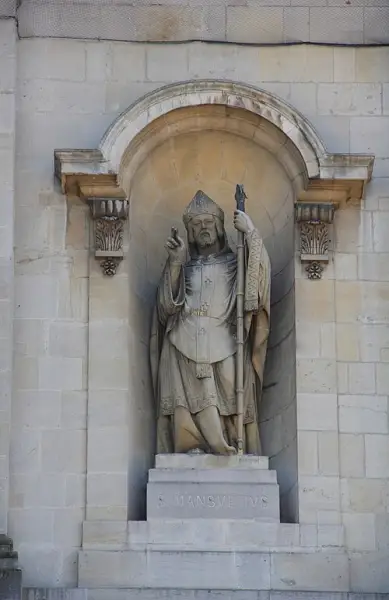
Mansuetus, honored in French as Saint Mansuy, was the first Bishop of Toul and died in 375. Tradition gives him Irish or Scottish roots; after training in Rome he was dispatched by Pope Damasus I to preach the Gospel in Gaul, and in 365 he took office as Toul's first bishop. He made his home in the forest in a dwelling of interwoven twigs, spending his days in prayer, and beside it raised an oratory dedicated to St. Peter. He was credited with the gift of healing, and tradition tells of lepers restored to health and of the prince of Toul's boy, drowned and then recalled to life through his prayer. Within the town he erected two churches, one honoring John the Baptist, the other given to the Mother of God and to Stephen the protomartyr; this latter became the cathedral church. For nearly forty years he preached among the Leuci with such success that he is called the Apostle of Lorraine. He died on 3 September 375, was buried in his oratory of St. Peter, and his shrine drew pilgrims, among them, it is said, Martin of Tours.
The Complete Life
From the Isles to Rome
The origins of Mansuetus reach to the western edge of the Christian world: tradition makes him a native of Ireland or of Scotland, a child of the isles who carried their faith to the centers of the old empire. What the tradition records clearly is his formation, for he pursued religious studies in Rome, the city where the memory of the apostles anchored the whole church of the West. There his gifts came to the attention of Pope Damasus I, who sent him north as a missionary to evangelize Gaul, a province still being won for the gospel in the fourth century. The commission joined the ends of the Latin world: an islander educated at the seat of Peter, dispatched to plant the church among the peoples of the Rhine frontier. Whatever hardships had shaped him before Rome, the pope's choice shows a man already proven in learning and in holiness. He carried with him no army and no wealth, only the teaching office of the church and, as the accounts of his life would later insist, a reputation for wonders that made his preaching hard to refuse.
§ Life
A Hut in the Woods and a Throne in Toul
In 365 Mansuetus became the first Bishop of Toul, the founding shepherd of a see that would endure for more than sixteen centuries. His manner of life as bishop remained strikingly austere. In the forest he raised for himself a hut woven of twigs, and there he passed his days in prayer and contemplation, a bishop whose throne was framed by a hermit's discipline. Beside this rustic dwelling he built a small oratory in Peter's honor, the apostle whose successor had sent him, and it was in this oratory that he would eventually be buried. The combination of episcopal office and eremitical simplicity made him a striking figure in fourth-century Gaul, a bishop who evangelized from a forest cell. The picture handed down is not of an administrator but of a man of God, sustained by contemplation and marked by the gift of healing, who governed a young church with the authority of one whom the people had seen praying in the woods before they had seen him presiding at the altar. His humility became the seed of his lasting fame.
§ Life
Wonders and Churches Among the Leuci
Mansuetus was believed to possess the gift of healing, and the traditions of his life gather around it. He was said to have cured lepers, and the most celebrated story recounts the rescue of the prince of Toul's drowned boy, a wonder that bound the leading family of the town to his mission. His preaching among the Leuci, the people of the region around Toul, occupied nearly four decades and was met, the sources record, with considerable success. For his growing flock he erected two churches within the town: one in honor of St. John the Baptist, and another dedicated to the Blessed Virgin and St. Stephen, which became the cathedral of the see and was rebuilt in later centuries by Gerard of Toul. In an age when the faith was still settling into the Gallic countryside, these buildings gave the new community permanence, and his long ministry gave it roots deep enough to survive the collapse of the empire that followed within a century of his death. He is honored as the Apostle of Lorraine. The diocese he planted among the Leuci counted its continuity in stone: a cathedral rebuilt by Gerard, and parishes that still bear the name of Mansuy a millennium and a half after his death.
§ Life
Burial at the Oratory of Peter
According to most accounts Mansuetus died on 3 September 375, after nearly forty years as bishop. He was laid to rest in the oratory of St. Peter he had raised beside his forest dwelling, the modest chapel he had chosen as his place of prayer becoming his tomb. The grave quickly became a site of pilgrimage, and it is said that Martin of Tours himself, the great wonder-working bishop of the next generation, visited the shrine. The honor paid to his resting place marks the transition every saint of the early church made from bishop to heavenly patron: the hut of twigs became a goal of journeys, and the missionary who had come north from Rome was now sought out as an intercessor. Of the closing years of his life the tradition adds nothing more, content to have ended the story where his own heart had always been, in prayer at the oratory of Peter. His death in 375 left to Lorraine a church already old enough to endure, and a founder whose memory the region has never relinquished. The grave drew pilgrims from the start, and the relics that left it in 1790, divided to survive the Revolution, show how much Toul had to protect.
§ Life
Vitae, Feasts, and a Scattered Cult
The church honors Mansuetus as a saint by the ancient pre-congregation rule, his cult resting on the antiquity and constancy of devotion rather than on formal process. His feast is kept on 3 September in the Roman Catholic Diocese of Toul and on 31 August at Saint-Dié. Medieval writers retold his life in several versions, the earliest composed by Adso of Montier-en-Der in the mid-tenth century at the request of Gerard of Toul, followed in the eleventh and twelfth centuries by a shorter and a metrical version. The Vita Sancti Gerardi records that Bishop Gerard, ill at some point in the episcopate he held from 963 to 994, had the remains of the two saints, Mansuetus and Aprus, translated into Toul and deposited in the church of John the Baptist. In 1790, with revolutionary violence approaching, the canons of Toul shared his relics out among themselves so that no single seizure could destroy them. His iconography appears on the shrine of Vittel and on a brotherhood statue at Fontenoy-le-Château, and parish churches honor St. Mansuy at Bouvron, Fontenoy-le-Château, Loisey-Culey, Nancy, and Sérécurt, while the church of that name at Dommary-Baroncourt was destroyed in 1974.
§ Veneration
Timeline
- 365
Sent by Pope Damasus I to evangelize Gaul, he becomes the first Bishop of Toul
§ Life
- 3 Sep 375
Dies after nearly four decades of preaching in the Leuci region and is buried in his oratory of St. Peter
§ Life
- 963
Bishop Gerard I of Toul, whose episcopate runs from 963 to 994, brings the relics of Mansuetus and Aprus into Toul while ill
§ Veneration
- 1790
Fearing destruction at the hands of revolutionaries, the canons of Toul divide his relics among themselves for safekeeping
§ Veneration
- 1974
The parish church of St. Mansuy at Dommary-Baroncourt is destroyed
§ Veneration
The Record
- Major works
- Oratory of St. Peter near Toul·Church of St. John the Baptist, Toul·Church of the Blessed Virgin and St. Stephen, later the cathedral of Toul
- Patron of
- Apostle and patron of Lorraine
- Canonization
- Pre-congregation; recognized as a saint by the ancient practice of the church
Prayer
Bibliography
Show 8 sources
- Texier, Jacques Rémi A. (1863). Dictionnaire d'orfèvrerie, de gravure et de ciselure chrétiennes.
- Laurent, André (Chanoine) (1980). "Ils sont nos aïeux, les saints de chez nous". Mirecourt.
- Baring-Gould, Rev. S. (1875). The Lives of the Saints. John Hodges, p. 36.
- O'Hanlon, John (1873). Lives of the Irish Saints. Ireland, p. 36 et seq.
- Monks of Ramsgate (1921). "Mansuetus". Book of Saints. CatholicSaints.Info, 16 November 2014.
- Butler, Alban (1866). "Saint Mansuet, Bishop". Lives of the Fathers, Martyrs, and Principal Saints. CatholicSaints.Info, 3 September 2016.
- Goullet, Monique (1998). "Les Vies de Saint Mansuy (Mansuetus) Premier Évêque de Toul". Analytica Bollandiana, vol. 116, pp. 57–105.
- Leyser, Karl; Reuter, Timothy (1992). Warriors and Churchmen in the High Middle Ages: Essays Presented to Karl Leyser. Continuum International Publishing Group, p. 56.
Profile text adapted from the Wikipedia article, licensed CC BY-SA 4.0.
Pray with this saint every day
Save St. Mansuetus of Toul to your favorites, read the full profile, and get feast-day reminders in the Saints app.
Get the Saints AppFree on the App Store for iPhone and iPad