
1st century AD·Feast May 21
St. Mantius of Évora
Legendary first bishop of Évora and martyr
Overview
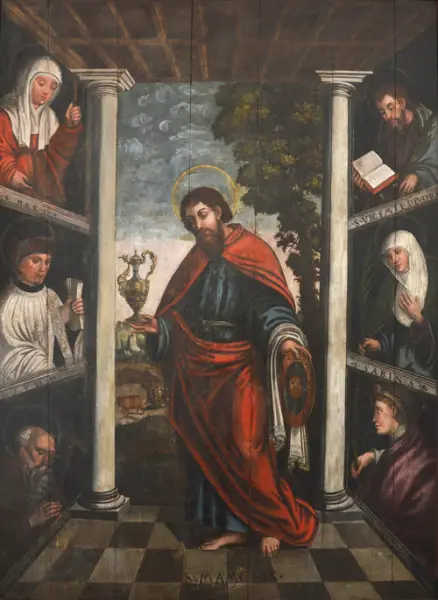
Mantius of Évora, in Portuguese São Manços, is remembered, by legend, as the first occupant of the episcopal thrones of both Lisbon and Évora in the first Christian century. In the best-known version of his story, recorded from at least the sixteenth century in André de Resende's Breviário Eborense of 1548, he was born in Rome, converted to Christianity, and traveled to Jerusalem, where he met Jesus Christ and became one of the seventy disciples, participating in the Last Supper and witnessing Pentecost. Sent out as a missionary after the crucifixion, he passed through Gaul, where a drowned nobleman at Châlons-en-Champagne was restored to life through him, and continued into Lusitania. There he preached through the Alentejo, converted many people, and established the Christian community of Évora as its first bishop, with a later tradition adding a foundation at Lisbon. The two episcopal traditions have no historical basis, and both dioceses in fact date from about the fourth century. Mantius is said to have been imprisoned in the Roman persecution and, refusing sacrifice to the pagan gods, martyred near Évora, traditionally on the site of the civil parish of São Manços.
The Complete Life
A Roman Among the Seventy
The legend that made Mantius a fixture of Portuguese devotion gives him one of the most exalted origins any saint could claim. According to the most familiar version, known from at least the sixteenth century and recounted in André de Resende's Breviário Eborense of 1548, he was born in Rome and, on converting to Christianity, journeyed to Jerusalem, where he met Jesus Christ in person and joined the company of his disciples. The story goes further still: Mantius is said to have taken part in the Last Supper and to have witnessed Pentecost, placing him among the seventy disciples of the Lord. If the chronology of the tale strains belief, its purpose is clear, to bind the young church of Lusitania directly to the apostolic generation and to claim for Évora a founder who had seen the Lord with his own eyes. The tradition stands as a monument of medieval local patriotism, and whatever its historical worth, it shaped the devotion of centuries and carried the name of São Manços across Portugal and into Castile. No other Portuguese saint can claim so audacious a pedigree, and Resende's printing of it in 1548 measures how much Évora wanted the apostolic age for a neighbor.
§ Legend
Through Gaul to Lusitania
After the crucifixion, the tale continues, Mantius went out as a herald of the Gospel. His road ran first through Gaul, where the story preserves a wonder worked in the name of Jesus at Châlons-en-Champagne: a young nobleman who had drowned was restored to life. From there the missionary pressed on into the Hispanic lands and arrived in Lusitania, the Roman province of the west of the Peninsula. He preached through the Alentejo and won many converts, and at Évora he established a Christian community over which he presided as the first bishop. A later strand of the tradition carries him also to Lisbon, where he is said to have founded a second community and served as its first bishop as well. Neither tradition has any historical basis, and both dioceses in fact trace their origins to around the fourth century. Yet the image of the apostolic missionary crossing Gaul and descending into the Alentejo gave the Portuguese church a story of beginnings reaching back to the generation that had walked with Christ. Lisbon and Évora gained founders, and Mantius gained a route — Rome, Châlons, the Alentejo — that no other Portuguese legend matches.
§ Legend
Martyrdom Near Évora
The closing act of the legend places Mantius in the time of Roman persecution. He was seized and imprisoned, and because he would not burn offerings to the idols of the empire he was killed outside Évora, bearing the title of martyr that the Roman Martyrology still gives him. Tradition identifies the place of his martyrdom with the ground where the parish of São Manços now lies, which takes his name and preserves his memory in the very landscape of the Alentejo. The church of São Manços became the keeper of his relics, and from there the story of his remains unfolds across the centuries, carried to Asturias in 714 to save them from Muslim invaders and moved again in 1070 to Castile after a dream instructed a knight to translate them. Whether the martyrdom belongs to the first century, as the legend holds, or to the sixth, as the most recent Roman Martyrology suggests, the devotion gathered around the spot where the saint was said to have died has never wholly faded from the region. A parish in the Alentejo and a village in Castile both answer to a man whose death date the Martyrology cannot fix to a single century.
§ Legend
A Cult Before the Records
Mantius belongs wholly to the pre-congregation age of the saints, venerated by acclamation of the faithful rather than by any process of canonization. The first written reference to him appears only in 1195, but devotion spread widely toward the close of the thirteenth century, possibly stirred when the saint's presumed remains were brought into Castile. He is venerated in both the Roman Catholic Church and the Eastern Orthodox Church, and his feast is kept on 21 May. The last edition of the Roman Martyrology names him a martyr, though it places his death, strikingly, in the sixth century rather than the first, a sign of how unsettled the tradition surrounding him has always been. His case illustrates the character of early cults: a local saint of Évora, remembered in a parish that bears his name, honored in medieval martyrologies, and carried across kingdoms by the wanderings of his relics, all before any scholar thought to ask when he had lived or whether the apostolic legend could bear its own weight. A May 21 feast, an entry in the Martyrology, and two communions venerating him: his cult rests on modest pegs, hung there now for more than eight centuries.
§ Veneration
The Relics' Long Road
The afterlife of Mantius is inseparable from the wanderings of his relics. According to the tradition, his remains rested in the church of São Manços until 714, when they were carried to Asturias among the remains of other saints rescued from the Muslim conquest. In 1070 the knight Gutierre Téllez de Meneses dreamed that the saint told him to take the relics to Castile. He obeyed, but the authorities of the Castilian town now called Villanueva de San Mancio, near Medina de Rioseco in the province of Valladolid, would not open their gates to the remains, so the knight erected a monastery outside the walls, backed by the Benedictine monks of Sahagún, and entrusted the relics to it. A town subsequently grew up around the monastery, which still bears the saint's name as San Mancio. Thus the legendary bishop of Évora gave his name both to an Alentejo parish and to a Castilian village, and the literary tradition that preserved him runs from Resende in 1548 through Jorge Cardoso's Agiologio lusitano of 1666 to modern scholarship. His name survives less in documents than on the landscape: an Alentejo parish, a Castilian village, and a paper trail running Resende, Cardoso, and onward.
§ Veneration
Timeline
- 714
His relics are carried from the church of São Manços to Asturias to preserve them from Muslim invaders
§ Veneration
- 1070
After a dream in which the saint instructed him, Gutierre Téllez de Meneses brings the relics into Castile
§ Veneration
- 1070
Refused entry to the town with the remains, the knight founds a monastery with the support of the Benedictines of Sahagún, where the relics are left
§ Veneration
- 1195
The first written reference to Saint Mantius is recorded
§ Veneration
- 1548
André de Resende recounts the saint's legend in the Breviário Eborense
§ Legend
The Record
- Canonization
- Pre-congregation; venerated in the Roman Catholic and Eastern Orthodox churches, listed in the Roman Martyrology
Prayer
Bibliography
Show 5 sources
- Resende, André de (1548). Breviário Eborense.
- Cardoso, Jorge (1666). Agiologio lusitano dos sanctos, e varoens illustres em virtude do Reino de Portugal, e suas conquistas (in Portuguese). Vol. 3. Lisbon: Officina de António Craesbeeck de Mello. pp. 337–342.
- Maximino, Patricia Alexandra Richau (2010). S. Manços: aspectos da romanização e da cristianização (Master's thesis). University of Évora. hdl: 10174/11800.
- Roman Martyrology.
- "Orthodox Europe :: Portugal".
Profile text adapted from the Wikipedia article, licensed CC BY-SA 4.0.
Pray with this saint every day
Save St. Mantius of Évora to your favorites, read the full profile, and get feast-day reminders in the Saints app.
Get the Saints AppFree on the App Store for iPhone and iPad