
1831 – 1925·Feast March 8
St. Manuel Míguez González
Piarist priest, scientist, and founder of the Calasanzian Institute
Overview
Manuel Míguez González, who took the religious name Faustino of the Incarnation, was a priest of Spain, a professed Piarist, and the founder of a congregation of women religious, the Daughters of the Divine Shepherdess, commonly called the Calasanzian Institute. Born on 24 March 1831 in Xamirás in the province of Ourense, he entered the Piarist novitiate in Madrid in 1850 and was ordained a priest on 8 March 1856. He taught in Piarist schools in San Fernando, Celanova, and Monforte de Lemos, and spent nearly three years in Cuba before illness forced his return in 1860. A gifted student of the natural sciences, he investigated the healing properties of plants and prepared remedies for the sick who came to him, seeing in them medicines provided by God. Moved by the plight of illiterate and marginalized women, he founded a congregation of religious sisters to educate girls, established on 2 January 1885 and approved by the Holy See in 1912. He spent his last decades in Getafe and died there on 8 March 1925. Beatified in 1998 by Pope John Paul II, he was canonized by Pope Francis on 15 October 2017.
The Complete Life
A Boy Who Loved Trees
Manuel Míguez González was born at Xamirás in the province of Ourense on 24 March 1831, the fourth and last of the children of Benito Míguez and María González, who already had Carmiña, Antonio, and José. The infant was baptized the following day, 25 March, at San Jorge de Acebedo, the parish church of the town beside his own. He made his First Communion in 1841. The boy showed an early and telling curiosity: he loved trees and passed long hours observing them, a habit that foreshadowed the naturalist he would become. Sent to study Latin and the humanities in Ourense, he discovered there his calling to the priesthood, a vocation that deepened when he learned that his elder brother Antonio was already advancing through ecclesial studies and that José intended to follow. His father at first resisted the idea, proposing that José remain to care for the farm while Antonio and Manuel pursued their callings. From a Galician farmhouse, then, came three children turned toward the church, and the youngest of them would carry the family name to the altars of Saint Peter's Basilica.
§ Life
Faustino of the Incarnation
In 1850 Manuel presented himself at Saint Ferdinand's in Madrid, the novitiate house of the Piarists; on 5 December of that year he put on the habit for the first time and took the religious name Faustino of the Incarnation. His solemn vows followed on 16 January 1853, and near the end of 1854 he accepted the minor orders and the tonsure, standing as subdeacon from 24 December onward. Ordained deacon in 1855, he was raised to the priesthood on 8 March 1856 by Vicente Horcos San Martín, Bishop of Osma-Soria, in Madrid's church of San Marcos; his first Mass followed on 19 March, the feast of Saint Joseph. Alongside his formation he studied the natural sciences, a discipline that would mark his whole apostolate. The Piarist order, founded for the free education of poor children, suited his double gift for teaching and faith. The new priest was sent to schools at San Fernando and Celanova and to Monforte de Lemos, before being dispatched in 1857 to Guanabacoa in Cuba, where he arrived on 3 November of that year. The island mission lasted barely two years and a half before illness brought him home in March 1860, the classroom and the confessional holding the whole of the rest of his life.
§ Life
Schools, Confessions, and Remedies
His years in the schools never narrowed his priesthood. He delighted in spending hour after hour in the confessional, and he became known for remarkable patience and sage counsel. Illness cut short his Cuban mission, and he returned on 3 March 1860, resuming his work in Spanish schools. His scientific training opened a second apostolate: he studied the curative virtues of different plants, regarding them as medicines that God had supplied for the relief of human ailments, and prepared remedies that restored the health of many who came to him for help. In this union of laboratory and sacristy he anticipated the modern dialogue between faith and science by a century, holding that the study of creation was itself a way of honoring its Maker. The decisive turn of his life came at Sanlúcar de Barrameda, where he encountered women who were marginalized and illiterate, deprived of any education and of the dignity that follows it. Rather than lament the injustice, he resolved to answer it with an institution of his own, a congregation of sisters devoted to teaching girls.
§ Life
A Formidable Pastor
Those who knew Faustino of the Incarnation described a formidable pastor, a man whose religious energy was matched by practical creativity. His spirituality joined the Piarist tradition of education with a frank confidence in the goodness of the created world: the plants he studied and dispensed were, in his eyes, remedies from God, and scientific knowledge was a form of stewardship rather than a rival to belief. He saw in the illiterate women of Sanlúcar de Barrameda not a hopeless class but a harvest awaiting laborers, and his answer to that marginalization was to establish, on 2 January 1885, a new family of sisters, the Daughters of the Divine Shepherdess, popularly styled the Calasanzian Institute, given to the education of girls and the advancement of women in life. He lived in Getafe from the last day of September 1888 until his death, steering his young congregation as it grew through diocesan approval from the Archbishop of Seville in mid-1889, the decree of praise granted by Pope Pius X at the close of 1910, and full papal approval in 1912. By that papal approval of 1912 he was an eighty-one-year-old still directing the congregation from Getafe, the Galician boy turned father of a religious family.
§ Life
Getafe and a Long Life's Close
Faustino spent the final decades of his long life in Getafe, south of Madrid, where he had resided since 30 September 1888. There he continued to direct the congregation he had founded, to hear confessions, and to prepare his natural remedies for the sick of the town. He died on 8 March 1925 at the age of ninety-three, having lived through the reigns of seven popes and the transformation of Spain from the monarchy of his childhood through republic and dictatorship. The work he left behind proved durable: in 2006 the Daughters of the Divine Shepherdess counted 268 religious living in 43 communities across countries from Ecuador to India and beyond. The priest from a Galician village who had entered the novitiate as a young man in 1850 thus closed a religious life of some seventy-five years, most of them spent in classrooms, confessionals, and the quiet chemistry of plant medicines. He was buried with the reputation of holiness that the church would soon be asked to examine formally. Holiness, not headlines, marked his passing: a ninety-three-year-old priest died in Getafe on 8 March 1925, and the process that ended in canonization opened within three decades.
§ Life
From Servant of God to the Altar
The process that led to his canonization moved with methodical care across six decades. An informative process opened in Madrid on 31 January 1953, later supplemented by an apostolic process; the Congregation for the Causes of Saints granted its nihil obstat and the cause was formally introduced on 7 January 1982, titling him a Servant of God. The two earlier processes were validated at the end of February 1984; theologians gave their approval in mid-1990, and the congregation followed that October. On 21 December 1992 Pope John Paul II recognized his heroic virtue and proclaimed him Venerable. The miracle for beatification, a healing examined in its diocese of origin and validated in Rome at the end of 1994, passed the medical board in late 1995, satisfied the theological consultants in mid-1997, and won the congregation's assent early in 1998; papal approval came that spring, and the beatification followed in Saint Peter's Square on 25 October 1998. Validation of the second miracle came in Rome at the close of May 2010, approved by Pope Francis on 21 December 2016, and the canonization was celebrated on 15 October 2017, with Mateusz Pindelski serving as postulator.
§ Sainthood
Educator of Women, Father of a Congregation
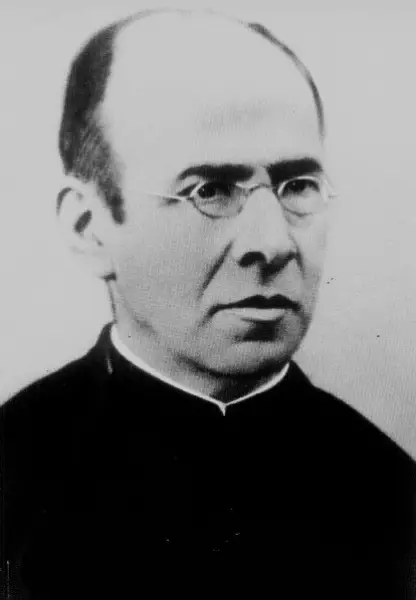
The lasting monument of Manuel Míguez González is the congregation he raised from nothing to answer one injustice: the exclusion of women from education. The Daughters of the Divine Shepherdess, founded on 2 January 1885, carried his ideal of schooling for girls into dozens of houses, and by 2006 numbered 268 religious in 43 communities spread across countries including Ecuador and India. He is honored as a patron of the congregation he fathered, and beyond it of pharmacists, scientists, and educators, three callings he joined in one life. His canonization in Saint Peter's Square on 15 October 2017 placed a Piarist science teacher beside the giants of the calendar, a sign that the church counts the patient work of the classroom and the dispensary among the paths to holiness. A signed photograph from about 1890 preserves the image of a sober priest in his clerical dress, the attributes in which he is remembered. For the people of Getafe, where he lived from 1888 and died on 8 March 1925, his feast on that date keeps alive the memory of their local saint.
§ Life
Timeline
- 24 Mar 1831
Born at Xamirás in the province of Ourense, the fourth and final child of Benito Míguez and María González
§ Life
- 1841
Makes his First Communion
§ Life
- 5 Dec 1850
Enters the Piarist novitiate in Madrid and receives the habit with the religious name Faustino of the Incarnation
§ Life
- 16 Jan 1853
Makes his solemn vows as a Piarist
§ Life
- 8 Mar 1856
Ordained to the priesthood by Bishop Vicente Horcos San Martín in the parish church of San Marcos in Madrid
§ Life
- 3 Nov 1857
Arrives in Cuba, sent to the school at Guanabacoa
§ Life
- 3 Mar 1860
Returns from Cuba due to illness
§ Life
- 2 Jan 1885
Founds the Daughters of the Divine Shepherdess, the Calasanzian Institute, for the education of girls
§ Life
- 30 Sep 1888
Takes up residence in Getafe, where he lives until his death
§ Life
- 12 Jun 1889
His congregation receives diocesan approval from the Archbishop of Seville
§ Life
- 6 Dec 1910
Pope Pius X grants the congregation the papal decree of praise
§ Life
- 8 Mar 1925
Dies at Getafe at the age of ninety-three
§ Life
- 7 Jan 1982
The cause for his sainthood is formally introduced and he is titled a Servant of God
§ Sainthood
- 21 Dec 1992
Pope John Paul II proclaims him Venerable in recognition of his heroic virtue
§ Sainthood
- 25 Oct 1998
Beatified by Pope John Paul II in Saint Peter's Square
§ Sainthood
- 15 Oct 2017
Canonized a saint by Pope Francis in Saint Peter's Square
§ Sainthood
The Record
- Major works
- Daughters of the Divine Shepherdess (Calasanzian Institute)·Natural medicines prepared from plant remedies for the sick
- Patron of
- Daughters of the Divine Shepherdess·pharmacists·scientists·educators
- Symbols
- priest's attire
- Canonization
- Canonized by Pope Francis on 15 October 2017 in Saint Peter's Square, having been beatified by Pope John Paul II on 25 October 1998
Prayer
Bibliography
Show 3 sources
- "Biographies of New Blesseds – 1998". EWTN.
- "Bl. Faustino Miguez". Catholic Online.
- "Blessed Faustino Miguez". Santi e Beati.
Profile text adapted from the Wikipedia article, licensed CC BY-SA 4.0.
Pray with this saint every day
Save St. Manuel Míguez González to your favorites, read the full profile, and get feast-day reminders in the Saints app.
Get the Saints AppFree on the App Store for iPhone and iPad