
325 – 410·Feast January 31
St. Marcella of Rome
Roman ascetic widow and martyr of the Gothic sack
Overview
Marcella of Rome (325–410) was a Christian ascetic of the Western Roman Empire, venerated today in the Catholic Church, the Orthodox Church, and the Anglican Communion. Born into a noble family whose palace stood on the Aventine Hill, she was formed in piety by her mother Albina and, still a little girl, looked on when the banished Athanasius, bishop of Alexandria, appeared within the city. After barely seven months of marriage her husband died, and when the consul Cerealis sought her hand she declined him, choosing rather to pattern her days on the monks and hermits of the East, forgoing wine and meat and giving her time to Scripture, prayer, and the shrines of the apostles and martyrs. Her palatial house became a center of Christian life: with her mother she gathered a group of religious women there, sheltering pilgrims and the poor, forty years before Jerome arrived in the city. When Pope Damasus I summoned Jerome to Rome in 382, it was under her roof that the biblical scholar lodged and taught, and after he returned to Jerusalem the priests of Rome consulted Marcella to clarify difficult texts. In 410, when the Visigoths sacked Rome, the eighty-five-year-old widow was scourged and beaten by soldiers seeking treasure she had long since given away. Borne to the Basilica of Saint Paul Outside the Walls, she succumbed within days to what the blows had done.
The Complete Life
A Daughter of the Aventine
Marcella was born in Rome in the year 325, a child of the senatorial nobility whose family residence rose on the Aventine Hill. The strongest influence of her girlhood was her mother Albina, a woman described as educated, wealthy, and benevolent, whose piety shaped the daughter's own. Rome itself supplied the first great religious impression of her life: while she was still a child the exiled bishop Athanasius of Alexandria visited the city, bringing the cause of the Eastern Church into the marble streets of the capital and, no doubt, into the conversation of its Christian households. The Aventine palace would remain the stage of her entire career. There, decades before any great name of Desert monasticism reached the city, she began to gather other women to study Scripture and to pray together in her aristocratic home; Christine Schenk notes that she was doing so fully forty years before Jerome arrived in Rome. The household into which she had been born thus became, almost imperceptibly at first, the seedbed of one of the first circles of Christian women's religious life in the city, a community of study and prayer conducted under a noble roof in the heart of the fading empire.
§ Biography
Widowhood and the Ascetic Resolve
The decisive turning point of Marcella's life came with the death of her husband, who died in the seventh month of their marriage. Young, wealthy, and now unattached, she became at once the object of advantageous matchmaking: the consul Cerealis, uncle of the Caesar Gallus, sought her hand. She refused him. According to Butler, her refusal of the consul announced a deliberate choice to pattern her existence on the monks and hermits of the East, whose renown had begun to reach Rome out of the Egyptian and Syrian deserts. The form her new life took was severe and precise. She abstained from wine and flesh, gave all her time to pious reading and prayer, prayed in the basilicas where the apostles and martyrs were honored, and carried her reserve toward men so far that no man ever spoke with her alone. In the society of late Roman aristocracy, where a wealthy widow was expected to remarry and administer her fortune, such a choice was a public declaration. Marcella's widowhood became in effect her religious profession, and her house on the Aventine its church.
§ Biography
The School on the Aventine
The community that gathered in Marcella's palatial home became a genuine center of Christian activity in Rome. With her mother Albina she formed a religious group of women in the house, drawing inspiration from the monastic traditions of the East; Paula's daughter Eustochium belonged to the circle, and Marcella's friend Lea, another wealthy widow, supported the house that Marcella ran. The home stood near the site of the present church of Santa Sabina and served as a refuge for weary pilgrims and for the poor. When Pope Damasus I summoned Jerome to Rome in 382 as his confidential secretary, the pope arranged the biblical scholar's lodging in Marcella's hospitality house, and there Jerome gave readings and lectures to her community and friends; it was in her home that he first met Paula. What set Marcella apart, however, was that she was no passive pupil. Jerome himself testified that when her renown as a student of the Scriptures was still fresh, she never came to him without questions, and refused to be satisfied at once, pressing back against his answers, not out of love of debate, but to discover by questioning what objections could be brought and met. After Jerome returned to Jerusalem, the priests of Rome consulted her to clarify biblical texts, and she engaged in public debate in the Origenist controversy that divided the Church of her day.
§ Biography
The Sack of Rome
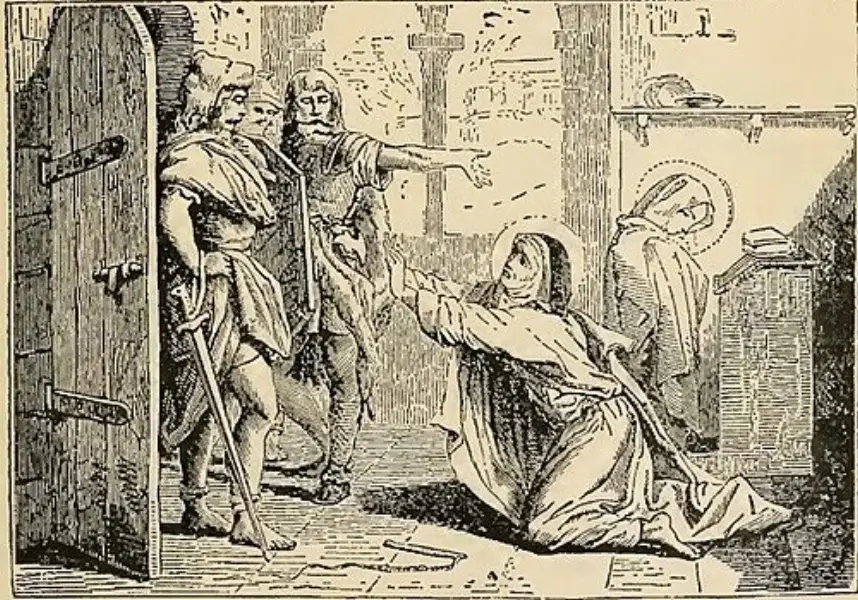
When Paula and Eustochium left Rome for the Holy Land, they invited Marcella to accompany them, but she chose to remain and tend her growing community, exchanging the palace with her pupil Principia for humbler lodgings on the Aventine. Her final trial came in 410, when the army of Alaric broke into the city and the Visigoths sacked Rome. The eighty-five-year-old ascetic fell into the hands of soldiers who, convinced that she must have hidden treasure, demanded her gold. She had none to give: her wealth had long before been distributed among the poor, and when they asked, she pointed to her coarse dress as proof. Unwilling to believe in her self-chosen poverty, they scourged her and beat her with cudgels. Jerome records that she felt no pain but threw herself at their feet, pleading through tears for Principia, that the young woman might not be taken or forced to endure what the old woman had no occasion to dread. A second band of soldiers then came up, men who still held holy things in awe, and they brought the two women to the Basilica of Saint Paul Outside the Walls, which Alaric had named a sanctuary. There, exhausted and injured, Marcella died of her wounds a few days later, having found in the apostle's basilica, as Jerome wrote, either a place of safety or a tomb.
§ Biography
Enrollment in the Martyrology
Marcella was never canonized by any formal process; her recognition belongs to the ancient pattern in which the Church received a holy death as testimony enough. Because she did not long survive the scourging she endured at the hands of the Goths, she was included in the Roman Martyrology, the record of those who suffered or died in the odor of sanctity, and her feast in the West was fixed on January 31, the day of her commemoration. The Orthodox Church likewise honors her, keeping her on the same date, and the Anglican Communion venerates her as well. In the Episcopal Church she holds a Lesser Feast on the Calendar of the Church Year, observed on January 31, an unusual distinction for a Roman matron of the fourth century and a measure of how far her example has traveled beyond the Aventine. Her death in the catastrophe of 410, in the year that shook Rome, joined her name to the memory of the city's greatest trauma, and the martyrology preserved what the soldiers of Alaric could not take: the witness of a widow who died of blows received for a treasure she had already given away to the poor.
§ Legacy
The Witness of Jerome's Letters
Almost everything known of Marcella comes through the correspondence of Jerome, and her imprint on that corpus is unmatched. Modern collections preserve numerous letters addressed to her, among them Letters 23, 25, 26, 29, 34, and 127; nearly a third of Jerome's extant letters went to women, and Thomas Lawler notes that no woman appears more often among Jerome's correspondents, and he ascribes that fact to the standing she held at the head of the distinguished company of devout women who gathered under her Aventine roof. His Letter 127, written to Principia on the occasion of Marcella's death, stands as her memorial: a tribute to her life and a consolation to the student she had shielded with her own body. In it Jerome recalled her tireless questioning of the Scriptures and confessed that whatever he had gathered by long study she had tasted, learned, and made her own. Her fame has proved durable in unexpected places as well: the artwork The Dinner Party by Judy Chicago includes a place setting for her, seating the Roman ascetic among the honored women of history. From the letters of a monk in Bethlehem to a place setting in twentieth-century art, Marcella's reputation has rested on the same foundations, her learning, her community of women, and her death in the sack of Rome.
§ Correspondence from Jerome
Timeline
- 325
Born in Rome into a noble family of the Aventine Hill.
§ Marcella of Rome
- 382
Pope Damasus I called Jerome to Rome and arranged his lodging at Marcella's hospitality house, where he lectured to her community.
§ Biography
- 410
Brutalized by Visigoth soldiers who believed she concealed treasure, she was scourged, beaten with cudgels, and taken with Principia to the Basilica of Saint Paul Outside the Walls.
§ Biography
- 410
Died of the injuries suffered during the sack of Rome a few days after the assault.
§ Biography
In Their Own Words
She suffered bodily ill-treatment at the hands of the Goths when they captured Rome in 410 and died from its effects.
Having lost her husband in the seventh month of her marriage, she rejected the suit of Cerealis the consul, uncle of Gallus Cæsar, and resolved to imitate the lives of the ascetics of the East. She abstained from wine and flesh, employed all her time in pious reading, prayer, and visiting the churches of the apostles and martyrs, and never spoke with any man alone.
Whatever I had gathered together by long study, and by constant meditation made part of my nature, she tasted, she learned and made her own.
The Record
- Major works
- Hospitality house and religious community for women on the Aventine Hill, Rome
- Canonization
- Pre-congregation; entered in the Roman Martyrology after dying from injuries suffered when the Goths sacked Rome in 410
Prayer
Bibliography
Show 12 sources
- Cross, F. L.; Livingstone, Elizabeth (2005). The Oxford Dictionary of the Christian Church. New York: Oxford University Press, p. 1039.
- Schenk, Christine (2017). Crispina and Her Sisters: Women and Authority in Early Christianity. Minneapolis, MN: Fortress Press, pp. 341–344. ISBN 978-1-5064-1189-7.
- Butler, Alban (1903). The Lives of the Fathers, Martyrs and Other Principal Saints, vol. 1. New York: P. J. Kenedy, p. 318.
- Holböck, Ferdinand. Married Saints and Blesseds: Through the Centuries. Ignatius Press, 2017. ISBN 9781681497532.
- Smith, Richard Upsher (2009). "Saint Monica and Lady Philosophy". Carmina Philosophiae. 18: 93–125. JSTOR 44078602.
- Bacchus, Francis Joseph. "St. Pammachius." The Catholic Encyclopedia, Vol. 11. New York: Robert Appleton Company, 1911.
- Monks of Ramsgate. "Lea". Book of Saints, 1921. CatholicSaints.Info, 4 November 2014.
- Dunbar, Agnes Baillie Cunninghame. "St. Marcella", A Dictionary of Saintly Women, Volume 2. George Bell and Sons, London, 1905.
- Moorhead, Sam; Stuttard, David. AD410: The Year that Shook Rome. The British Museum Press, 2010, p. 12.
- Lawler, Thomas Comerford (1963). The Letters of St. Jerome, Letters 1–22. Ancient Christian Writers, vol. I. New York: Newman Press, pp. 12, 22.
- Rebenich, Stefan. Jerome. London: Routledge, 2002.
- "Lesser Feasts and Fasts 2018".
Profile text adapted from the Wikipedia article, licensed CC BY-SA 4.0.
Pray with this saint every day
Save St. Marcella of Rome to your favorites, read the full profile, and get feast-day reminders in the Saints app.
Get the Saints AppFree on the App Store for iPhone and iPad