
327 – 398·Feast July 17
St. Marcellina
Consecrated virgin and elder sister of St. Ambrose
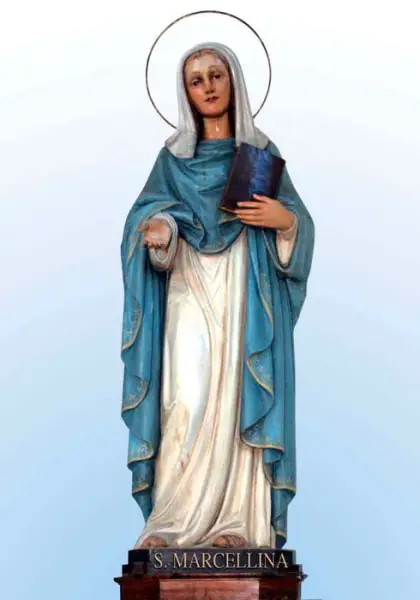
Overview
Marcellina was born around 327 in the Gallic city of Trier, to a father who governed Gaul as praetorian prefect, and grew up as the elder sister of Ambrose of Milan and Satyrus. Raised in a Roman Christian family, she was left fatherless about the year 354, when the family moved to Rome; there she took charge of her younger brothers' upbringing and taught them to desire true virtue rather than the appearance of it. She gave herself to prayer, fasting, and asceticism, and was veiled as a consecrated virgin by Pope Liberius, embracing severe self-denial in the family home, which tradition says she turned into a church dedicated to Mary, later known as Sant'Ambrogio della Massima. When Ambrose became Bishop of Milan in 374, he summoned her to his side, and there she proved a fervent helper in planting the ascetic life among Milan's young women. Ambrose honoured her by dedicating to her his three books on virginity, written in 377. It was from Marcellina that Paulinus the Deacon learned the details he recorded in his Life of Ambrose. She survived her brother by about a year, dying in 398, and was buried in the crypt beneath the altar of the Ambrosian Basilica in Milan. The Institute of St. Marcellina in London keeps her memory alive today.
The Complete Life
The Prefect's Daughter in Rome
Marcellina first saw the light at Trier, the imperial seat of Gaul, about the year 330, within a Roman Christian house of the first distinction, its head governing the province as praetorian prefect. She stood eldest of three children, above her brothers Ambrose and Satyrus, both of whom would one day be counted among the saints. About the year 354 the father, Ambrosius, died, and the widow moved her family to Rome, the ancestral city. In that household of bereavement Marcellina, as the eldest child, assumed a responsibility beyond her years: once both parents were gone, she directed the rearing and formation of her two younger brothers. What she gave them was not merely care but formation. She set herself deliberately to instil in Ambrose and Satyrus a hunger for virtue that was real rather than displayed, a schooling aimed at the heart and not at reputation. The lesson bore fruit beyond imagining: one brother would become the great bishop and doctor of Milan, the other a holy and generous deacon. The family affection that bound the three together endured for a lifetime, and Ambrose in his discourse on Satyrus's death spoke movingly of that bond and of his sister's grief.
§ Life
The Veil from Pope Liberius
In Rome Marcellina gave her life to God in the state of consecrated virginity, receiving the veil from Pope Liberius himself, a public and solemn act that bound her to a life of continence in the sight of the Church. The calling she embraced demanded continual abstinence, dedication to prayer, and strict fasting, and she practised it with an austerity so severe that Ambrose, who knew the cost of such discipline, tried to persuade her to mitigate it. According to tradition she transformed the family home into a church dedicated to Mary, the house that later generations knew as Sant'Ambrogio della Massima, so that her dwelling became literally a place of prayer. In this she stood among the first generations of Christian women to live consecrated virginity as a publicly recognized state of life within an imperial city still half pagan. Her example mattered not only for herself but for the movement she inspired: the consecrated virgin under the bishop's care was becoming a visible order in the fourth-century Church, and Marcellina practised that vocation at its source of authority, veiled by a pope, advised by a bishop-brother, and imitated by the women who gathered around her example of piety and self-denial.
§ Life
Ambrose's Assistant in Milan
When Ambrose was chosen Bishop of Milan in 374, he called his sister from Rome to his side, and in her he gained a fervent co-worker who cultivated and spread the ascetic life among the young women of the city. Her presence gave the bishop's teaching on virginity a living illustration: here was a woman of the highest Roman society, sister of the prefect's house, who had given her youth to Christ and flourished in holiness. In 377 Ambrose committed his teaching on the subject to writing in the three books De virginibus, which he dedicated ad Marcellinam, to Marcellina herself, so that her name became permanently attached to one of the foundational texts of Christian teaching on consecrated virginity. The dedication was no empty courtesy; the treatise grew up in a household context of counsel and encouragement between brother and sister. Marcellina's role as witness proved equally lasting. Paulinus the Deacon, writing his Life of Ambrose at the request of Augustine of Hippo, learned from Marcellina the details of the bishop's life, so that this woman of the fourth century stands behind one of the principal biographies of the Latin Church. Through her, the memory of Ambrose's family, his virtues, and his affection passed into the written tradition of the Church.
§ Life
Death, Burial, and Remembrance
Marcellina survived her illustrious brother by about a year, dying in 398. Honoured as a saint without any formal process, she was buried in the crypt beneath the altar of the Ambrosian Basilica in Milan, laid to rest in the church of the brother whose assistant and confidante she had been, so that the faithful who gathered at Ambrose's tomb prayed equally beside his sister's remains. Her veneration spread through both the Catholic and the Eastern Orthodox Churches, and her feast is kept on July 17. Her memory has been renewed in modern times on a different continent: in 1955 the Institute of St. Marcellina was established at Hampstead in London in her honour, a house run by the Sisters of St. Marcellina that serves as a residence for foreign students, extending to a new generation of young people far from home the same care that she once gave to her orphaned brothers in Rome. Thirteen centuries after her death, the sister who formed Ambrose and Satyrus in the desire for true virtue thus continues her ancient work of hospitality and formation, a quiet testament to how the influence of a holy woman outlasts the empire into which she was born.
§ Legacy
Timeline
- 327
Born at Trier in Gaul, daughter of the Praetorian prefect of Gaul.
§ Life
- 354
Her father Ambrosius died, and the family moved to Rome.
§ Life
- 374
Ambrose became Bishop of Milan and summoned her to assist in fostering the ascetic life among the maidens of the city.
§ Life
- 377
Ambrose dedicated to her Libri III de virginibus ad Marcellinam, his work on virginity.
§ Life
- 398
Death came about a year after Ambrose's; she was laid in the crypt beneath the altar of Milan's Ambrosian Basilica.
§ Life
- 1955
The Institute St. Marcellina was established in Hampstead, London, as a residence for foreign students.
§ Legacy
The Record
- Major works
- The family house in Rome, converted into a church dedicated to Mary, later Sant'Ambrogio della Massima
- Patron of
- Consecrated virgins
- Symbols
- The veil of consecrated virginity
- Canonization
- Pre-congregation saint, venerated in the Catholic and Eastern Orthodox Churches
Prayer
Bibliography
Show 8 sources
- Loughlin, James. "St. Ambrose." The Catholic Encyclopedia Vol. 1. New York: Robert Appleton Company, 1907.
- Monks of Ramsgate. "Marcellina". Book of Saints, 1921. CatholicSaints.Info, 18 November 2014
- Kirsch, Johann Peter. "St. Marcellina." The Catholic Encyclopedia Vol. 9. New York: Robert Appleton Company, 1910.
- Butler, Alban. "St. Marcellina, Virgin", The Lives of the Saints, 1866
- "Marcellina, a Sister of Saint Ambrose". A Dictionary of Early Christian Biography (Henry Wace, ed.) 1911
- Paulinus of Milan. The Life of St. Ambrose, A Translation of the Vita Sancti Ambrosii, (Mary Simplicia Kaniecka, trans.) Arx Publishing, LLC, 2020, p. 3, n. 3
- "St. Marcellina, Sister of St. Ambrose", Antiochian Orthodox Christian Archdiocese of North America
- The Institute St. Marcellina, Sisters of St. Marcellina, London
Profile text adapted from the Wikipedia article, licensed CC BY-SA 4.0.
Pray with this saint every day
Save St. Marcellina to your favorites, read the full profile, and get feast-day reminders in the Saints app.
Get the Saints AppFree on the App Store for iPhone and iPad