
died c. 304·Feast June 2
St. Marcellinus and Peter
Priest and exorcist martyrs of Diocletian's Rome
Overview
Marcellinus and Peter, remembered in Italian as Marcellino e Pietro, are venerated by the Catholic Church as martyrs beheaded in Rome during the Diocletianic Persecution, dying around the year 304. Marcellinus was a priest and Peter an exorcist, two ranks of the early clerical order, yet little is known of their actual lives. Pope Damasus I, writing their epitaph, claimed to have heard their story from their own executioner, who had become a Christian. According to this account the magistrate Severus, or Serenus, ordered them killed at an out-of-the-way spot three miles from the city, a thicket overgrown with thorns and brambles, so that other Christians could not bury and venerate their remains; instead the saints themselves cleared the ground of their death, and there they were beheaded and buried. Two women, Lucilla and Firmina, led by a revelation from heaven, recovered the remains and gave them honorable burial alongside St. Tiburtius on the Via Labicana, in the cemetery that came to carry the two martyrs' own names. Their cult flourished early: their sepulcher is named in the Martyrologium Hieronymianum, their feast is kept on 2 June, Constantine the Great built a basilica in their honor, and their names are spoken in the Roman Canon itself. Their relics were translated to Seligenstadt in the ninth century and to a Roman church near the Lateran in 1253.
The Complete Life
A Priest and an Exorcist of Rome
Of the lives of the two men before their arrest, history preserves almost nothing. The tradition that grew around them identifies Marcellinus as a priest and Peter as an exorcist, two of the minor and major orders by which the early Roman clergy served the Christian community, and later devotion remembers Peter under the title Petrus Exorcista, Peter the Exorcist. Hagiography places them in the Rome of the early fourth century, when the emperor Diocletian's final and most systematic assault on Christianity swept up clergy in particular, whose capture struck at the Church's ability to celebrate the sacraments. What the tradition does preserve is a striking chain of testimony: Pope Damasus I, who as a boy may have known witnesses of the persecution, testified that his knowledge of the pair came from their own executioner, whom their death had brought over to Christ. From that conversion of one of their own killers, the earliest stratum of their legend begins. Whatever the obscurity of their origins, their identities as cleric and minister of the Roman Church were fixed early and firmly, inscribed in the liturgical books within a few generations of their deaths.
§ Hagiography
Martyrdom in the Thorny Thicket
The account preserved by Pope Damasus gives the shape of their deaths. The magistrate Severus, called by some Serenus, ordered that the two clerics be executed not in the city but at an out-of-the-way spot, picked so that fellow believers could never recover or honor the remains. The ground chosen was a wild tangle of thorns and brambles three miles beyond the walls. The tradition savors the reversal that followed: the two saints went gladly to the ground prepared for their disgrace and cleared it with their own hands, and on that very plot, meant to blot out their memory, they were beheaded and laid in the earth. Before long two Christian women, Lucilla and Firmina, led by a heavenly prompting, tracked down the remains and gave them honorable burial alongside St. Tiburtius on the Via Labicana, in the cemetery that now carries the two martyrs' names, the Catacombs of Marcellinus and Peter. A somewhat later passion, composed around the sixth century, wove a further martyrdom into theirs: that of the jailer Artemius, converted by Marcellinus, whose wife Secunda or Candida and daughter Paulina also believed, so that Artemius was beheaded and the two women buried alive under a pile of stones at the twelfth milestone of the Via Aurelia.
§ Hagiography
An Ancient and Universal Cult
The veneration of Marcellinus and Peter took root almost immediately and rose to the highest places of the Roman liturgy. Pope Damasus himself opened their catacombs and set up at their grave a Latin epitaph recounting how they died, so that the bishop of Rome himself became the herald of their passion. The Martyrologium Hieronymianum names their resting place, which lay under the mark of the two laurels — ad duas lauros — beside the third milestone of the Via Labicana, which also records the clerical ranks of the two men and fixes their feast at 2 June. From the seventh century onward pilgrims made their way to the grave, and the feast turns up in local liturgies and saint-literature. The Liber Pontificalis credits Constantine with a basilica erected for the two saints, replacing a building of Damasus that Gothic raiders had razed. Milan's Ambrosian rite took up their names and, more remarkably, the Roman Canon itself, the ancient Eucharistic prayer of the city of their death, where they are commemorated among the martyrs to this day. Honored by the Catholic, Eastern Orthodox, and Oriental Orthodox churches alike, they stand among the oldest witnesses of the Roman persecution.
§ Veneration
Relics on the Move
The bones of the two martyrs traveled far across the centuries. In 1253 Alexander IV had the bones moved to an old church close to today's Via Merulana, one already on record in 595, and it took from them the name Santi Marcellino e Pietro; there the seventeenth-century altarpiece by Gaetano Lapis, painted in 1751, depicts their martyrdom. A bolder journey had carried them north in the ninth century: relics of the saints were sent by Pope Gregory IV to Einhard, the biographer of Charlemagne, and after translations through Strasburg and Michelstadt they were established at Mulinheim, thereafter called Seligenstadt, where Einhard built a church in their honor in 829 and became its first abbot. A second, less flattering account tells that Einhard's servant Ratleic, aided by the Roman deacon Deusdona, whose record of trafficking in relics was an open scandal, stripped the bones out of a catacomb and shipped them off to Michelstadt; only when the relics showed themselves displeased with their new tomb were they moved again to Seligenstadt, where they proved wonder-working. Agostino Amore has judged the whole translation fraudulent because of Deusdona's reputation. Cremona Cathedral also claims a share of the relics in a sarcophagus in one of its transepts, and a church stands dedicated to the pair at Imbersago.
§ Veneration
Timeline
- 304
During the Diocletianic Persecution, the priest Marcellinus and the exorcist Peter were beheaded at a thorny thicket three miles from Rome, by order of the magistrate Severus.
§ Hagiography
- 304
Guided by a heavenly prompting, Lucilla and Firmina recovered the remains and laid them to rest near St. Tiburtius on the Via Labicana.
§ Hagiography
- 595
First mention of the ancient church near the present-day Via Merulana that would later receive the saints' relics.
§ Veneration
- 827
Einhard built a basilica at Michelstadt and sent his servant Ratleic to Rome to find relics for it.
§ Veneration
- 829
Einhard dedicated a new church to the two martyrs at Mulinheim, the town later named Seligenstadt, and served it as first abbot.
§ Veneration
- 1253
Pope Alexander IV translated the relics to the church of Santi Marcellino e Pietro near the present-day Via Merulana.
§ Veneration
- 1751
Gaetano Lapis painted the altarpiece of the Martyrdom of Saint Peter and Saint Marcellino for their Roman church.
§ Veneration
In Their Own Words
It was thought at one time that forty-four other martyrs died with Marcellinus and Peter, but this is due to a misreading of the Hieronymianum.
The Record
- Symbols
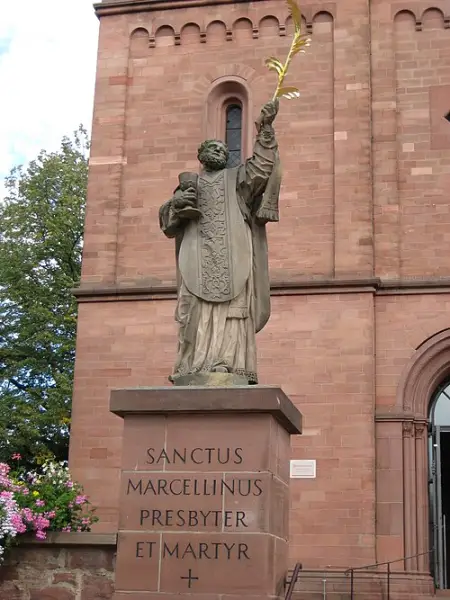
- Two tonsured men holding crowns·Palms of martyrdom·Sometimes depicted alongside St. Pollio
- Canonization
- Pre-congregation; honored as martyrs from antiquity, with their names inscribed in the Roman Canon of the Mass
Prayer
Bibliography
Show 9 sources
- Amore, Agostino (5 Nov 2008). "Santi Marcellino e Pietro". Santi e Beati. Retrieved January 9, 2009.
- Butler, Alban; Jones, Kathleen; Burns, Paul. Butler's Lives of the Saints. Continuum International Publishing Group, 1997, p. 14.
- "Sts. Marcellinus and Peter". Catholic News Agency.
- "Sts. Marcellinus and Peter, Martyrs". FaithND.
- "Saints Marcellinus and Peter". Franciscan Media.
- "SS. Marcellino e Pietro al Laterano". Turismo Roma.
- Smith, Julia. 'Einhard'. Transactions of the Royal Historical Society, March 2002, quoting Einhard's letter of April 836 to Lupus of Ferrieres.
- "La chiesa dei SS. Marcellino e Pietro". Comune of Imbersago.
- Jameson, Anna. Sacred and Legendary Art.
Profile text adapted from the Wikipedia article, licensed CC BY-SA 4.0.
Pray with this saint every day
Save St. Marcellinus and Peter to your favorites, read the full profile, and get feast-day reminders in the Saints app.
Get the Saints AppFree on the App Store for iPhone and iPad