
c. mid 3rd century – 298·Feast October 30
St. Marcellus of Tangier
Centurion martyr of Mauretania Tingitana
Overview
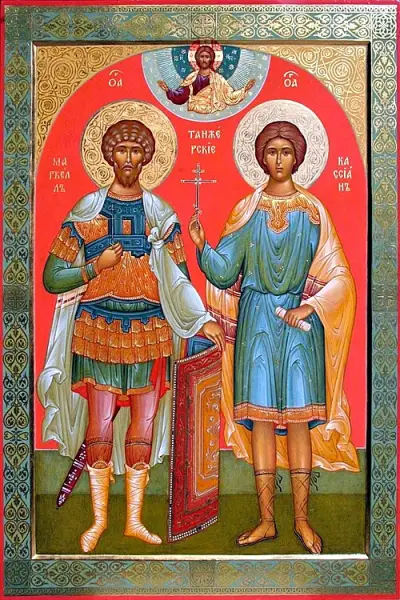
Marcellus the Centurion was a soldier of the Roman army stationed at Tingis in Mauretania Tingitana, the modern Tangiers in Morocco, during the last decades of the third century. He is remembered for a singular act of conscience: when the birthday of the Emperor Maximian was being celebrated with ceremonies that required sacrifice to the Roman gods, Marcellus refused to take part. Casting aside his military belt, his weapons, and the vine staff that marked his rank, he declared himself a servant of Christ alone. Brought before a judge named Fortunatus, he was remanded to the emperor's tribunal, but instead he fell into the hands of Aurelius Agricolanus, the deputy Praetorian prefect, before whom he admitted that he had renounced allegiance to an earthly leader. He was condemned and put to death by the sword. An early tradition adds that Cassian, the court shorthand writer, could not bring himself to write down what the court had done, and for that silence he too was condemned and died.. An alternative, largely apocryphal legend makes Marcellus a native of León in Spain, a soldier of the seventh legion, and a husband and father of martyred children. His relics were eventually enshrined at León, of which city he became a principal patron, and his feast is kept on October 30.
The Complete Life
A Soldier of Rome in Mauretania
Marcellus served as a centurion in the Roman army, stationed at Tingis, the coastal city of Mauretania Tingitana that corresponds to modern Tangiers in Morocco. He is said to have lived around the middle of the third century, at a time when service in the imperial army was inseparable from the public religion of the state: the emperor's person was honored with sacrifices to the Roman gods, and no soldier could escape the ceremonial obligations of his post. One later tradition offers a different origin, claiming that Marcellus was born in the middle of the third century in what is now León in northwestern Spain and served as a centurion of the Legio VII Gemina Pia Felix, living near the city walls. Modern scholarship, however, has demonstrated that this account is almost entirely legendary, for the earliest texts say nothing of either León or the seventh legion. What the early traditions agree upon is his profession and his station: a professional soldier, of the rank that bore the vine staff of command, serving in an African garrison at the close of the age of persecution. It was precisely within that military world, with its festivals and its gods, that his conscience would be put to the test and would answer with a clarity that made him a martyr.
§ Life
The Refusal of a Centurion
The crisis of Marcellus's life came with the general birthday celebrations of the Emperor Maximian, festivities that required participation in sacrifice to the Roman gods. Marcellus, a Christian, refused. His refusal was not whispered but enacted: he threw off his military belt, his weapons, and the vine staff, the very symbols of his rank, in a public renunciation of the emperor's cult and of military allegiance itself. Summoned before a judge named Fortunatus, he did not retract anything. The judge, remanding the case upward, sent him to lay his cause before Maximian and Constantius, the latter of whom was known to be friendly to Christians; had he reached that tribunal, his fate might have been different. Instead, Marcellus was taken before Aurelius Agricolanus, the deputy Praetorian prefect, a magistrate not inclined to leniency. Asked to answer for himself, Marcellus pled guilty in the fullest sense: he acknowledged that he had repudiated his allegiance to an earthly leader, choosing the sovereignty of Christ over the oath to the emperor. The confession was, in Roman eyes, a capital offense; in Christian memory it became a proclamation. His fidelity expressed the conviction that no uniform, no career, and no command can bind a man when the price of obedience is the worship of false gods.
§ Life
Sentence at Tangiers
Before the tribunal of Agricolanus, Marcellus's course ran swiftly to its end. The deputy Praetorian prefect condemned him to death, and the sentence was carried out with the sword: the centurion who had abandoned the arms of the empire was executed by the authority of the empire he had ceased to serve. An early account preserves a moving sequel. The official shorthand writer at the trial, a man named Cassian, was so outraged by the verdict that he laid down his pen and refused to take down the acts of the trial, and for this act of defiance he also suffered death., joining his witness to that of the soldier he had watched condemn himself for Christ. Later elaborations surrounded the martyr's death with a family of fellow sufferers: a late tradition gives the date of his beheading as 29 October 298 and names as his companions in death a wife, Nona, and a progeny of twelve sons, among whom later devotion numbered several groups of Spanish martyrs, including Claudius, Lupercus, and Victorius, honored at León, and Servandus and Germanus, venerated at Cádiz. Critical scholarship regards most of these family connections as legendary accretions, though it allows that these three may truly have been Spaniards serving in the army who were put to death at León under Diocletian, just as the tradition maintains. The core account remains that of the centurion who died for a single act of public fidelity.
§ Alternative version
A Witness Honored From the Beginning
Marcellus was never subjected to any formal process of canonization; he belongs to the company of martyrs whose sanctity the Church recognized by keeping their memory from the earliest times. Veneration of the centurion of Tingis took root on both shores of the Mediterranean and in both the great communions of East and West: he is honored as a martyr-saint today in the Eastern Orthodox Church and in the Catholic Church alike, and his feast is celebrated on October 30. The Roman Martyrology itself placed Marcellus and the three martyrs honored as his sons, Claudius, Lupercus, and Victorius, together under that date, and the association of the four saints was accepted in subsequent breviaries and hagiographies even though their family relationship is probably apocryphal. The diffusion of his cult into Spain gave it institutional permanence. Churches across the country were dedicated to the martyrs of his circle, and at León in particular his memory became civic as well as liturgical. No hagiographical decree was ever needed to establish what the devotion of centuries had already made certain: that a soldier who laid down the insignia of an earthly emperor rather than sacrifice to idols had died the death of a martyr, and that his name deserved a place in the calendar of the saints alongside those whose stories are fuller and better documented.
§ Claudius, Lupercus, Victorius
Patron of León
The afterlife of Marcellus's cult is centered on the Spanish city of León. His relics were brought there and enshrined, and the centurion martyred in Mauretania became a patron saint of the Leonese city and province, so closely identified with it that a principal square, the Plaza de San Marcelo, bears his name. The church of San Marcelo, which serves as his shrine, has roots reaching back to the tenth century, and the neighboring devotion to the martyrs honored as his sons followed its own path through the centuries: their relics were translated several times, King Ferdinand I of Castile carrying some of them to the church of San Isidoro in León, and in 1173 the remains were transferred once more, to a church newly raised in honor of the three martyrs. When that church was destroyed in 1834, the relics found their final resting place in the church of San Marcelo, beside those of their presumed father. Scholarly study eventually disentangled legend from history; the theory of the Leonese birth and the seventh legion was shown to be late, and the family ties to various Spanish martyrs were judged apocryphal. Yet the devotional edifice remained standing: the feast of October 30 continues to be kept in Spain and Portugal, and the martyr of Tangiers remains, in name and shrine, a son of León.
§ Life
Timeline
- Jul 298
Amid the birthday festivities held for Emperor Maximian, Marcellus publicly cast aside the emblems of his military rank, declaring that he acknowledged a single God.
§ Alternative version
- 29 Oct 298
Condemned by the vice-prefect Agricolanus, Marcellus was decapitated at Tangiers.
§ Alternative version
- 1173
The remains of the three martyrs honored as Marcellus's sons were translated to a church newly built in their honor.
§ Claudius, Lupercus, Victorius
- 1834
When that building was destroyed, the remains found a new resting place at San Marcelo in León, the church named for their reputed father.
§ Claudius, Lupercus, Victorius
The Record
- Patron of
- patron of the city of León and the Province of León, Spain
- Symbols
- centurion's vine staff·sword·military belt
- Canonization
- Pre-congregation martyr, venerated since antiquity in the Catholic and Eastern Orthodox Churches.
Prayer
Bibliography
Show 4 sources
- Monks of Ramsgate. "Marcellus". Book of Saints, 1921. CatholicSaints.Info. 19 November 2014. Web
- de Gaiffier, B. (1943). "S. Marcel de Tanger ou de Léon ? Évolution d'une légende", Analecta Bollandiana 61: 116–139. doi:10.1484/J.ABOL.4.02202
- Baring-Gould, Sabine; Hodges, J. (1874). The Lives of the Saints. p. 410 – via archive.org
- Noé Villaverde Vega, Tingitana en la antigüedad tardía, siglos III–VII, p. 341
Profile text adapted from the Wikipedia article, licensed CC BY-SA 4.0.
Pray with this saint every day
Save St. Marcellus of Tangier to your favorites, read the full profile, and get feast-day reminders in the Saints app.
Get the Saints AppFree on the App Store for iPhone and iPad