
died c. 120·Feast March 6
St. Marcian of Tortona
First bishop and martyr of Tortona
Overview
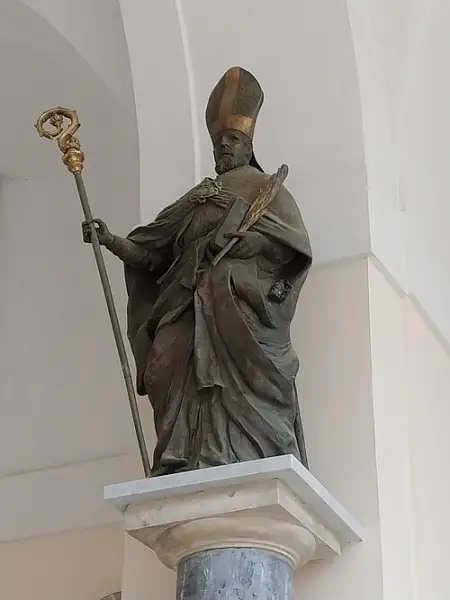
Marcian, also called Marciano, Marziano, or Marcianus, is honored as the first bishop of Tortona in north-western Italy and as a martyr of the early second century. According to pious tradition preserved from the earliest ages of the Church in Italy, he was born to a pagan family, was brought to faith in Christ by the preaching of Barnabas, and was later confirmed in the Christian life by Sirus, bishop of Pavia. Tradition also relates that Secundus of Asti, while still a pagan, met Marcian at Tortona, and that this meeting helped move Secundus toward his own conversion. Marcian is said to have governed the see of Tortona for forty-five years before sealing his witness with blood, crucified for his adherence to the Christian faith. Sources disagree about the year of his death, some placing it in 117 under the emperor Trajan and others in 120 under Hadrian. Whatever the exact date, his cult reaches back to antiquity: records of the 700s confirm his tenure of the see, and Walafrid Strabo attested that Tortona's earliest shepherd had died a martyr's death. His relics rest today in the cathedral of Tortona, of which he is the principal patron.
The Complete Life
From Paganism to the Episcopate
The tradition of the Church in northern Italy recounts that Marcian did not receive the faith by birth but by grace. Born into a pagan family in the generation after the Apostles, he heard the gospel from Barnabas himself, the companion of Paul, and believed; later he was confirmed in the Christian faith by Sirus, the bishop of Pavia, becoming a steadfast member of a community still small and hunted within the Roman Empire. His path soon joined him to Tortona, the town in what is now the north-west of the Italian peninsula over which he would preside as its first bishop. The sources speak of an episcopate of forty-five years, an extraordinary tenure that carried the young church of the Tortonese from its fragile beginnings to settled maturity under his care. His influence extended beyond his own flock: Secundus of Asti, then still a pagan, is said to have met Marcian at Tortona, and the encounter with the bishop's faith and person helped dispose Secundus toward the Christianity he would later embrace, becoming in his turn a saint of the Piedmontese church. Marcian's apostolate thus bore fruit in other dioceses as well as his own, and the memory of it endured for centuries in the written records of the region.
§ Legend
Martyrdom in the Age of Trajan and Hadrian
Marcian ended his long episcopate as he had fulfilled it, by a public confession of Christ. Tradition states that he was crucified for his Christianity, condemned to the most Roman of deaths, the same gibbet on which his Master had died. The sources are not agreed on the year: some place his martyrdom in 117, in the last months of the emperor Trajan, while others assign it to 120, in the reign of Hadrian whose empire was still unsettled toward the new religion. Either date falls within the era in which the faith was advancing through northern Italy under the shadow of periodic persecution, and in which a bishop who would not sacrifice to the gods of the state could expect precisely such a sentence. Some writers have argued that the martyr of Tortona is in reality the same person as Marcian of Ravenna, a question that the brevity of the early records does not allow to be settled with certainty. What the constant tradition preserves is the manner of his end: a crucified bishop, dead at Tortona, honored by the community he had led for nearly half a century. His death made him, in the memory of the local church, its first martyr as well as its first bishop.
§ Legend
Relics and Patronage of Tortona
The veneration of Marcian at Tortona has never ceased since his death. Eighth-century records bear witness to his tenure of the see, fixing the memory of Tortona's earliest pastor in writing long after the events themselves. Walafrid Strabo, the ninth-century scholar, affirmed — prompted by the erection of a church dedicated to the saint — that Marcian had been the earliest occupant of the Tortonese see and had died a martyr, a judgment that settled the outline of his cult for later generations. His relics were discovered in the fourth century on the left bank of the Scrivia by Innocent, bishop of Brescia, and were translated to Tortona, where they remain today in the cathedral of the city. The devotion to the saint also spread beyond his see: a finger bone associated with him has been kept at Genola, a town of which he is likewise the patron. He is the principal patron saint of Tortona, invoked as its first bishop and its martyr, and his feast is celebrated on March 6 in the Roman Catholic Church, which venerates him together with the Orthodox Church. After so many centuries, the church of Tortona still gathers around the relics of the man who first gathered it in the name of Christ.
§ Historicity
The Record
- Patron of
- patron of Tortona·patron of Genola
- Symbols
- palm of martyrdom
- Canonization
- Pre-congregation martyr-bishop, venerated since antiquity in the Roman Catholic and Orthodox Churches.
Prayer
Bibliography
Show 3 sources
- Catholic-Forum.com entry on Marcian
- Saints of March 6: Marcian of Tortona
- San Marciano (Marziano) di Tortona (in Italian)
Profile text adapted from the Wikipedia article, licensed CC BY-SA 4.0.
Pray with this saint every day
Save St. Marcian of Tortona to your favorites, read the full profile, and get feast-day reminders in the Saints app.
Get the Saints AppFree on the App Store for iPhone and iPad