
died 9 January 304·Feast January 9
St. Marciana
Virgin martyr who shattered the idol of Diana
Overview
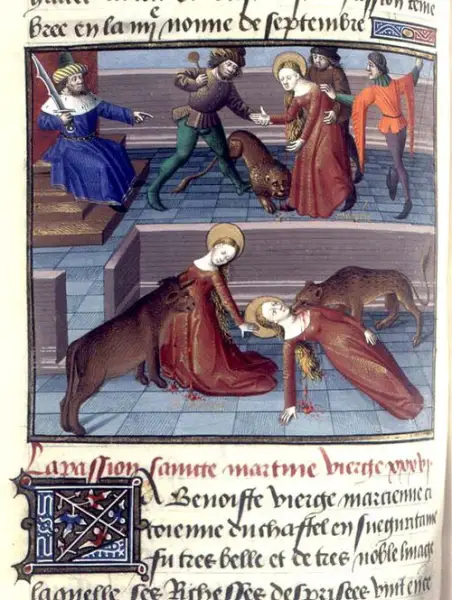
Marciana, remembered also as Marciana of Mauretania and Marciana of Caesarea, was a virgin martyr put to death at Caesarea in Mauretania Caesariensis on 9 January 304, during the Great Persecution of Diocletian. A native of Rusuccur, modern Dellys in Kabylia, she was a devout young Christian of striking beauty who so burned with zeal for her faith that she left her family home and traveled some hundred and twenty-eight kilometers east to Caesarea. There she renounced the advantages of her social rank, gave away her riches, and took up residence in a cave, consecrating herself to God through fasting and other practices of self-denial. Her legend credits her with a bold hostility to the civic religion of the empire: walking in the public square of Caesarea, she attacked a statue of the goddess Diana, striking off its head and shattering the body. Arrested by the townspeople and brought before the governor's tribunal, she was confined in the gladiatorial school and then cast into the arena, where a bull gored her, and a leopard was sent in to finish the deed by snapping her neck. Her relics were later translated to Toledo in Spain, which gave her the name by which she is best known, Marciana of Toledo, and her cult spread through both the Catholic and Eastern Orthodox Churches.
The Complete Life
A Daughter of Mauretania
Marciana came from Rusuccur, the coastal town of Kabylia known today as Dellys, in the Roman province of Mauretania, in what is now Algeria. The accounts of her life, preserved in a Latin passio probably composed in the fifth century, present her as a devout young Christian woman of notable beauty and high social standing, filled with zeal for the faith she had embraced. The Africa of her youth was a land where Christian communities had flourished for generations, yet where the old civic religion still held public space, and the accession of Diocletian in 284 would soon bring the empire's most systematic assault on the Church. In the judgment of the historian Brent Shaw, the tale foregrounds her virginity and ascetic resolve, and adds to the familiar antagonism of Christian and pagan a distinctively sharper militancy. Marciana was not content with private piety. By the account's telling, her zeal for the faith lately embraced burned so hot that the security of her family's house and possessions could no longer contain her. While still young, she determined to surrender the two things the Roman world valued most in a woman of rank, her wealth and her marriageability, and to seek in a distant city a life belonging to God alone.
§ Life
The Virgin of the Cave
Marciana's consecration took visible form. She abhorred the worldly benefits that her high social status conferred, put aside her riches, and traveled from her home to Caesarea in Mauretania, roughly a hundred and twenty-eight kilometers east of her family's house, the provincial capital where the Roman administration sat under the emperor Diocletian. In that city she took up residence in a cave, choosing the life of a solitary so that her virginity, endangered by the beauty for which she was known, might be preserved inviolate for God. Her asceticism was deliberate and severe: she gave herself to fasts and other practices of self-deprivation, exercises which, in the theology of the age on the eve of persecution, could stand in place of martyrdom as a daily dying to the world. This was the shape of her vocation, a young woman of means choosing destitution, a beauty veiled in a cavern, a citizen of a provincial elite making herself an outsider to the religious and social order of her city. When the Great Persecution broke upon the African church, the cave could no longer contain her; the same zeal that had carried her from Rusuccur to Caesarea now drove her from hidden prayer into open confrontation with the idols of the empire.
§ Life
The Broken Statue of Diana
The act for which Marciana is remembered was a public and provocative assault on the civic religion of Caesarea. Walking in the public square of the city, she attacked a statue of the goddess Diana, tore the head from the image, and smashed the body to pieces. The historian Brent Shaw describes this as the climactic moment of an aggressive anti-idolatry campaign that her legend attributes to her, and notes that her story displayed an aggressive hostility to the traditional forms of civic religion from the moment of her arrival in the city. In the Roman world an image of a deity was not decoration but the presence of the god in the civic order; to destroy one was an offense against both religion and the community. The citizens of Caesarea reacted accordingly: they seized Marciana and hauled her before the governor's tribunal to answer for her deed. For a Christian of the Diocletianic era, that tribunal was not a court of minor offences but the gateway to interrogation, torture, and death, and Marciana entered it without retracting anything. Her gesture has echoed through the centuries as one of the most vivid acts of iconoclastic defiance recorded of any early Christian martyr, a woman armed with nothing but zeal striking down the bronze goddess in the heart of a Roman city.
§ Martyrdom
The Arena of Caesarea
Marciana's punishment followed swiftly from her confession. The townspeople seized her and dragged her to the tribunal of the governor, and from there she was sent to confinement in the local gladiatorial school, a confinement that Shaw characterizes as a brutal test of her sexual purity, a preliminary torment aimed at the virgin whose body the prosecution could not otherwise touch. When the sentence was finally carried out, it took the form the arena provided: Marciana was thrown to the beasts before the crowd of Caesarea. A bull was set upon her, and she was mangled by the animal in the sand of the amphitheater. Death did not come quickly enough, and a leopard was sent in after the bull; the great cat sprang upon the dying woman and snapped her neck, ending her martyrdom. She died at Caesarea in Mauretania Caesariensis on 9 January 304, one of the host of African Christians consumed in the Diocletianic Persecution. The Latin account of her passion was written down possibly in the fifth century, preserving the memory of the virgin of the cave who died between the bull and the leopard. Shaw cautions that the tradition as it stands also reflects the polemical literature of its age, and that narratives including Jews among the persecutors of African Christians in the fourth and fifth centuries were exceedingly rare.
§ Martyrdom
From Caesarea to Toledo
The cult of Marciana crossed the sea from Africa to Spain, carried by her relics, which were moved to Toledo; this translation gave her the title by which the Latin West chiefly knows her, Marciana of Toledo. Her feast is celebrated on January 9 in some of the early calendars, the day of her martyrdom, while the Catholic Church and the Eastern Orthodox Church commemorate her on July 12. The ancient Spanish liturgy preserved a distinctive memorial of her: the Mozarabic office contains a special hymn composed in her honor, a sign of how deeply her cult took root in the Iberian church. In Christian art she is sometimes depicted with a leopard and a bull near her, the two beasts of her passion, an iconography that makes her instantly recognizable among the virgin martyrs. Popular devotion assigned her a particular intercession: she is invoked to cure wounds, an appeal that draws its meaning directly from the wounds inflicted on her in the arena, the martyr made a healer of the hurts she once endured. Scholarly attention, notably in the work of Brent Shaw, has recovered her story as a window onto the religious hatreds of Roman Africa, but for the churches that keep her memory she remains what the calendars have always called her, a virgin and martyr of the one unstained sacrifice.
§ Veneration
The Record
- Patron of
- invoked to cure wounds
- Symbols
- leopard·bull
- Canonization
- Pre-congregation martyr of the Diocletianic Persecution; venerated in the Catholic and Eastern Orthodox Churches.
Prayer
Bibliography
Show 6 sources
- Shaw, Brent D. (2011). Sacred Violence: African Christians and Sectarian Hatred in the Age of Augustine. Cambridge, Massachusetts: Cambridge University Press. ISBN 9780521127257. p. 265
- Butler, Alban. "St. Marciana, Virgin and Martyr", The Lives of the Saints. 1866
- Husenbeth, Frederik Charles. Emblems of Saints: By which They are Distinguished in Works of Art, Longman, Green, Longman, and Roberts, 1860, p. 108
- Watkins, Basil. The Book of Saints: A Comprehensive Biographical Dictionary, Bloomsbury Publishing, 2015, p. 463. ISBN 9780567664150
- Morcelli, Stefano Antonio. Africa christiana, Volume I, Brescia 1816, p. 268
- Gordini, Gian Domenico. "Marciana di Cesarea di Mauritania", Santi e Beati, October 9, 2002
Profile text adapted from the Wikipedia article, licensed CC BY-SA 4.0.
Pray with this saint every day
Save St. Marciana to your favorites, read the full profile, and get feast-day reminders in the Saints app.
Get the Saints AppFree on the App Store for iPhone and iPad