
c. 500 – 558·Feast May 1
St. Marculf
Abbot of Nantus and healer of scrofula
Overview
Marculf, known in French as Marcoult, Marcouf, Marcoul, or Marcou, was an abbot of the sixth century, born around the year 500 in the Saxon colony of Bayeux in Neustria, and remembered as the abbot of Nantus in the Cotentin peninsula. From his monastery he directed the evangelization of the Channel Islands, sending Saint Helier as missionary to the people of Jersey; Jersey itself received a visit from him in person, and wonders were attributed to him there. He died on the first of May, 558, among the small islands off the Cotentin's eastern coast that have ever since been called the Îles Saint-Marcouf. His cult spread quickly through Normandy and beyond, and his remains were conveyed to Corbény abbey in Champagne, where their renown grew apace: they figured in the rites by which the kings of France were crowned at Reims, and from their reputed efficacy, so the chronicle of Joan of Arc known as the Chronique de la Pucelle would have it, stems the age-old conviction of the kings of France and England that their touch could heal the king's Evil, scrofula. Marculf is thus one of the saints bound up with the sacral kingship of medieval Europe, and the Chapel of Saint Marcouf in the cathedral of Coutances preserves his memory in stained glass to this day.
The Complete Life
Abbot of Nantus and Apostle of the Islands
Marculf belonged to the generation of monks who carried the Christian faith through the Saxon-settled lands of northern Gaul. Born around the year 500 in the Saxon colony of Bayeux, he embraced the monastic life and rose to govern the abbey of Nantus in the Cotentin as its abbot. From that house on the edge of the Frankish world he looked outward to the Channel Islands, still dark with paganism, and sent Saint Helier to bring the Christian faith to the islanders of Jersey, an act of missionary foresight that made him the spiritual father of the island's Christianity. The accounts of his life have become interwoven with Helier's, the abbot and the hermit-martyr joined in the memory of the Norman church. Marculf did not remain behind his walls: he visited Jersey in person, and popular devotion ascribed miracles to him on the island itself, so that his sanctity was confirmed both in the monastery and in the mission field. His association with the healing of scrofula, the disease known as the king's Evil, attached itself to his name in this early period and made his intercession sought by sufferers for a thousand years. As abbot he embodied the twin works of the sixth-century monk, the ordering of a community of prayer and the carrying of the gospel to the gentes beyond the frontier.
§ Life
Death Among the Islands That Bear His Name
Marculf's earthly life closed in the places his mission had sanctified. The abbot's life closed in 558, on the first day of May, among the small islands off the Cotentin's eastern seaboard whose very title preserves him, the most enduring monument of his passage through the region. His death on the first day of May fixed the date of his liturgical memory, and the islands of his retreat became a goal of the devotion that gathered around his tomb. After his death the veneration of the abbot grew beyond the Cotentin; his relics, the tangible pledge of his continuing intercession, were transferred from the islands to the abbey of Corbény in Champagne, a translation that carried his cult from the Norman shore into the heart of the Frankish kingdom. There the saint's remains would acquire a role in the most solemn rites of the realm. He had lived as a monk of the Saxon frontier and died as a recluse among the islands; within a few generations he was numbered among the great intercessors of the French church, whose bones stood near the anointing of kings. The arc of his final years thus runs from the silence of the monastic cloister to the center of royal ceremony, a posthumous journey he neither sought nor imagined.
§ Life
The Royal Touch and the Saint of Corbény
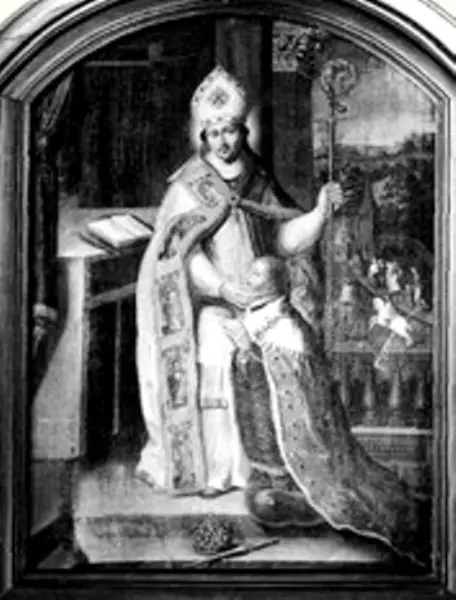
Marculf's most remarkable legacy is his entanglement with the sacred monarchy of medieval Europe. His relics, enshrined at the abbey of Corbény in Champagne, had a place in the enthronement rites of the French monarchy at Reims, so that the abbot of a Cotentin monastery stood spiritually beside the anointing of the realm. From the reputed efficacy of those relics, according to the Chronique de la Pucelle, the chronicle of Joan of Arc, derives the famous prerogative by which the crowned heads of France and England were believed able to heal the king's Evil, scrofula, with a touch: a grace once sought by pilgrims at Corbény became, in the ideology of kingship, a prerogative of crowns. Few saints of the early medieval church can claim so wide an influence on the political theology of a continent. His cult also remained rooted in Normandy. Communes called Saint-Marcouf still mark the map of the peninsula where he lived and died, and in the cathedral of Coutances the north ambulatory holds the Chapel of Saint Marcouf, its stained glass window unfolding scenes from the saint's life for the pilgrims and visitors of later centuries. The abbot who sent Helier to Jersey remains, a millennium and a half after his death, a presence in the landscape and liturgy of Normandy and in the memory of the French crown.
§ Life
Timeline
- 500
In about the year 500, Marculf was born at Bayeux, in the Saxon settlement established there.
§ Life
- 1 May 558
The saint died among the islands that would later bear his name, the Îles Saint-Marcouf, on 1 May 558.
§ Life
The Record
- Major works
- Monastery of Nantus in the Cotentin, of which he was abbot·Mission of Saint Helier to Jersey
- Patron of
- invoked for the healing of scrofula (the king's Evil)
- Canonization
- Pre-congregation saint of the early Norman church, venerated since the Merovingian era.
Prayer
Bibliography
Show 3 sources
- Monks of Ramsgate. "Marculphus". Book of Saints 1921. CatholicSaints.Info. 22 November 2014
- Butler, Alban. "Saint Marcou, or Marculfus, Abbot". Lives of the Fathers, Martyrs, and Principal Saints 1866. CatholicSaints.Info. 29 April 2013
- M. Charles Grosset, "A Theory on the Evangelisation of the Cotentin". members.societe-jersiaise.org
Profile text adapted from the Wikipedia article, licensed CC BY-SA 4.0.
Pray with this saint every day
Save St. Marculf to your favorites, read the full profile, and get feast-day reminders in the Saints app.
Get the Saints AppFree on the App Store for iPhone and iPad