
died after 430·Feast May 20
St. Marcus Eremita
Fifth-century ascetic writer and monk of the desert
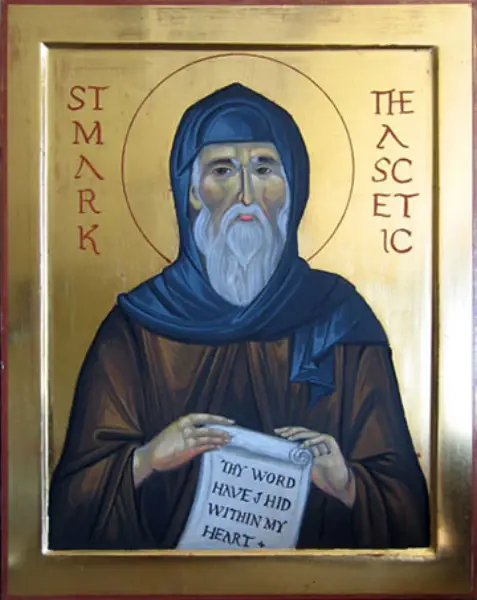
Overview
Marcus Eremita, remembered also as Mark the Ascetic or Mark the Monk, was a Christian theologian and ascetical author who wrote in Greek during the fifth century. Tradition places him first as the superior of a laura at Ancyra, and later, in old age, as a solitary in the desert region east of Palestine, close by Mar Saba. His lifetime overlapped that of Nestorius, and he is thought to have died after 430, probably before the Council of Chalcedon. As a writer he concerned himself less with dogmatic argument than with the practical guidance of monks: he accepted the Church's teaching as given and directed his attention to how the spiritual life is actually lived. In this he belongs to the Antiochene tradition and is described as a disciple of John Chrysostom. His treatises, which address subjects such as repentance, baptism, fasting, humility, and the control of anger, circulated widely, reaching Syriac- and Arabic-speaking Christians, and excerpts from his writings were later gathered into the Philokalia. His feast is kept on 20 May.
The Complete Life
A Difficult Identification
Few early Christian writers are as shadowy in their biography as Mark the Ascetic. Centuries of readers have advanced competing theories about who he was and when he lived. Some Eastern sources place him in the fourth century, identifying him with an Egyptian monk mentioned by Palladius in the Historia Lausiaca; the Byzantine Menaia support this view. Cardinal Bellarmine went so far as to connect him with a monk who, around the year 900, prophesied to Emperor Leo VI that he had ten more years to live, though Tillemont refuted that suggestion. A further line of identification links him with a writer from Tartus who corresponded with Severus of Antioch. The question was largely settled by the modern recovery of a treatise in which Mark attacks the teaching of Nestorius, since the existence of such a work requires an author active in the early fifth century. Whatever the truth of the older theories, the polemic anchors its author firmly beside the Christological controversies of his day. On this basis scholars accept him as a contemporary of Nestorius who died after 430 and, in all likelihood, before the Council of Chalcedon convened in 451.
§ Identification
From Laura to Desert
The most widely accepted reconstruction of his career, associated with the German scholar Johannes Kunze, pictures a life passed entirely within the monastic movement of the Christian East. Mark first served as the superior of a laura at Ancyra, the chief city of Galatia in Asia Minor, where he would have borne responsibility for the discipline and spiritual direction of a community of ascetics. A laura of that kind combined communal stability with the solitude of separate dwellings, and its head needed both administrative prudence and personal holiness. In his old age Mark withdrew still further, leaving his monastery to live as a hermit, probably in the desert country east of Palestine near the monastery of Mar Saba. This final solitude resembles the pattern of many desert fathers who, after years of guiding others, ended their lives in unbroken prayer. The trajectory from leadership to seclusion also explains the character of his books, which speak with the authority of a practiced director addressing monks he understood from the inside. In such a post obedience, stability, and the training of novices formed the daily fabric of sanctity.
§ Identification
An Ascetic Rather Than a Dogmatician
Mark's writing is marked by a deliberate restraint: he is content to receive the dogmas of the Church without argument and devotes his whole attention to the conduct of the spiritual life. He has therefore been described as an ascetic rather than a dogmatic writer, practical rather than mystical, a man of the Antiochene school and, by tradition, a disciple of John Chrysostom. His treatises map the interior battlefield of the monk. One work treats the spiritual law that governs the soul's growth; another warns those who imagine they can be justified by works alone. He writes on penitence and on baptism, on fasting joined to humility, and on the conquest of anger and lust in a letter addressed to a disciple named Nicholas. A dialogue of the mind with its own soul rebukes the human habit of charging Adam, Satan, or other people with sins for which the sinner himself is responsible. Even his one properly theological polemic, directed against the claim that identified Melchisedek with an apparition of the divine Word, serves the same pastoral ends. Each treatise answers a single pastoral question, and together they form a course in the monastic interior life.
§ Works
Veneration
Mark was never the subject of a formal process of canonization; his cult arose in the ancient manner, rooted in the esteem in which monks and theologians held his person and his books. Both the Eastern Orthodox Church and the Roman Catholic Church reckon him among the saints, and he stands in the traditional catalogues of the Fathers of the Church. The Synaxarion of the Orthodox Church, in the brief notice it devotes to him, assigns his feast to the twentieth of May, the day on which his memory is still celebrated. In the West his name entered the patristic collections at an early date, and Renaissance and post-Tridentine scholars such as Gallandi and the editors of the Patrologia Graeca preserved and printed his works for later generations. This continued liturgical and scholarly attention across both communions testifies to a saint recognized not by miracle stories but by the endurance of the wisdom he left in writing. The absence of a dated decree is no obstacle: antiquity of honor, not paperwork, made him a saint. He belongs to the company of writers whom the Church keeps on her altars chiefly because generations of readers have found the road to prayer made plainer by their pages.
§ Identification
A Teacher Carried Across Languages
Mark's influence traveled far beyond the Greek monasteries in which his treatises were first read. His works survive in good Greek manuscripts, but most of them were translated early into Syriac, and those Syriac versions too survive in manuscript. Among the faithful of the Church of the East his writings spread widely: the great Syriac author Babai the Great, who died in 628, composed a commentary on Mark's treatise On the Spiritual Law, evidence that the hermit of Ancyra was being studied and glossed in Persian lands within two centuries of his death. Arabic translations carried his teaching still further. Nine of the treatises traditionally attributed to him were catalogued in the Myrobiblion and printed in Gallandi's collection, though one of them is now judged spurious. In the modern era his reputation rose again through the Philokalia, the eighteenth-century anthology of mystical and ascetic texts, in which generous excerpts from his writings appear alongside the greatest masters of Orthodox prayer. Few authors of any century can claim so long and so wide a readership, from the scribes of ninth-century Byzantium to the printers of the Philokalia's modern editions.
§ Works
Timeline
- 430
Scholarly reconstruction holds that Mark died after this year as a hermit of advanced age.
§ Identification
- 451
Mark probably died before the Council of Chalcedon assembled, which closes his life's terminus.
§ Identification
- 628
Babai the Great, dying in this year, left a commentary on Mark's treatise On the Spiritual Law.
§ Works
- 900
Cardinal Bellarmine linked Mark to the monk who foretold Emperor Leo VI a further decade of life.
§ Identification
- 1891
P. Kerameus printed a treatise by Mark against Nestorius, which fixed his historical period.
§ Identification
- 1896
Johannes Kunze published a Leipzig study defending the chronology of Mark's life and writings.
§ Identification
The Record
- Major works
- On the Spiritual Law·Concerning Those Who Think to Be Justified Through Works·On Penitence·On Baptism·To Nicholas, on Refraining from Anger and Lust·Disputation Against a Scholar·Consultation of the Mind with Its Own Soul·On Fasting and Humility·On Melchisedek·Against the Nestorians
- Canonization
- Pre-congregation, venerated in Eastern Orthodoxy and Roman Catholicism from antiquity
Prayer
Bibliography
Show 6 sources
- Fortescue, Adrian. "Marcus Eremita." The Catholic Encyclopedia, Vol. 9. New York: Robert Appleton Company, 1910.
- Brock, Sebastian Patrick. Gorgias Encyclopedic Dictionary of the Syriac Heritage. Gorgias Press, LLC, 2011.
- Kunze, Johannes. Marcus Eremita, ein neuer Zeuge fur das altkirchliche Taufbekenntnis. Leipzig, 1896.
- Gallandi, Andrea. Bibliotheca veterum Patrum, VIII. Venice, 1788, pp. 1-104.
- de Durand, Georges-Mathieu. Marc le Moine, Traités. Two volumes, 1999.
- Palmer, G. E. H.; Ware, Kallistos; Sherrard, Philip. The Philokalia: The Complete Text, Vol. 1. London: Faber and Faber, 1979.
Profile text adapted from the Wikipedia article, licensed CC BY-SA 4.0.
Pray with this saint every day
Save St. Marcus Eremita to your favorites, read the full profile, and get feast-day reminders in the Saints app.
Get the Saints AppFree on the App Store for iPhone and iPad