
c. 1556 – 1586·Feast October 25
St. Margaret Clitherow
The Pearl of York, martyr of Elizabethan England
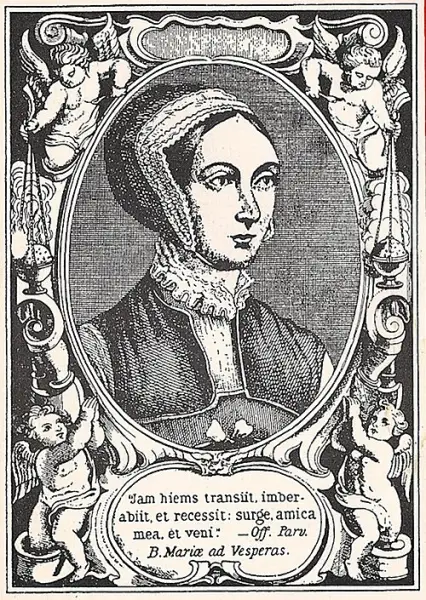
Overview
Margaret Clitherow, born Margaret Middleton around 1556, was an English Catholic recusant remembered as the Pearl of York. The daughter of a wax-chandler who served as Sheriff of York, In 1571 she became the wife of John Clitherow, a prosperous butcher who served the city as its chamberlain, and the family settled in the Shambles. She converted to Roman Catholicism in 1574 and endured repeated imprisonment for refusing to attend the Established Church's services. At a time when harbouring a priest had been made a capital offence, she sheltered fugitive clergy in hidden chambers and in a rented house nearby, making her home one of the chief refuges of the persecuted faith in northern England. She sent her eldest son to the English College at Reims to prepare for priesthood. When her house was searched in March 1586 and a priest hole was revealed, she was arrested and brought before the York assizes. Refusing to enter a plea, she spared her children from being forced to testify and was condemned to be pressed to death. She was crushed under weights at the Toll Booth on Ouse Bridge on 25 March 1586, Lady Day and Good Friday that year. Canonized in 1970, she is venerated by Roman Catholics and Anglicans alike.
The Complete Life
A Merchant's Daughter in York
Margaret Middleton was born in 1556 at York, the youngest child of Thomas and Jane Middleton. Her father was a respected freeman and a businessman in the wax-chandler's trade, and his standing in the city was considerable: he served as Sheriff of York in 1564 and acted as churchwarden of St Martin's Church in Coney Street in the years around her birth. He died when Margaret was fourteen, leaving her to grow toward adulthood in a prosperous but fatherless household in a city still adjusting to the religious revolution of the Tudor century. At about fifteen, on 1 July 1571, she became the bride of John Clitherow, a prosperous butcher serving the city as its chamberlain, who brought to the marriage two young sons from an earlier marriage. The family settled in the Shambles, the butchers' street of York, at the house known today as numbers 10 and 11. There Margaret bore three children of her own and learned the commerce and cares of a trading household in Elizabethan England. York in those years was a city of guilds and parish bells, and the Middletons belonged to its respectable core.
§ Life
Conversion and Its Price
In 1574 Margaret converted to Roman Catholicism, a decision that shaped every remaining year of her life. Her husband John belonged to the Established Church, yet he proved supportive of her conscience; his own brother William was a Catholic priest, and John paid the fines that Margaret incurred for absenting herself from the services of the state church. Her refusal to conform nonetheless carried real consequences. She was first imprisoned in 1577 for failure to attend church, and two further terms of incarceration at York Castle followed. Her imprisonment became, strangely, a school: her third child, William, first saw light inside the prison walls, and it was during those days of confinement that Margaret learned to read and write. The recusant's life taught her to unite domestic responsibility with religious defiance, and by the mid-1580s she had moved from passive resistance to active aid of the persecuted clergy. In an age when the old faith survived only in hidden rooms, this butcher's wife of the Shambles had chosen a vocation of shelter and risk. Conversion in Elizabethan England was never a private act; it re-ordered a household, a purse, and a reputation.
§ Life
Harbouring the Priesthood
Margaret risked her life by harbouring and maintaining Catholic priests at a time when the Jesuits, etc. Act of 1584 had made such shelter a capital offence. She maintained two chambers for the clergy, one adjoining her own house; and as that house came under surveillance, she rented a second dwelling some distance away, where priests could be concealed and Mass celebrated through the thick of the persecution. Her arrangement made the house rank among the chief refuges that the north of England offered to priests on the run, and local tradition adds that she lodged clerical guests at The Black Swan on Peasholme Green, where the Queen's agents themselves were quartered. Her hopes extended to the next generation: her eldest son, Henry, was dispatched to the English College, then relocated to Reims in France, to prepare for priesthood, an act that summoned her husband before the authorities to account for the boy's absence abroad. On 10 March 1586 officials searched the Clitherow house, and a boy, panicked, disclosed where the priest hole lay. Margaret was taken and arraigned before the assizes at York.
§ Life
Silence Before the Assizes
Charged with harbouring Catholic priests, Margaret refused to enter a plea. Her silence was itself an act of protection: a trial would have required her three children to give evidence against her and exposed them to the threat of torture, and by declining to plead she prevented that ordeal from ever beginning. The court, applying the standard inducement of the age, sentenced her to the peine forte et dure. Although she was pregnant with her fourth child, the sentence was carried out on Lady Day, 25 March 1586, which fell that year on Good Friday, in the Toll Booth at Ouse Bridge in York. The two sergeants who should have carried it out hired four destitute beggars in their place. Margaret was stripped, a handkerchief bound across her face, and laid upon a jagged stone no larger than a man's clenched hand; over her was set the very door of her own house and loaded with seven or eight hundredweight of stones. Death came within fifteen minutes, yet her body was left under the weight for six hours, and afterward she was buried secretly according to Catholic rites. Her husband later remarried and remained a Protestant.
§ Life
From Contemporary Memory to the Altar
The memory of Margaret's death was preserved at once by the Catholic community she had served. Within three months of her execution, John Mush wrote his Trewe Reporte of the Lyfe and Marterdome of Mrs Margarete Clitherowe, the account on which nearly all later knowledge of her rests. Three centuries later the English Jesuit poet Gerard Manley Hopkins honoured her in a poem found among his papers after his death, praised as a tribute to her faith, courage, and the manner of her end. Her formal recognition followed in the twentieth century: Pope Pius XI beatified her on 15 December 1929, and Pope Paul VI canonized her on 25 October 1970 among the Forty Martyrs of England and Wales. In the current Roman Catholic calendar her feast is kept on 4 May in England and 25 October in Wales, and she is commemorated on 30 August together with the martyrs Anne Line and Margaret Ward, a trio also added to the Episcopal Church liturgical calendar. The Bar Convent in York preserves a relic believed to be her hand, and her shrine stands on the Shambles near her husband's former shop.
§ Veneration
Patroness and Pilgrim City
Margaret Clitherow's witness has taken root in institutions and places across the English-speaking world. She is patroness of the Catholic Women's League and co-patroness of the Latin Mass Society, which gathers each year for a pilgrimage to York made in her honour. Catholic schools from Bracknell, Brixham, Manchester, and Middlesbrough to Thamesmead, Brent, Tonbridge, and Stevenage bear her name, as does St Margaret of York Church and School in Loveland, Ohio. In Liverpool and Salford, groups of parishes have been united into single communities under her patronage. All Saints, the York Catholic secondary school that shares its chapel with the Bar Convent where her left hand is preserved, holds the distinction of being England's first school established solely for the education of Catholic girls, and it counts her among its inspirations for teaching the word of God. Her memory is fixed in the city of her martyrdom: the shrine on the Shambles attracts pilgrims, and in 2008 the Bishop of Middlesbrough unveiled a commemorative plaque at the Micklegate end of Ouse Bridge, marking the Toll Booth where she died. Her story reached the Broadway stage in 1950 in William Berney and Howard Richardson's Design for a Stained Glass Window, with Martha Scott as Margaret and Charlton Heston as her husband.
§ Legacy
Timeline
- 1556
Margaret Middleton was born at York, the youngest child of Thomas and Jane Middleton.
§ Life
- 1564
Her father Thomas Middleton served as Sheriff of York and churchwarden of St Martin's Church.
§ Life
- 1 Jul 1571
Margaret married John Clitherow, a wealthy butcher and widower who was chamberlain of York.
§ Life
- 1574
Margaret converted to Roman Catholicism despite her husband's membership of the Established Church.
§ Life
- 1577
She was first imprisoned for failing to attend Anglican services, with two later terms at York Castle.
§ Life
- 1584
The Jesuits, etc. Act made harbouring Catholic priests a capital offence during the persecution.
§ Life
- 10 Mar 1586
A search of the Clitherow home ended when a boy, frightened, disclosed where the priest hole lay.
§ Life
- 25 Mar 1586
Margaret was pressed to death at the Toll Booth on Ouse Bridge, York, refusing to plead.
§ Life
- 15 Dec 1929
Pope Pius XI beatified Margaret Clitherow in Rome.
§ Veneration
- 25 Oct 1970
Pope Paul VI canonized her among the Forty Martyrs of England and Wales.
§ Veneration
- 29 Aug 2008
The Bishop of Middlesbrough unveiled a commemorative plaque at the Micklegate end of Ouse Bridge.
§ Legacy
The Record
- Patron of
- Businesswomen·Converts·Martyrs·Catholic Women's League·Latin Mass Society
- Symbols
- Door·Bible·Martyr's palm·Rosary
- Canonization
- Beatified 15 December 1929 by Pope Pius XI; canonized 25 October 1970 by Pope Paul VI among the Forty Martyrs of England and Wales
Prayer
Bibliography
Show 6 sources
- Walker, Claire. "Clitherow [née Middleton], Margaret [St Margaret Clitherow] (1552/3-1586), Roman Catholic martyr." Oxford Dictionary of National Biography. Oxford University Press, 2004, revised 2017. doi: 10.1093/ref:odnb/5692
- Camm, Bede. "St. Margaret Clitherow." The Catholic Encyclopedia, Vol. 4. New York: Robert Appleton Company, 1908.
- Lake, Peter; Questier, Michael. "Margaret Clitherow, Catholic Nonconformity, Martyrology and the Politics of Religious Change in Elizabethan England." Past & Present (185): 43-90. doi: 10.1093/past/185.1.43
- Cross, Claire. "An Elizabethan Martyrologist and his Martyr: John Mush and Margaret Clitherow." Studies in Church History 30: 271-281. doi: 10.1017/S042420840001175X
- Lake, Peter; Questier, Michael. The Trials of Margaret Clitherow: Persecution, Martyrdom and the Politics of Sanctity in Elizabethan England. New York/London: Continuum, 2011.
- Garner, W. H. (ed.). Gerard Manley Hopkins: Poems and Prose. Harmondsworth: Penguin, 1953, pp. 78-80.
Profile text adapted from the Wikipedia article, licensed CC BY-SA 4.0.
Pray with this saint every day
Save St. Margaret Clitherow to your favorites, read the full profile, and get feast-day reminders in the Saints app.
Get the Saints AppFree on the App Store for iPhone and iPad