
1647 – 1690·Feast October 16
St. Margaret Mary Alacoque
Visitation nun and apostle of the Sacred Heart
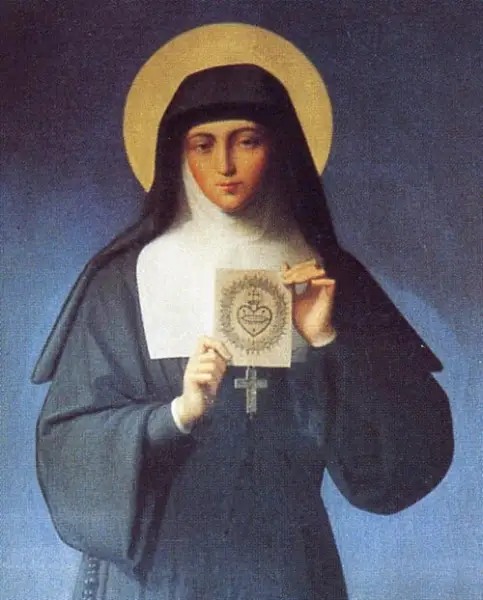
Overview
Margaret Mary Alacoque was a French Visitation nun and mystic whose visions of Christ gave modern form to devotion to the Sacred Heart of Jesus. Born in 1647 at L'Hautecour in Burgundy, the fifth of seven children of a well-to-do notary, she lost her father at eight, suffered years of rheumatic illness, and as a girl made a vow to consecrate herself to God. Drawn back for a time into the social life her mother hoped would end in marriage, she was recalled by a vision of Christ after a Carnival ball and entered the Visitation Convent at Paray-le-Monial in May 1671, making her profession in November 1672. Between December 1673 and June 1675 she received a series of apparitions in which Christ disclosed his love for humanity, lamented its ingratitude, and asked for acts of reparation: communion on nine first Fridays, a nightly Holy Hour of prayer, and a feast in honor of his Heart. Encouraged at last by the Jesuit Claude de la Colombière, she saw the feast observed in her monastery from 1686 and a chapel raised at Paray-le-Monial two years later. She died on 17 October 1690, and her cause, examined with severity for decades, ended in canonization in 1920.
The Complete Life
Childhood of Sorrow and Promise
Margaret Alacoque was born on 22 July 1647 at L'Hautecour in Burgundy, now part of the commune of Verosvres, the fifth of their seven children and their lone daughter, born to Claude and Philiberte Lamyn Alacoque. Her father practiced as a notary of comfortable standing, and her godmother was the Countess of Corcheval. From early childhood she showed an intense love of the Blessed Sacrament. Her childhood darkened when she was eight: her father died of pneumonia, and an uncle who controlled the family's assets refused to surrender them, plunging the household into poverty. Sent to a convent school of the Poor Clares at Charolles, she made her First Communion at nine. Rheumatic fever then confined her to bed for four years, until, having promised the Blessed Virgin Mary that she would give herself entirely to the religious life, she found herself instantly restored to health; in gratitude she appended the name Mary to the one she had received at baptism. In her later account, visions of Christ had accompanied her since childhood, which she assumed everyone experienced, and she practiced austerity from her earliest years. Her consolation through the lean years was prayer before the Blessed Sacrament in the local church.
§ Early life
From the Ballroom to the Cloister
When her brother came of age and recovered the family property, Margaret was seventeen, and her mother encouraged her to seek a suitable husband. Acting from obedience, and judging her childhood vow no longer binding, she accompanied her brothers to dances and balls. The decisive turn came after one such evening: returning home from a Carnival ball in her finery, she saw a vision of Christ scourged and bleeding, who reproached her forgetfulness yet assured her that his heart remained filled with love for her on account of the promise she had made to his Blessed Mother. She resolved to fulfill her vow, and on 25 May 1671, shortly before her twenty-fourth birthday, she entered the Visitation Convent at Paray-le-Monial. Her path there was far from smooth, for she endured many trials meant to test the genuineness of her vocation: clothed with the habit in August 1671, she was not permitted to profess with her class the following year, and only on 6 November 1672 was she admitted to profession. A fellow novice remembered her as humble, simple, and frank, and above all kind and patient, though the infirmary duties assigned her found her unskillful.
§ Monastic life
The Apparitions of the Sacred Heart
Between 27 December 1673 and June 1675, Margaret Mary reported a series of apparitions and private revelations of Jesus Christ at her monastery. In the first, on the feast of St. John, she said Christ permitted her to lean her head against his heart, unfolding to her the wonders of his love, declaring that he wished them made known to all mankind and had chosen her for the work. Subsequent visions carried a note of sorrow: Christ spoke of the grief he felt that his great love was repaid with nothing except ingratitude and indifference, coldness and contempt, a pain he described as heavier than all he had suffered in his Passion. From these revelations came the practices that now bear her name across the Catholic world: the First Fridays devotion, with its Great Promise of the grace of final penance; the Holy Hour of Thursday-night prayer before the agony in the garden; and, in a vision of June 1675, the request for a feast in honor of his Heart, on the first Friday following the octave of the Blessed Sacrament. She also received three messages for the King of France, asking royal consecration to the Sacred Heart.
§ Visions
Love Repaying Love
The spirituality that flowed from Margaret Mary's revelations is one of reparation: love answering the coldness shown to love. Communion on nine consecutive first Fridays, made with the intention of amending the ingratitude of the world, carries her Great Promise of a grace-filled death; the Holy Hour she was commanded to keep each Thursday night has become a widespread Catholic practice of Eucharistic adoration. Her own response was total. Around 1681 she composed a personal testament, giving her life entirely to Jesus, and with her superior's permission she cut the name of Jesus into her flesh above her heart, signing the document with her blood as a disciple of the Divine Heart. When the carved name began to fade she tried, with a distressing persistence, to reopen the wounds, and at last burned her chest, an act that sent her to the infirmary under the dry discipline of Mother Greyfie. For years her claims met skepticism: her superior Mother de Saumaise consulted a Benedictine and a Jesuit without being persuaded, and many of Margaret Mary's own community doubted her. Only the Jesuit Claude de la Colombière, who for a while served the community as its confessor, declared the visions genuine, and his support carried the devotion through its first trials.
§ Visions
Recognition Within the Cloister
The last decade of Margaret Mary's life saw her revelations move from private trials to public observance. In 1683 the election of Mother Melin as superior ended the opposition within the community; Melin named Margaret Mary her assistant, and she later served as novice mistress, forming others in the spirituality she had received. In 1686 her monastery began keeping the Feast of the Sacred Heart privately, and two years afterwards a chapel honoring it was raised at Paray-le-Monial, while the observance spread to other Visitation convents. In 1689 she received what she understood as a private request from Christ to urge King Louis XIV to consecrate the nation to the Sacred Heart; a letter to the king appears to have gone unanswered, and the request bore no fruit in her lifetime, though history would later entangle it with the tragedy of the French crown. She died at Paray-le-Monial on 17 October 1690, aged forty-three, her mission seemingly local and small. The devotion she carried, however, was already crossing the walls of her convent, carried by the Jesuits who had championed it from the first.
§ Visions
A Long and Severe Examination
Recognition of Margaret Mary came slowly and only after extraordinary scrutiny. The devotion she transmitted remained controversial within the Catholic Church and went officially unrecognized for seventy-five years after her death, while her revelations, actions, and teachings were examined with severity and in minute detail. On 30 March 1824 Pope Leo XII declared her Venerable and opened her cause; commissaries sent by the Holy See to Paray-le-Monial opened her tomb in July 1830 and found her brain incorrupt 140 years after her death, recording the finding with two instantaneous cures in a formal report. Fourteen years were spent examining her virtues and writings. In 1846 Pope Pius IX declared her heroic virtues, and on 18 September 1864 he beatified her, a second opening of the tomb revealing the same incorruptibility after 174 years. Pope Benedict XV canonized her on 13 May 1920, resting the decree on two instant and complete cures: Louise Agostini-Coleshi's healing of chronic transverse meningo-myelitis and Countess Antonia Artorri's healing of right papillary cancer. The same pope inserted the Great Promise of the First Fridays devotion into the bull of canonization, and in 1928 Pope Pius XI affirmed the credibility of her visions in the encyclical Miserentissimus Redemptor.
§ Veneration
A Devotion for the Whole Church
Margaret Mary's influence vastly exceeds the quiet convent where she lived. The Feast of the Sacred Heart she requested became a solemnity of the universal Church, celebrated eight days after Corpus Christi; the First Fridays and the Holy Hour are practiced across the world; and her body lies enshrined above a side altar within the Chapel of the Apparitions at the Visitation Monastery in Paray-le-Monial, a goal of international pilgrimage. Her short devotional work, La Devotion au Sacré-Coeur de Jesus, published posthumously by J. Croiset in 1698, has remained continuously popular. Papal teaching has built upon her revelations, from the consecration of the human race to the Sacred Heart in Annum sacrum to the 2024 encyclical Dilexit nos, which quotes her autobiography. Her feast entered the General Roman calendar in 1929 and was moved to 16 October in the reform of 1969. On the Caribbean island of Saint Lucia the Marguerite flower festival keeps her day, 17 October, as its grande fete. Spanish soldiers' detente bala amulets are said to derive from her emblems, and in James Joyce's Dubliners a coloured print picturing the promises made to Blessed Margaret Mary hangs in an Irish home, a detail capturing how deeply her devotion entered ordinary Catholic life.
§ Veneration
Timeline
- 22 Jul 1647
Born at L'Hautecour in Burgundy, fifth of the seven children of Claude and Philiberte Lamyn Alacoque.
§ Early life
- 25 May 1671
Entered the Visitation Convent at Paray-le-Monial, intending to become a nun.
§ Early life
- 25 Aug 1671
Admitted to wearing the religious habit of the Visitation.
§ Monastic life
- 6 Nov 1672
Finally admitted to religious profession after trials testing the genuineness of her vocation.
§ Monastic life
- 27 Dec 1673
On the feast of St. John, received the first of her revelations, resting her head upon the heart of Christ.
§ Visions
- 1674
Further apparitions disclosed the First Fridays devotion of reparation and the nightly Holy Hour.
§ Visions
- 16 Jun 1675
Received the request for a feast honoring the Sacred Heart and three messages for the King of France.
§ Visions
- 1681
Carved the name of Jesus above her heart and signed in blood her testament donating her life to Christ.
§ Visions
- 1683
Mother Melin's election as superior brought the community's opposition to an end; she made Margaret Mary her assistant.
§ Visions
- 1686
Her monastery began observing the Feast of the Sacred Heart privately.
§ Visions
- 1688
A chapel honoring the Sacred Heart was raised at Paray-le-Monial.
§ Visions
- 1689
Sent a letter urging King Louis XIV to consecrate France to the Sacred Heart; no reply is recorded.
§ Visions
- 17 Oct 1690
Died at the Visitation convent in Paray-le-Monial at the age of forty-three.
§ Visions
- 1698
Her devotional work La Devotion au Sacré-Coeur de Jesus was published posthumously by J. Croiset.
§ Veneration
- 30 Mar 1824
Pope Leo XII pronounced her Venerable, opening the cause of her canonization.
§ Veneration
- Jul 1830
Her tomb was opened at Paray-le-Monial and her brain was found incorrupt 140 years after her death.
§ Veneration
- 23 Aug 1846
Pope Pius IX officially declared her heroic virtues, granting the title Servant of God.
§ Veneration
- 18 Sep 1864
Pope Pius IX declared her Blessed; her tomb was opened again and her remains still showed incorruptibility.
§ Veneration
- 13 May 1920
Pope Benedict XV canonized her in Vatican City after two approved miracles of healing.
§ Veneration
- 1929
Her liturgical commemoration entered the General Roman calendar on 17 October, later moved to 16 October.
§ Veneration
In Their Own Words
I promise you in the excessive mercy of My Heart that My all-powerful love will grant to all those who shall receive communion on the First Friday in nine consecutive months the grace of final penance; they shall not die in My disgrace nor without receiving their sacraments; My Divine Heart shall be their safe refuge in this last moment.
On each night of Thursday to Friday, I will make you participate in the mortal sadness that I have accepted to feel in the Garden of Olives, (...), you will get up from eleven until midnight, to prostrate yourself during an hour with Me...
That the first Friday after the octave of the Blessed Sacrament be dedicated to a particular feast to honor my heart, by receiving communion on that day and making reparation to it by honorable amends...
The Record
- Major works
- La Devotion au Sacré-Coeur de Jesus (published posthumously, 1698)·Testament donating her life to the Sacred Heart, signed in her own blood·Autobiography and accounts of her revelations
- Patron of
- La Marguerite flower festival society of Saint Lucia
- Symbols
- Visitandine religious habit·Image of the Sacred Heart
- Canonization
- Beatified 18 September 1864 by Pope Pius IX; canonized 13 May 1920 by Pope Benedict XV
Prayer
Bibliography
Show 6 sources
- Doll, Mary Bernard. "St. Margaret Mary Alacoque." In Herbermann, Charles (ed.). Catholic Encyclopedia, Vol. 9. New York: Robert Appleton Company, 1910.
- Bougaud, Monseigneur. Revelations of the Sacred Heart of Jesus to Blessed Margaret Mary and the History of Her Life. New York: Benziger Brothers, 1890, pp. 209-210.
- Chisholm, Hugh, ed. "Alacoque, Marguerite Marie." Encyclopaedia Britannica, 11th ed. Cambridge University Press, 1911.
- Adams, Henry Gardiner, ed. "Alacoque Marie." A Cyclopaedia of Female Biography: 25, 1857.
- Alacoque, Marguerite Marie. Vie et oeuvres. Paris: Poussielgue, 1915.
- Oxford Dictionary of the Christian Church. Oxford University Press, 2005: article "Margaret Mary Alacoque, St".
Profile text adapted from the Wikipedia article, licensed CC BY-SA 4.0.
Pray with this saint every day
Save St. Margaret Mary Alacoque to your favorites, read the full profile, and get feast-day reminders in the Saints app.
Get the Saints AppFree on the App Store for iPhone and iPad