
1247 – 1297·Feast February 22
St. Margaret of Cortona
Penitent of the Third Order of Saint Francis
Overview
Margaret of Cortona was an Italian penitent of the Third Order of Saint Francis, born at Laviano near Perugia in 1247. The daughter of farming parents, she lost her mother at seven, chafed under a disliked stepmother, and at seventeen ran away with a young knight, living as his mistress in the castle of Valiano for nine years and bearing him a son. His murder, discovered when his favourite hound led her into the forest to the body, shattered her old life: she gave up her goods, restored what was owed to his family, and returned to beg her father's forgiveness, only to be turned away at her stepmother's insistence. With her child she found refuge among the Franciscans of Cortona and began a public penance of extraordinary severity. Received into the Third Order in 1277 after three years of probation, she cared for the sick and poor, founded a hospital, gathered a congregation of Tertiary Sisters known as the poverelle, and established a confraternity devoted to Our Lady of Mercy. A mystic drawn into close communion with Christ, she also acted as peacemaker among feuding factions and twice publicly rebuked the warlike Bishop of Arezzo. She died at Cortona on 22 February 1297 and was canonized in 1728.
The Complete Life
The Runaway of Laviano
Margaret was born around 1247 in Laviano, a small village standing among the rolling hills of Castiglione del Lago, roughly midway between Montepulciano and Cortona, to parents who worked the land. Her childhood broke early: when she was seven her mother died, her father remarried, and the girl and her new stepmother grew to dislike one another bitterly. As she grew older Margaret became wilful and reckless, and her standing in the village suffered. At seventeen she was seduced by a young knight, said in some accounts to be the son of Guglielmo di Pecora, lord of Valiano, and ran away with him to his castle not far from Montepulciano. There she lived not as wife but as mistress, defying convention less than the arrangement suggested, and for nine years she kept his house and bore him a son. It was a life of comfort without security, and it ended without warning: one day the knight failed to return from visiting one of his estates, and his favourite hound came home alone, agitated and searching. The village world that formed her was narrow, devout, and ungentle to scandal.
§ Life
The Hound in the Forest
The hound led Margaret into the forest to the murdered body of her lover, and the sight of the crime shook her into a new life. She turned at once to prayer and penance, gave up all her worldly goods, restored to the knight's family what was due to them, and left his castle. With her son she made her way to her father's house at Laviano and begged forgiveness, but at her stepmother's insistence her father refused to receive her. Mother and child then walked to Cortona, some twenty kilometres away, and sought help from the Franciscan friars; two ladies of the town, Marinana and Raneria, gave them shelter, and the boy was sent to school in Arezzo, where he would in time become a Franciscan friar himself. What followed was a penitence so public and severe that it became her identity: revolted by the memory of her former life, she embraced mortifications of extraordinary severity — among them prolonged self-starvation of the kind later called holy anorexia, and acts of self-mutilation. Only once did she turn her violence toward disfigurement of her beauty with a razor, and her confessor averted the act.
§ Life
Mother of the Poor of Cortona
Settled in a cottage in Cortona with her son, Margaret supported herself at first by minding children and nursing unwell ladies, but her days came to be consumed by the needs of the poor and the sick, joined always to prayer. In 1277, after three years of probation, she was received into the Third Order of Saint Francis, hoping to wear the habit of the mendicants she had come to love. Her charity soon took institutional shape. She established a hospital for the sick, the homeless, and the destitute; to staff it, and to aid those in prison, she brought into being a congregation of Tertiary Sisters, known among them as the poverelle, the little poor ones. She went on to found a confraternity devoted to Our Lady of Mercy, whose members pledged financial backing for the hospital and practical help for the needy. As word of her sanctity spread, penitents sought her counsel. She was drawn as well into the quarrels of Tuscany: in 1288 she was asked to reconcile families torn apart by the Guelph and Ghibelline conflict, and she mediated between Cortona's townspeople and Guglielmino degli Ubertini, the Bishop of Arezzo, whom she twice arraigned in public for waging war like a prince rather than living as a cleric.
§ Life
A Second Magdalene
Margaret's spirituality was born of a broken life remade, and contemporaries named her a second Magdalene. Her penance was public: one Sunday morning she presented herself at the Eucharist in the church of her native Laviano and there made a full confession of her past, begging pardon from the community of her childhood. Her asceticism was harsh to the point of harm, yet it rested on a deep mystical communion with Christ, into which her life of prayer and contemplation in the Franciscan Third Order steadily drew her. For sleep she used a wooden trellis in a cell of the Church of St. Francis in Cortona, under the care of the local friary. The heart of her interior life is preserved in the words she reported hearing in prayer, when Christ asked what she wished, and she answered that she sought nothing and wished for nothing but him, her Lord Jesus. From that exchange she took the name she loved, poverella, little poor one, the feminine echo of the poverello of Assisi whose example animated everything she undertook, from her hospital to her sisterhood of little poor ones.
§ Life
Among the Ruins of St. Basil
By 1288 Margaret had withdrawn to contemplative seclusion in the ruins of a little oratory honoring St. Basil, living there in solitude, apart from her priest's visits. The little church had been damaged in the 1258 siege of Cortona by soldiers from Arezzo, and Margaret led the effort to rebuild it and its adjacent monastery, a modest structure of barely fifteen metres, dedicated to Saints Basil, Giles, and Catherine of Alexandria. There she spent the last years of her life, in the room behind the old church where she dwelt, still remembered today by pilgrims to the basilica that absorbed it. She died there on 22 February 1297, not yet fifty years old, and her body was sealed into a wall of the adjoining chapel of St. Basil. The people of Cortona acclaimed her a saint at once, though the Church's formal canonization would wait more than four hundred and thirty years. The city that had once given the penitent shelter had by then made her its own, and her grave in the chapel wall became the seed of a great shrine. In that hillside solitude the penitent of Laviano finished the work her conversion had begun. Few penitents of the Middle Ages have received so long and so steady an honors list.
§ Life
Canonization and Cult
Margaret's passage from local acclaim to universal recognition spanned the centuries in which the Church slowly formalized its process of declaring saints. The people of Cortona venerated her from the day of her death, and the Franciscan order cherished her memory as one of the greatest penitents of the Third Order. Pope Benedict XIII finally canonized her on 16 May 1728. Her feast is kept in the Catholic Church on 22 February, the day of her death, with an additional observance on 16 May recalling her canonization; the Episcopal Church in the United States also honours her with a Lesser Feast on 22 February, a rare instance of shared commemoration across the two communions. Her patronage gathers the people her life understood best: reformed prostitutes and penitents, single mothers and their children, orphans and stepchildren, the homeless and the falsely accused, midwives, and those battling temptation or mental illness, and those whose piety is ridiculed. In her the Church honours the truth that no past, however scandalous, is beyond the reach of conversion. Few penitents of the Middle Ages have received so long and so steady an honors list.
§ Life
Basilica, Body, and Art
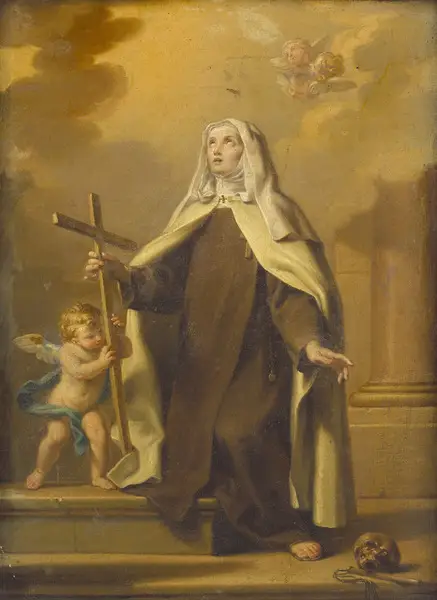
Cortona built its enduring monument to Margaret almost immediately. By 1330, from a design attributed to Giovanni Pisano, the citizens had raised the larger basilica of Santa Margherita, thirty metres long, subsuming the old church of St. Basil into its nave; near the third altar on the left stands the spot where Margaret died. In 1456 her body was exhumed and transferred to the basilica, where it was declared incorrupt and remains preserved to this day in a silver casket, drawing pilgrims to the hilltop shrine above the town. Artists have returned to her story repeatedly: Giovanni Lanfranco painted The Ecstasy of St Margaret of Cortona in 1622, now in the Palazzo Pitti, and Gaspare Traversi depicted her around 1758; a stained-glass window at the Highlanes Gallery in Ireland preserves her image. In illustrations of her life a dog often appears, the faithful hound that guided her through the forest to the murdered body of her lover and so, in the economy of grace, to sainthood. Her afterlife extends to letters and screens: Edith Wharton published a short story imagining her deathbed reflections in 1901, Licinio Refice made her the heroine of his 1938 opera Margherita da Cortona, and Mario Bonnard filmed her life in 1950 with Maria Frau in the title role.
§ In art
Timeline
- 1247
Born at Laviano, a village amid the hills of Castiglione del Lago, within the diocese of Chiusi, to farming parents.
§ Life
- 1277
After three years of probation, she was received into the Third Order of Saint Francis.
§ Life
- 1288
Sought out to broker reconciliation among local families divided by the Guelph and Ghibelline conflict.
§ Life
- 1288
Mediated between the citizens of Cortona and Guglielmino degli Ubertini, the Bishop of Arezzo, whom she twice rebuked in public.
§ Life
- 22 Feb 1297
Died at Cortona, not yet fifty years old; her body was laid in a wall of the chapel of St. Basil.
§ Life
- 1330
Cortona's citizens completed the larger basilica of Santa Margherita from a design by Giovanni Pisano.
§ Life
- 1456
Her body was exhumed, declared incorrupt, and housed in the basilica as an object of veneration.
§ Life
- 16 May 1728
Canonized by Pope Benedict XIII, more than four centuries after her death.
§ Life
In Their Own Words
What is your wish, poverella?
I neither seek nor wish for anything but You, my Lord Jesus.
The Record
- Major works
- Hospital for the sick, homeless, and impoverished at Cortona·Congregation of Tertiary Sisters, the poverelle, to nurse the hospital's patients and aid prisoners·Confraternity devoted to Our Lady of Mercy, supporting the hospital financially
- Patron of
- Reformed prostitutes·Falsely accused people·Homeless people·Orphans·Mentally ill people·Midwives·Single mothers·Penitents·Stepchildren·Single laywomen·The third child·People whose piety is ridiculed·People battling temptation, especially sexual
- Symbols
- Dog
- Canonization
- Acclaimed a saint immediately after her death; canonized 16 May 1728 by Pope Benedict XIII
Prayer
Bibliography
Show 6 sources
- Hess, Lawrence. "St. Margaret of Cortona." The Catholic Encyclopedia, Vol. 9. New York: Robert Appleton Company, 1910.
- Goodier S.J., Alban. "St. Margaret of Cortona - A Second Magdalene." Saints For Sinners. Sheed & Ward, Inc.
- Farmer, D. H. The Oxford Dictionary of Saints, 5th Edition Revised. Oxford University Press, Oxford, UK, 2011.
- Bell, Rudolph M. Holy Anorexia. University of Chicago Press, 1987, p. 95.
- Butler, Alban. The Lives or the Fathers, Martyrs and Other Principal Saints, Vol. II. D. & J. Sadlier, & Company, 1864.
- Foley OFM, Leonard. "St. Margaret of Cortona." Saint of the Day, Lives, Lessons, and Feast, revised by Pat McCloskey OFM, Franciscan Media.
Profile text adapted from the Wikipedia article, licensed CC BY-SA 4.0.
Pray with this saint every day
Save St. Margaret of Cortona to your favorites, read the full profile, and get feast-day reminders in the Saints app.
Get the Saints AppFree on the App Store for iPhone and iPad