
1242 – 1270·Feast January 18
St. Margaret of Hungary
Royal Dominican nun of the island in the Danube
Overview
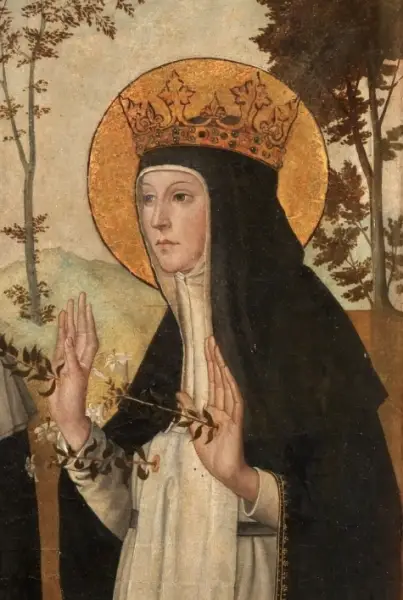
Margaret of Hungary was a Dominican nun, the daughter of King Béla IV of Hungary and Maria Laskarina, and a niece of St. Elizabeth of Hungary. She was born on 27 January 1242 in the fortress of Klis, where the royal family had taken refuge during the Mongol invasion of Hungary, and her parents vowed that if the kingdom were delivered they would dedicate the child to God. Entrusted at the age of three to the Dominican monastery at Veszprém, she was transferred some six years later to the Monastery of the Blessed Virgin on Nyulak Szigete, Rabbit Island near Buda, founded by her parents; the island bears her name today. There she spent her entire religious life, refusing every political marriage her father proposed, including alliance with King Ottokar II of Bohemia, and receiving the Consecration of Virgins to forestall attempts to have her vows dispensed. The Legend of Saint Margaret records severe penances from childhood, an iron girdle, hairshirts, spiked shoes, and the meanest work of the convent, austerity that may have hastened her death on 18 January 1270 at the age of twenty-seven. Venerated almost immediately, she was canonized by Pope Pius XII on 19 November 1943.
The Complete Life
A Birth in a Fortress
Margaret entered the world in the shadow of catastrophe. She was born on 27 January 1242 at the fortress of Klis, in the Kingdom of Croatia over which her father, Béla IV of Hungary, also ruled, where the royal family had fled before the Mongol armies that were ravaging Hungary in the first great invasion. She was the eighth and last daughter of the marriage of Béla and Maria Laskarina, the ninth of their ten children, born after an older sister of the same name who had died before her own birth. Through her father she was niece to Elizabeth of Hungary, the most celebrated royal saint of the century, and her elder sisters included Kinga and Yolanda of Poland, themselves later raised to the altars. Her birth in exile from her own burning kingdom became the occasion of her destiny: her parents vowed that if Hungary were freed from the Mongols, the child would be dedicated to religion. The kingdom recovered, and the vow was kept, giving the Hungarian royal house one more saint and the Church one of its most striking examples of renounced royalty.
§ Life
Given to God at Three
The fulfillment of her parents' vow began almost before Margaret could speak. At the age of three, in 1245, she was entrusted to the Dominican monastery at Veszprém, a child oblate in all but name. Some six years later she was moved to the Monastery of the Blessed Virgin on Nyulak Szigete, Rabbit Island in the Danube near Buda, a house her own parents had founded, and she remained there for the rest of her life. The island monastery became the entire world of the princess: today it is Margaret Island, part of Budapest and named for her, and the ruins of her convent can still be visited. Her family did not easily abandon the political uses of a royal daughter. Béla IV sought to arrange her marriage to King Ottokar II of Bohemia, and Margaret opposed every such attempt with the full stubbornness of her character. To make her consecration irreversible, she received the Consecration of Virgins — a marked departure from her Order's usual practice — together with other royals, so that no dispensation from the pope could free her vows for marriage. She appears to have taken solemn vows at about eighteen.
§ Life
Penance of a Princess
Most of what is known of Margaret's inner life comes from the Legend of Saint Margaret, a life probably written in the fourteenth century and translated from Latin into Hungarian in the fifteenth; its only surviving copy is the Margaret Codex, transcribed around 1510 by the Dominican nun Lea Ráskay. The legend portrays an asceticism extraordinary even by medieval standards. From early childhood Margaret chastised her body, wore an iron girdle beneath her habit and hairshirts against her skin, and walked in shoes spiked with nails. In a convent filled with the daughters of the nobility she insisted on the most menial work, taking the tasks that royal birth would have excused her from everywhere else in the kingdom. This severity was not mere morbidity but the shape of her vocation: a woman who had refused a crown needed some daily counterpart to that refusal, and she chose labor, discomfort, and self-denial. Modern readers have judged the extravagance of her penances likely to have shortened her life, and indeed she died at twenty-seven, having spent her whole conscious existence within monastery walls. Her austerity, joined to the prayer of her Dominican order, made the island monastery a place of renown long before her canonization.
§ Life
Death on Rabbit Island
Margaret died on 18 January 1270, a week before her twenty-eighth birthday, in the monastery that had been her home since childhood. The hagiographer's judgment was that the extravagance of her penances may have shortened her life, and the plainness of the record, a princess dead at twenty-seven in a cloister on an island in the Danube, captures both the heroism and the cost of her vocation. Her contemporaries did not hesitate about her sanctity: she was venerated as a saint almost immediately after her death, and her brother King Stephen V, who succeeded their father, took up the cause of her official recognition. Steps toward canonization were taken at once, and the necessary investigations were carried out between 1270 and 1276. Her intercession was credited with seventy-four miracles, most of them cures of illnesses, among them even a raising from the dead; twenty-seven people whose miracles had been wrought gave testimony. Yet the medieval process failed, and the princess of Rabbit Island would wait more than six centuries for the honors her first generation of devotees had assumed were certain.
§ Life
A Slow Road to the Altar
The failure of the thirteenth-century process did not end Margaret's cult. A church dedicated to her at Bocfolde in Zala County appears in documents of 1426, evidence of popular devotion spread far beyond her monastery. Unsuccessful attempts to canonize her were renewed in 1640 and again in 1770. She was beatified by Pope Pius VI on 28 July 1789 in Saint Peter's Basilica, and at last canonized by Pope Pius XII on 19 November 1943, a ceremony held in the darkest year of the Second World War and on the feast day of her aunt, St. Elizabeth of Hungary, whose royal sanctity hers so consciously repeated. Her feast, kept by the Dominican Order on the day of her death, 18 January, was raised by Pope Pius VII to the rank of festum duplex. The delay of nearly seven centuries between death and canonization is itself part of her story: the Hungarian royal house's vow, the child's own refusal of marriage, the seventy-four recorded miracles, and the patience of the Dominicans finally converged in the declaration of 1943. The wartime ceremony made her, fittingly, a saint for a Hungary in turmoil, as she had been a nun for a Hungary in invasion.
§ Veneration
An Island That Bears Her Name
Margaret's most visible monument is geography itself. Rabbit Island in the Danube, where she spent her life, is today Margaret Island, a park at the heart of Budapest, and the ruins of the Dominican monastery her parents founded still stand among the trees. Her body survived the centuries with difficulty: when Emperor Joseph II suppressed the monastic orders in 1782, her monastery was among those dissolved, and her remains passed to the Poor Clares, kept at Pozsony, today Bratislava, and at Buda. In 1789 portions of the relics were destroyed, but what survived was distributed to Esztergom, Győr, and Pannonhalma, where they remain. In art she appears in the Dominican habit, a white lily and a book in her hands, emblems of virginity and wisdom; a sixteenth-century carving by Diego de Robles keeps her memory in the Santo Domingo Convent in Quito, evidence of how far Dominican devotion to the royal penitent traveled. Modern scholarship has returned to her through the critical edition of her oldest legend, the acts of her canonization process, and her recorded miracles, published in Latin and English in 2018, making one of medieval Hungary's most documented saintly lives newly accessible.
§ Veneration
Timeline
- 27 Jan 1242
Born at Klis Fortress, where the royal family resided during the first Mongol invasion of Hungary.
§ Life
- 1242
Her parents vowed that, should Hungary be delivered from the Mongols, their child would be given over to religion.
§ Life
- 1245
The three-year-old Margaret was entrusted to the Dominican monastery at Veszprém.
§ Life
- 1251
Transferred to the Monastery of the Blessed Virgin on Nyulak Szigete near Buda, founded by her parents.
§ Life
- 18 Jan 1270
Died on Nyulak Szigete at the age of twenty-seven, her health perhaps broken by extravagant penances.
§ Life
- 1270
Her brother King Stephen V requested her canonization, and investigations gathered testimony through 1276.
§ Veneration
- 1426
Documents record a church dedicated to her at Bocfolde in Zala County.
§ Veneration
- 1510
The Dominican nun Lea Ráskay copied the Margaret Codex, the only surviving copy of her legend.
§ Life
- 1782
Her monastery was suppressed under Emperor Joseph II and her remains given to the Poor Clares.
§ Veneration
- 28 Jul 1789
Pope Pius VI beatified her in Saint Peter's Basilica in the Papal States.
§ Veneration
- 1789
Her relics were partly destroyed, though portions survived and are kept at Esztergom, Győr, and Pannonhalma.
§ Veneration
- 19 Nov 1943
Canonized by Pope Pius XII in Saint Peter's Basilica on the feast day of her aunt, St. Elizabeth of Hungary.
§ Veneration
The Record
- Symbols
- A lily and a book·Dominican nun's habit
- Canonization
- Beatified 28 July 1789 by Pope Pius VI; canonized 19 November 1943 by Pope Pius XII
Prayer
Bibliography
Show 4 sources
- Aldásy, Antal. "Bl. Margaret of Hungary." The Catholic Encyclopedia, Vol. 9. New York: Robert Appleton Company, 1910.
- Duffy, Patrick. "Jan 18 - St Margaret of Hungary (1242-70)." Catholic Ireland, January 18, 2012.
- Attwater, Donald and Catherine Rachel John. The Penguin Dictionary of Saints, 3rd edition. New York: Penguin Books, 1993.
- Csepregi, Ildikó; Klaniczay, Gábor; Péterfi, Bence; Flanigan, C. Clifford; Perraud, Louis (eds.). Legenda vetus, acta processus canonizationis et miracula sanctae Margaritae de Hungaria. Budapest: CEU Press, 2018.
Profile text adapted from the Wikipedia article, licensed CC BY-SA 4.0.
Pray with this saint every day
Save St. Margaret of Hungary to your favorites, read the full profile, and get feast-day reminders in the Saints app.
Get the Saints AppFree on the App Store for iPhone and iPad