
c. 1045 – 1093·Feast November 16
St. Margaret of Scotland
Queen of the Scots and reformer of the church
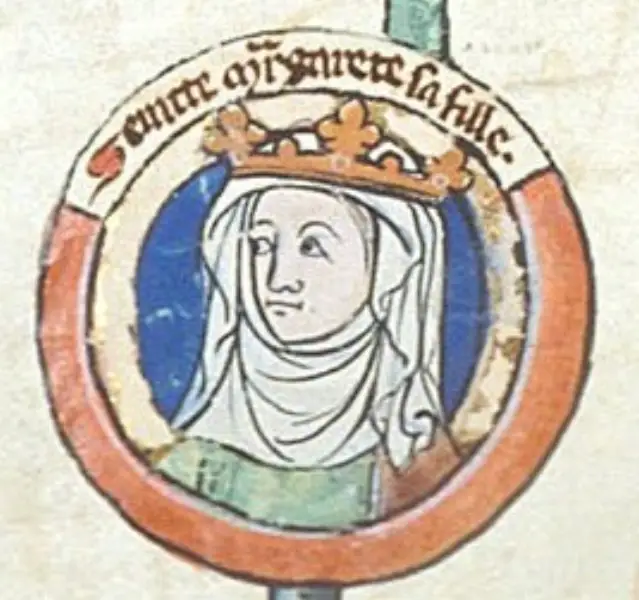
Overview
Margaret of Scotland, sometimes called the Pearl of Scotland, was born in Hungary around 1045 into the exiled English royal house of Wessex, daughter of Prince Edward the Exile and granddaughter of King Edmund Ironside. Recalled to England with her family in 1057 as heirs to the childless Edward the Confessor, she saw her hopes overturned by the Norman Conquest, and in 1068 she fled north by ship to the kingdom of Scotland, where King Malcolm III gave the refugees shelter. The two were married in 1070, and Margaret became queen of Alba as the wife of a warrior king and mother of eight children, three of whom would reign in Scotland and one of whom, Matilda, would be queen consort of England. Her reign was marked by intense personal piety and by reform: guided by Lanfranc and recorded by her friend Turgot of Durham, she reshaped Scottish church observance toward continental practice, invited the Benedictines to Dunfermline, founded pilgrim ferries across the Firth of Forth, restored Iona Abbey, and served the poor daily with her own hands. In November 1093 her husband and eldest son were killed at the Battle of Alnwick; Margaret, not yet fifty, died in Edinburgh Castle three days later, reportedly of grief. Canonized by Pope Innocent IV in 1250, she remains the patroness of Scotland, of queens, and of widows.
The Complete Life
An Exile Born to Royalty
Margaret's life began far from the kingdom she would one day sanctify. Her father was Edward the Exile, an English prince, and her mother was called Agatha; through him she descended from Edmund Ironside, who had ruled England, whose death in 1016 had ended the old English line's hold on the throne. Canute had shipped the boy Edward and his brother overseas, first to the court of Olof Skötkonung in Sweden, and from there they had drifted eastward toward Kievan Rus'; as an adult Edward made his way to Hungary, where in 1046 he helped Andrew I win the Hungarian crown. Margaret first saw the light there around 1045; Edgar Ætheling and Cristina followed at short intervals. Piety saturated the Hungarian court in which she spent her girlhood, and there she absorbed the Roman liturgical practice that would later mark her reforming work in Scotland. The origins of her mother Agatha remain disputed among historians. In 1057 the family's fortunes shifted: the childless King Edward the Confessor summoned Edward the Exile back to England as a possible heir. Margaret came with the family, but her father was dead almost before he set foot ashore, and no one could say whether nature or treachery had taken him. The children remained at the English court, with young Edgar now regarded as a possible heir to the throne.
§ Early life
Storm, Shipwreck, and a Crown
The Norman Conquest swept away whatever future the family might have had in England. January 1066 brought the Confessor's death, and the crown passed to Harold Godwinson, the boy Edgar being judged too young for the throne. Hastings followed before the year was out; Harold fell, Edgar was raised up as King of England in his stead, and when Norman troops closed on London the assembly of the wise men handed the boy over to William the Conqueror. In 1068 Edgar, Margaret, Cristina, and their mother fled north to Northumbria. Tradition holds that the widowed Agatha resolved to take her children back to the continent, but a tempest carried their vessel out of its course and drove it onto the coast of the Scottish kingdom in 1068. King Malcolm III received the shipwrecked fugitives, and the place where they are believed to have come ashore is still known as St Margaret's Hope. The story of Margaret's arrival has been heavily romanticized, and its earlier chapters are debated: Orderic Vitalis even reports that as early as 1059 Malcolm journeyed to the Confessor's court to negotiate for the hand of Edward's kinswoman Margaret, a compact that, if it was ever concluded, never took effect, while Symeon of Durham implies the couple first met only in 1070. Whatever the truth, Malcolm, a widower drawn to one of the last daughters of the House of Wessex, married Margaret in 1070, and the Saxon exile became Queen of Alba. Eight children followed, including three future kings of Scotland.
§ Journey to Scotland
Reforming the Church of the Scots
As queen, Margaret set about bringing the worship and practice of the Scottish church into line with the continental Christianity she had known in her childhood, working under the inspiration and guidance of Lanfranc, the future archbishop of Canterbury. The chroniclers credit her with reforms that measurably changed Scottish religious life: henceforth Lent would open on Ash Wednesday, in the universal manner, and no longer on the Monday after, and the ancient habit of resting from labor on the Sabbath rather than on the Lord's Day was abolished. Turgot of Durham, her friend and spiritual adviser, credited her as well with a civilizing influence on her husband, whom she instructed by reading him narratives from the Bible. Her works of charity and foundation were equally concrete. Dunfermline received a Benedictine house at her invitation in 1072, Iona Abbey owed its restoration to her prompting, and for pilgrims crossing from south of the Firth of Forth toward St Andrews in Fife she provided boat passages at Queensferry and North Berwick; the towns of South Queensferry and North Queensferry still bear the names her ferry gave them. She interceded for English exiles reduced to serfdom after the Norman conquest and won their release. Because of such achievements she was regarded as an exemplar of the just ruler, and her example shaped her husband and, above all, her youngest son, the future King David I.
§ Piety
The Queen at Prayer
Margaret's public reforms flowed from a private discipline of unusual rigor. Each day she waited on orphans and beggars before touching her own food, and she performed for the destitute the humble ablution that Christ had performed for his disciples. Every night at midnight she left her bed for the offices of the night, keeping a vigil that would have exhausted courtiers half her age. At Dunfermline she retreated for prayer to a cave in the bank of the Tower Burn; that hiding place, known as St Margaret's Cave and now covered beneath a municipal car park, remains open to the public. Her piety filled the quieter hours of a queen's day with prayer, the reading of holy books, and needlework for the church. Her husband, portrayed by some writers as illiterate, was so struck by her devotion that he commissioned covers of gold and silver for her books; one of these, a pocket gospel book bearing portraits of the Evangelists, survives in the Bodleian Library at Oxford. Turgot of Durham, bishop of St Andrews, who came to know the Scottish court closely, depicted her as a character of strength, purity, and nobility whose faith was heartfelt, ardent, and shaped by the newest Roman observance, and whose influence over Malcolm carried deep into Scottish ecclesiastical history. Malcolm himself was not especially religious, yet he let her carry out every reform she wished, proof of how deep the affection between them ran.
§ Piety
Grief at Edinburgh Castle
The end of Margaret's life came with the wars that had marked its beginning. On 13 November 1093 her husband, Malcolm III, and their eldest son, Edward, were killed at the Battle of Alnwick, fighting against Robert de Mowbray, the Norman Earl of Northumbria. Her son Edgar was left with the devastating duty of carrying the news to his mother. Margaret was then at Edinburgh Castle, and she was not yet fifty years old. She received the report of the double death and did not recover from it: three days later, on 16 November 1093, she died, and the cause was reportedly grief itself. Contemporaries understood her passing as the fitting close of a life that had bound her heart to both the royal family she had raised and the church she had reformed; the queen who had interceded for exiles, served the poor daily, and held a storm-tossed family together died as she had lived, in a spirit of sacrifice. She was buried before the high altar of Dunfermline Abbey in Fife, the monastic house she herself had brought to Scotland, beside the king whose wars had taken him from her. Within little more than a decade three of her sons would reign in Scotland in succession, and her daughter Matilda would be queen of England, extending her influence into the next generation.
§ Death
Canonization and the Wandering Relics
Devotion to Margaret grew quickly at Dunfermline, where monks wrote down the literature attesting to her miraculous intercession. In 1250 Pope Innocent IV canonized her, moved by her holiness of life, her loyalty to the Roman faith, her reforming labor, and her almsgiving. On 19 June of that year her remains were translated to a chapel in the eastern apse of Dunfermline Abbey. The centuries that followed scattered what the translation had enshrined. Amid the Scottish Reformation and rising iconoclasm, Abbot George Durie spirited the remains of Margaret and Malcolm out of Dunfermline and concealed them on his country estate at Craigluscar. In 1560 Mary, Queen of Scots, claimed the martyr's head for Edinburgh Castle, trusting it would protect her through childbirth; in 1597 the head reached the Jesuits of the Scots College at Douai in France, and vanished amid the upheavals of the French Revolution. By 1580 Philip II of Spain had arranged for the other remains of Margaret and Malcolm to be transferred to the royal monastery of El Escorial near Madrid, though their present location has not been discovered. Her feast day itself has wandered: Innocent XII moved it to 10 June in 1693, traditionalists kept that date, and the 1969 reform of the General Roman Calendar returned it to 16 November, the day of her death.
§ Canonisation, feast day and patronages
The Pearl of Scotland Remembered
Few medieval queens left so broad a mark on their adopted country. Margaret is honored today by Orthodox, Catholic, Anglican, and Scottish Episcopal faithful alike, who keep her memory on 16 November, and she stands as patroness of Scotland, of queens, and of widows. The 1916 Roman Martyrology authorized by Cardinal Gibbons remembered her chiefly for her tenderness toward the poor and her own chosen poverty. Her son David I founded St Margaret's Chapel in Edinburgh Castle, long thought to have been her own oratory and now understood as a twelfth-century foundation; it is the oldest edifice in Edinburgh and was restored in the nineteenth century and refurbished in the 1990s. Churches throughout the world bear her name, as do schools and Queen Margaret University in Scotland, and her story has drawn continuous scholarly attention, from Turgot's twelfth-century vita to modern studies of her cult and miracles. The places of her life remain part of her shrine: the landing place called St Margaret's Hope, the ferry towns of the Forth, her prayer cave at Dunfermline, and the ruined shrine at the abbey where she and Malcolm lay. For Scotland she remains what her medieval title proclaimed, the pearl set at the heart of the nation's Christian memory.
§ Veneration
Timeline
- 1045
Born into the exiled English house of Wessex at the Hungarian court, where her father Edward the Exile then lived.
§ Early life
- 1057
Came to England when her father was recalled as heir to the childless Edward the Confessor; he died just after landing.
§ Return to England
- 1059
Orderic Vitalis records Malcolm III travelling to Edward the Confessor's court to arrange a marriage with Margaret.
§ Journey to Scotland
- Jan 1066
Edward the Confessor died and Harold Godwinson was chosen king, her brother Edgar being judged too young.
§ Return to England
- 1066
After Harold's defeat at the Battle of Hastings, her brother Edgar was proclaimed King of England but never crowned.
§ Return to England
- 1068
Fled north with her family; a storm drove their ship to Scotland, where King Malcolm III gave the shipwrecked family refuge.
§ Journey to Scotland
- 1070
Married King Malcolm III of Scotland and became Queen of Alba.
§ Journey to Scotland
- 1072
Invited the Benedictine Order to establish a monastery at Dunfermline in Fife.
§ Piety
- 13 Nov 1093
Her husband Malcolm and eldest son Edward were killed at the Battle of Alnwick against Robert de Mowbray.
§ Death
- 16 Nov 1093
Died at Edinburgh Castle, three days after receiving news of the deaths, reportedly of grief; buried at Dunfermline Abbey.
§ Death
- 1100
Between this year and 1107, Turgot of Durham wrote her vita at the request of her daughter Matilda, queen of England.
§ Piety
- 1250
Canonized by Pope Innocent IV in recognition of her holiness, fidelity, reform of the church, and charity.
§ Canonisation, feast day and patronages
- 19 Jun 1250
Her body was translated to a chapel in the abbey's eastern apse at Dunfermline.
§ Canonisation, feast day and patronages
- 1560
Mary, Queen of Scots, claimed the saint's head for Edinburgh Castle, hoping it would see her safely through childbirth.
§ Canonisation, feast day and patronages
- 1580
Philip II of Spain had her remaining relics, with those of Malcolm, moved to the royal monastery of El Escorial near Madrid.
§ Canonisation, feast day and patronages
- 1597
Her head came to the Jesuits at the Scots College in Douai, France; it was lost during the French Revolution.
§ Canonisation, feast day and patronages
- 1693
Pope Innocent XII moved her feast to 10 June, honoring the birth of James Francis Edward Stuart.
§ Canonisation, feast day and patronages
- 1969
The reformed General Roman Calendar returned her observance to 16 November, the anniversary of her death.
§ Canonisation, feast day and patronages
In Their Own Words
Saint Margaret, who was born in Hungary and married to Malcolm the Great, King of Scotland, gave birth to eight sons and was greatly concerned about the good of the kingdom and the Church, combining prayer and fasting with generosity towards the poor, thus providing an example of an excellent wife, mother and queen.
The Record
- Major works
- Reform of Scottish church observance toward continental practice·Benedictine monastery at Dunfermline (invited 1072)·Pilgrim ferries at Queensferry and North Berwick·Restoration of Iona Abbey·Vita S. Margaritae (Scotorum) Reginae by Turgot of Durham, written about her
- Patron of
- patroness of Scotland·patroness of queens·patroness of widows
- Symbols
- royal crown and gospel book·queen giving alms to the poor
- Canonization
- Canonized by Pope Innocent IV in 1250; remains translated to Dunfermline Abbey on 19 June 1250
Prayer
Bibliography
Show 6 sources
- Duncan, A.A.M., The Kingship of the Scots 842–1292: Succession and Independence. Edinburgh University Press, Edinburgh, 2002. ISBN 0-7486-1626-8
- Keene, Catherine (2013). Saint Margaret, Queen of the Scots: A Life in Perspective. Springer. ISBN 978-1-137-03564-6.
- Farmer, David Hugh (1997). The Oxford Dictionary of Saints (4th ed.). Oxford University Press. ISBN 978-0-19-280058-9.
- Lee, Sangdong (2018). "The Miracles and Cult of St Margaret of Scotland". The Scottish Historical Review. 97 (1 (244)): 1–11. ISSN 0036-9241.
- Turgot of Durham, Vita S. Margaritae (Scotorum) Reginae.
- Ritchie, R. L. Graeme, The Normans in Scotland, Edinburgh University Press, 1954
Profile text adapted from the Wikipedia article, licensed CC BY-SA 4.0.
Pray with this saint every day
Save St. Margaret of Scotland to your favorites, read the full profile, and get feast-day reminders in the Saints app.
Get the Saints AppFree on the App Store for iPhone and iPad