
c. 289 – c. 304·Feast July 20
St. Margaret the Virgin
Virgin-martyr of Antioch who vanquished the dragon
Overview
Margaret, honored in the East as Saint Marina the Great Martyr and in the West as Margaret of Antioch, was a young virgin put to death at Antioch in Pisidia during the persecutions of Diocletian, around the year 304. Her story, preserved in a ninth-century martyrology of Rabanus Maurus, tells of a daughter of the pagan priest Aedesius whose mother died soon after her birth, she was nursed by a Christian woman in the countryside, she embraced the faith, consecrated her virginity to God, and was disowned by her father. When Olybrius, governor of the Roman Diocese of the East, demanded her hand together with her apostasy, she refused, and was tortured and finally beheaded. In the legend that carried her name across Europe, a dragon, in which Satan had clothed himself, swallowed her; she walked out alive when the cross in her hands rent the beast apart. However doubtful historians judge the narrative — medieval scholars already questioned it — her cult spread from Pisidia through England, France, and Germany, numbering her among the Fourteen Holy Helpers and dedicating more than 250 English churches to her. She is invoked by pregnant women, nurses, peasants, exiles, the dying, and those suffering kidney disease.
The Complete Life
A Priest's Daughter Nursed in the Faith
The account of Margaret's origins comes chiefly through a ninth-century martyrology compiled by Rabanus Maurus, which places her at Antioch in Pisidia, a city in what is now Turkey. She was born around the year 289, the daughter of Aedesius, a priest of the pagan religion. Her mother died soon after giving birth, and the infant was sent some distance from the city — a matter of about fifteen to eighteen miles — to be nursed by a Christian woman. In that rural household the child encountered a faith foreign to her father's, and she received it as her own. When Aedesius learned what had become of his daughter, he disowned her; her nurse adopted her, and Margaret was raised in the countryside, tending sheep beside her foster mother. The picture is of a shepherdess on the hills above Pisidian Antioch: a girl cut off from her birth family by her Christianity, yet unburdened by it, consecrating her virginity to God while flocks grazed around her. Western art would long remember her in precisely this guise, staff in hand among the fields, before remembering her triumph.
§ Hagiography
The Refusal Before Olybrius
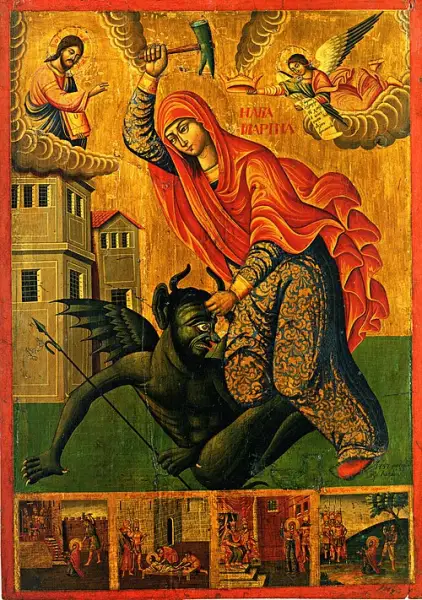
Margaret's consecration to Christ was tested when Olybrius, governor of the Roman Diocese of the East, took notice of her and asked to marry her. His proposal carried a condition: she must renounce Christianity. Her answer defined the rest of her life. She refused, holding together the two gifts she would not surrender — her faith and her virginity — against the combined promise of a advantageous marriage and the threat that followed its refusal. The governor's response was torture, applied with cruelty and described in the tradition as prolonged. Out of that passion the legend grew rich with marvels, most famously the episode in which Satan, taking on the form of a dragon, swallowed her alive; she came forth unharmed because the cross she held tormented the creature's bowels. Eastern iconography preserves another episode of her torment, in which she wrestled a demon in her cell, seized him by the hair, and beat him with a copper hammer. Whatever form the attacks took, the outcome the tradition records is the same: her body could be broken, but not her confession, and the sentence passed upon her was death.
§ Hagiography
Martyrdom at Antioch
Margaret's trial ended at the block. Around 304, in the course of the empire-wide persecution launched under Diocletian, she was decapitated at Antioch in Pisidia, still in her mid-teens — her age at death is given as about fifteen, the same age at which, in other lives of saints, trials were only beginning. The tradition adds that she had pledged rich indulgences to all who copied or perused her story or sought her prayers, a feature of her legend that undoubtedly accelerated the spread of her following in later centuries. Historians have long weighed the story skeptically: the Encyclopædia Britannica judges her tale generally fictitious, the Catholic Encyclopedia concedes that even her century is uncertain, and Jacobus de Voragine himself, the great medieval compiler of the Golden Legend, dismissed the dragon episode as legend rather than history. Yet doubt never dislodged her from the memory of the Church. A martyr named Margaret or Marina, who chose death over apostasy and dishonor at Antioch in Pisidia, remained fixed in the martyrologies of East and West alike, her execution remembered as the seal of a wholly surrendered life.
§ Hagiography
A Cult Carried West
Margaret was never the subject of a formal canonization; as a martyr of the early Church she was venerated from antiquity, and she stands today in the Roman Martyrology for 20 July. Her cult traveled from its Pisidian home in ways the sources only sketch. The distinction between Antioch in Pisidia and Antioch of Syria, preserved in the Greek tradition of Marina, was lost in the West, where she became Margaret of Antioch. From the East her veneration spread toward England, France, and Germany during the eleventh century, carried in the wake of the Crusades. In 1222 the Council of Oxford enrolled her among the feasts of the English Church, and her popularity flourished: thirteenth-century England told her story in Anglo-Norman, English, and Latin — one version ascribed to Nicholas Bozon — and more than 250 English churches came to bear her dedication, chief among them St. Margaret's, Westminster, the parish church of the Houses of Parliament. Later centuries adjusted her rank: included for some eight hundred years in the general calendar of the Roman Rite, she was removed from it in 1969 by the apostolic letter Mysterii Paschalis, while the Orthodox Churches continue to keep her feast as Marina on 17 July.
§ Veneration
The Saint of the Dragon
Few early martyrs have left so deep a mark on the Christian imagination. Margaret is numbered among the Fourteen Holy Helpers of Roman Catholic tradition, the company of saints invoked against particular evils, and her patronage embraces pregnant women, nurses, servant maids, peasants, exiles, the falsely accused, the dying, and sufferers of kidney disease, together with deliverance from diabolical infestation. In art she appears as a shepherdess, or standing above and escaping from the dragon; the Western painter's version shows her emerging from the beast's belly, while Byzantine iconography shows her hammer in hand, gripping the demon by the hair. Raphael, Titian, Zurbarán, and Jean Fouquet all painted her; her image stands on the coat of arms of Vehmaa and in the glass and stone of Chartres and Burgos. Her relics live on in the East: the Church of Saint Mary in Cairo preserves a hand believed to be hers, carried there from the church of Angel Michael after that building's destruction in the thirteenth century. The Coptic Orthodox Church celebrates her martyrdom on Epip 23 and the dedication of her church on Hathor 23, and in 2022 the Episcopal Church restored her to its calendar on 24 November, sharing the day with Catherine of Alexandria and Barbara of Nicomedia.
§ Patronage
Timeline
- 289
Born at Antioch of Pisidia, daughter of the pagan priest Aedesius.
§ Hagiography
- 304
Tortured and beheaded at Antioch in Pisidia after refusing Governor Olybrius, during the Diocletianic Persecution.
§ Hagiography
- 1222
The Council of Oxford enrolled her among the Church's feast days, and her cult spread through England.
§ Veneration
- 24 Nov 2022
Officially added to the Episcopal Church liturgical calendar, sharing a feast with Catherine of Alexandria and Barbara of Nicomedia.
§ Feast day
The Record
- Patron of
- pregnant women·nurses·servant maids·peasants·exiles·the falsely accused·the dying·against kidney disease·against diabolical infestations
- Symbols
- slaying a dragon·hammer and defeated demon·shepherdess's crook
- Canonization
- Pre-congregation martyr; listed in the Roman Martyrology for 20 July
Prayer
Bibliography
Show 8 sources
- "Margaret of Antioch". The Oxford Dictionary of Saints. David Hugh Farmer. Oxford University Press, 2003.
- MacRory, Joseph. "St. Margaret." The Catholic Encyclopedia, Vol. 9. New York: Robert Appleton Company, 1910.
- Delehaye, Hippolyte (1911). "Margaret, St". Encyclopædia Britannica. 17 (11th ed.). p. 700.
- de Voragine, Jacobus (1993). The Golden Legend: Readings on the Saints. Vol. 1. Translated by Ryan, William Granger. Princeton UP. pp. 368–70.
- "St. Margaret's, Westminster Parish details". Westminster Abbey. Archived from the original on 5 March 2008.
- Martyrologium Romanum (Libreria Editrice Vaticana, 2001)
- Calendarium Romanum (Libreria Editrice Vaticana, 1969), p. 130
- "The Calendar". The Church of England.
Profile text adapted from the Wikipedia article, licensed CC BY-SA 4.0.
Pray with this saint every day
Save St. Margaret the Virgin to your favorites, read the full profile, and get feast-day reminders in the Saints app.
Get the Saints AppFree on the App Store for iPhone and iPad