
c. 1550 – 1588·Feast August 30
St. Margaret Ward
Pearl of Tyburn, martyr who freed a hunted priest
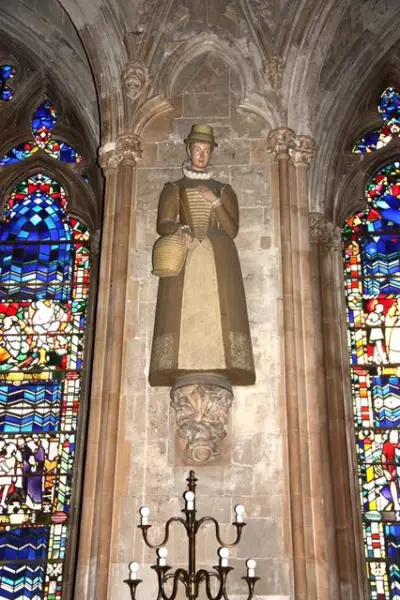
Overview
Margaret Ward, called the pearl of Tyburn, was an English Catholic martyr executed in the reign of Elizabeth I for helping a priest escape from prison. Born around 1550 in Congleton, Cheshire, to a good family, she went to London and served as housekeeper or companion in the household of a lady of distinction named Whitall. There she learned of William Watson, a priest confined in the Bridewell prison, and resolved to free him. She befriended the gaoler's wife, carried food to the prisoner, and smuggled in a rope; two Catholic watermen waited on the Thames below the prison walls and rowed Watson to safety after his desperate descent left him with a broken arm and leg. The rope left hanging from the prison wall was traced to her, and she was arrested, tortured by hanging from her wrists and beaten over eight days, and tried for aiding a traitor's escape. Offered her life in return for asking the queen's pardon and conforming to the established Church, she refused, and was hanged at Tyburn on 30 August 1588 alongside John Roche, who had exchanged clothes with the fugitive priest. Her canonization came in 1970, when she was ranked among the Forty Martyrs of England and Wales; she is commemorated on 30 August.
The Complete Life
A Gentlewoman of Cheshire
Margaret Ward was born around 1550 in Congleton, a town in Cheshire in the northwest of England. Beyond the place and approximate date, little is recorded of her beginnings. The Catholic Encyclopedia records that she came of a good family, and contemporary description gives her the standing of a gentlewoman. The hagiographer Alban Butler places her among the victims of the renewed persecution of Catholics that marked the reign of Elizabeth I, a period in which the old faith survived at the price of fines, imprisonment, and sometimes death. At some point she made her way to London, where she entered the household of a lady of standing named Whitall, serving her as housekeeper and companion. Her life to that point was ordinary and respectable; what raised it into history was the decision, taken in that London household, to involve herself in the perilous underground that sustained the outlawed Catholic priesthood in Elizabethan England. Congleton itself was a market town of modest size, and nothing in her upbringing suggested the daring that would one day make her name known across the Catholic world.
§ Life
The Escape from Bridewell
The exploit for which Margaret Ward is remembered was the rescue of William Watson, a priest held in the Bridewell prison in London, a man who would later be executed for treason; Butler observed that Ward's story is largely bound up with his. She set about the rescue with patience and daring. She cultivated the friendship of the gaoler's wife, which gave her access to the prisoner; she carried food to Watson to keep him alive; and she smuggled in a length of rope, hidden against discovery. She then arranged for two Catholic watermen to wait in a boat on the Thames beneath the prison walls. Watson climbed down the rope, breaking an arm and a leg in the descent, but the watermen reached him and rowed him to a safe hiding place. The escape succeeded, yet its instrument betrayed its authors: the rope was left hanging from the prison wall, and when it was traced back to Margaret Ward, she found herself arrested, charged, and prosecuted for helping a traitor to slip away. John Roche — perhaps her servant, perhaps one of the watermen who ferried Watson along the river, having swapped garments with the fugitive — was seized and stood trial at her side.
§ Life
Torture and Tyburn
Margaret Ward paid for her mercy in her own body before she paid for it with her life. Under torture her tormentors flogged her and strung her up by the wrists, her toes alone brushing the ground, beaten across eight days until she was crippled and paralyzed; the Jesuit Robert Southwell, himself a martyr, wrote that these sufferings only strengthened her for her last struggle. At trial, an escape was offered: she and Roche might walk free if they would petition for the queen's pardon and consent to conforming with the established Church. Both refused. Conformity would have purchased life at the cost of the conscience for which they had already suffered, and they would not make the exchange. On 30 August 1588, Margaret Ward was hanged at Tyburn, the execution ground that gave her the title by which Catholics have remembered her, the pearl of Tyburn. She died in the company of John Roche, who mounted the gallows with her for his part in the same act of charity. Her death came four years after the law had made harbouring priests a capital matter, at the height of the nation's fear of invasion and conspiracy.
§ Life
From Tyburn to the Altar
Margaret Ward was never canonized by any process of the medieval kind; her cause belongs to the modern recognition of the English martyrs. She and John Roche were beatified together in a large group by Pope Pius XI on 15 December 1929, when Rome raised scores of the Elizabethan and Stuart martyrs to the altars. On 25 October 1970 Pope Paul VI canonized her as one of the Forty Martyrs of England and Wales, the selection of men and women from the centuries of persecution chosen to represent the whole company of English Catholic witness. Her feast is kept on 30 August, the anniversary of her execution, by both the Roman Catholic Church and the Episcopal Church, which added her to its own calendar of lesser feasts alongside her fellow martyrs Anne Line and Margaret Clitherow. In the Church of England's memory as in Rome's, she stands as a representative of the laywomen whose quiet daring sustained the forbidden priesthood, remembered not for writings or foundations but for a single act of rescue carried through to the gallows. Her recognition rests not on a single verdict of Rome alone but on centuries of uninterrupted remembrance.
§ Veneration
Memory in the North West
Margaret Ward's memory lives chiefly in the part of England where she was born. In the Diocese of Shrewsbury she is depicted in stained or painted panels in St Joseph's Church in Sale and St Alban's Church in Wallasey, and for years a wooden statue of her stood in St Lawrence's Church in Birkenhead. Both a school and a church in Sale are named for her, and another church in Holmes Chapel carries her dedication in Cheshire's Catholic landscape. In Tunstall, Staffordshire, the St Margaret Ward Catholic Academy keeps her name at the head of a whole school community, teaching her story to generations of Catholic children in the region. Her emblems, a basket and a rope, recall the homely instruments of her crime: the household goods and the cord by which a gentlewoman outwitted a prison. She is one of the trio of women martyrs, with Anne Line and Margaret Ward's companion Margaret Clitherow, whose common feast on 30 August gathers the laywomen of the English persecution into a single commemoration, and whose witness has been taken up by Anglican as well as Catholic churches.
§ Veneration
Timeline
- 1550
Margaret Ward was born in Congleton, Cheshire, around this year, into a family of good standing.
§ Life
- 30 Aug 1588
Refusing to ask the queen's pardon or conform to the established Church, she was hanged at Tyburn with John Roche.
§ Life
- 15 Dec 1929
Margaret Ward and John Roche were beatified by Pope Pius XI in a large group of English martyrs.
§ Veneration
- 25 Oct 1970
Pope Paul VI canonized her among the Forty Martyrs of England and Wales.
§ Veneration
In Their Own Words
She was flogged and hung up by the wrists, the tips of her toes only touching the ground, for so long a time that she was crippled and paralyzed, but these sufferings greatly strengthened the glorious martyr for her last struggle.
Her story is largely part of Watson's.
The Record
- Symbols
- Basket·Rope
- Canonization
- Beatified 15 December 1929 by Pope Pius XI; canonized 25 October 1970 by Pope Paul VI among the Forty Martyrs of England and Wales
Prayer
Bibliography
Show 4 sources
- Burton, Edwin. "St. Margaret Ward." The Catholic Encyclopedia, Vol. 15. New York: Robert Appleton Company, 1912.
- Butler, Alban; Burns, Paul. Butler's Lives of the Saints. Collegeville, Minnesota: Liturgical Press, 2003, p. 405.
- Martin, Patrick H. Elizabethan Espionage: Plotters and Spies in the Struggle between Catholicism and the Crown. Jefferson, North Carolina: McFarland, Incorporated, 2016.
- "St Margaret Ward, August 30th." Diocese of Shrewsbury. Retrieved 15 September 2023.
Profile text adapted from the Wikipedia article, licensed CC BY-SA 4.0.
Pray with this saint every day
Save St. Margaret Ward to your favorites, read the full profile, and get feast-day reminders in the Saints app.
Get the Saints AppFree on the App Store for iPhone and iPad