
1815 – 1879·Feast June 27
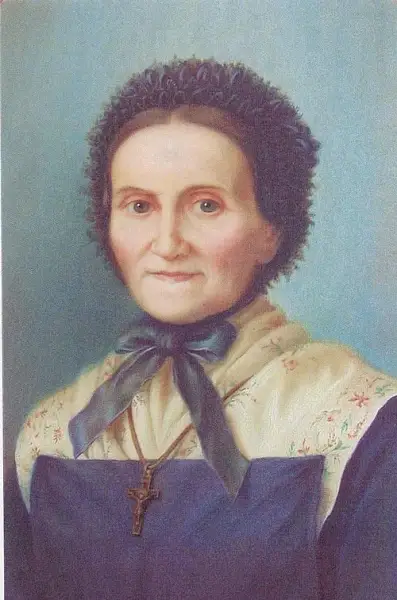
St. Marguerite Bays
Swiss seamstress and stigmatic of Fribourg
Overview
Marguerite Bays was a Swiss seamstress and mystic who lived her whole life as a laywoman in the Secular Franciscan Order, translating its charism into the quiet economy of a farm household in the canton of Fribourg. Born at La Pierraz on 8 September 1815, the second of seven children of farming parents, she showed early a taste for contemplation, keeping a small altar to the Virgin Mary in her room and choosing solitude and prayer over the games of her schoolmates. She declined every invitation to enter a religious institute, preferring to consecrate her virginity while remaining in the world. From her home she served the poor of the district, carrying them milk and bread, washing and mending their clothes, and teaching catechism to their children, while walking twenty minutes to Mass at Siviriez and lingering for Eucharistic adoration. Bowel cancer struck her in 1853, and she pleaded with the Mother of God for relief; on 8 December 1854, the very day Pius IX defined the dogma of the Immaculate Conception, she realized she was cured, and took this deliverance as a summons to greater service. Around the same period the wounds of Christ's passion appeared on her hands, feet, and chest — the stigmata that made her known far beyond her valley. She bore them, with weekly ecstatic sufferings, until her death at Siviriez on 27 June 1879. Pope Francis canonized her on 13 October 2019.
The Complete Life
A Farmer's Daughter at La Pierraz
Marguerite Bays was born on 8 September 1815 in the Fribourg hamlet of La Pierraz, belonging to Chavannes-les-Forts, as the second of seven children of Pierre-Antoine Bays and Josephine Morel, farming people and devout Christians. Her siblings were Jean, Marie-Marguerite — called Mariette — Joseph, Blaise, who died at twelve, Seraphine, the last-born, and Claude. At school in Chavannes-les-Forts she showed marked intelligence, but what distinguished her more was her bent toward reflection: she gradually withdrew from her classmates' company in favor of solitary conversation with God. Confirmation came in 1823 and First Communion in 1826, and with them the shape of her inner life was fixed. In her own room she built a small altar bearing flowers and a statue of the Blessed Virgin, and each morning she asked the Mother of God's intercession there before going out to the farm's duties. In her free hours she told the children of the neighborhood the story of Christ's life. Family life itself demanded maturity: her sister's marriage dissolved, her brother Joseph served a prison sentence for his violent temper, and her brother Claude fathered a child, François, out of wedlock — a boy whom Marguerite, at seventeen, took in hand to rear and educate.
§ Childhood and education
A Virgin in the World
Those around her expected Marguerite to become a sister; she declined. She had no wish to flee the world but to be consecrated within it, living a virginal and austere life for Jesus Christ amid the farm work and household duties that could not be set aside. The decision found its instrument when her service of the poor led her to the Secular Franciscan Order, whose charism she took as the rule of her life in the world. Its pattern shaped her days: labor done for God, poverty honored rather than resented, and a social apostolate carried on without office or title. Every habit of her life testified to it. She walked twenty minutes to Mass at the neighboring village of Siviriez whenever the Eucharist was celebrated, and remained afterward for Eucharistic adoration; she went on pilgrimage to the Marian shrines of the region; she taught catechism to children and visited the sick in their homes. Advisers and relatives urged the cloister on her; she answered them by living the counsels where she was. It was the vocation of a working woman who understood that holiness does not require a habit — only a heart given wholly, tested in the repetition of daily duties.
§ Childhood and education
Service of the Poor and the Hidden Cross
During Marguerite's adolescence, the mechanization of agriculture threw peasant farmers out of work across her district, and the poor of the region grew in number and need. Her response was direct and bodily: she carried milk and bread to destitute households, washed and mended their clothing, and sometimes provided new garments from her needle. Her charity was not confined to strangers. Her sister-in-law Josette, who had married her brother Claude and who took pleasure in humiliating her, fell ill in due course, and Marguerite nursed her to the end of her life without a word of resentment. In 1853 her own body became the site of her hardest service: dizziness, acute stomach pain, and nausea announced the bowel cancer that she tried at first to conceal even from her family, refusing medicine until the disease forced a diagnosis that ruled out surgery. She begged the Mother of God to heal her — and asked in the same breath that, if healing were withheld, her pain be joined to the suffering of Christ, for she regarded the illness as the cross assigned to her. On 8 December 1854, as Pius IX promulgated the dogma of the Immaculate Conception, she discovered her illness gone and read the event as a sign that she was being sent out to greater service of God and neighbor.
§ Service to the poor
The Stigmata and the Weekly Passion
Around the time of her healing, Marguerite discovered on her body the marks that made her a figure of wonder in Catholic Switzerland: intense burning sensations, then red blotches on her hands, her feet, and her chest — the stigmata of Christ's passion. Her first instinct was the one that had governed her illness: concealment. She tried to hide the wounds, but they could not stay hidden, and word of her condition spread through the countryside. She consulted her local bishop so that the authenticity of the stigmata might be properly verified, and on 11 April 1873 she submitted to a medical examination at her home, her niece permitted to be present. In the same period she began to fall into ecstatic raptures each week, feeling in her own flesh the pain of Christ's death on its recurring anniversary. Skeptics had to be answered: Jules Grangier, after repeated requests, visited her at La Pierraz in 1873 to examine the wounds for himself. Her spirituality, however, was never spectacle. She had asked that her cancer be united to Christ's suffering, and when the passion was impressed upon her body she received it under the same discipline — silent, uncomplaining, offered — a seamstress bearing in her hands the marks of the One whose garments she had spent her life mending for the poor.
§ Stigmata and death
The Last Weeks
In the weeks before Lent of 1879, Marguerite's condition worsened sharply. Eating and drinking in any ordinary way had become impossible; mere sips of milky herbal tea and, now and then, a thin bread soup were all that got past her lips. Acute pain settled in her head, her throat, and her chest, and she grew frail and thin — her brother Jean said that carrying her in his arms felt like carrying a bundle of sticks. No one yet knew the true nature of her final illness, and she herself remained silent about the measure of her agony, as she had been silent about the cancer twenty-five years before. The pain continued through several more weeks until the afternoon of 27 June 1879, when she died at three o'clock. The parish burying her knew what it had lost: hundreds came to her funeral on 30 June. Her remains were afterwards transferred to the parish church at Siviriez, where the woman who had refused the cloister was honored in the church of the village she had walked to for Mass. The reports of her life, her cure, and her wounds did not fade with her; within fifty years they had become the matter of a formal cause, examined first in Switzerland and then in Rome.
§ Stigmata and death
From Servant of God to the Altar
The road to the altar was long. A process opened in Switzerland in 1929, and her cause was formally introduced in Rome on 24 May 1930, giving her the title Servant of God. A further local process ran from 1953 to 1955; her writings were examined and approved on 25 November 1956; and both processes were ratified on 13 December 1985. The Positio went to the Congregation for the Causes of Saints in 1986, won the approval of theologians on 13 February 1990 and of the congregation itself that June, and on 10 July 1990 Pope John Paul II declared that she had practiced heroic virtue, proclaiming her Venerable. The beatification miracle — the 1940 cure of Bernard Pochon — passed through medical scrutiny, theological review, and papal assent on 23 December 1993, and on 29 October 1995 John Paul II beatified her in Saint Peter's Basilica. The second miracle concerned a girl who survived a tractor accident in 1998 after her grandfather invoked Bays's intercession; the process closed on 27 May 2014, was validated on 1 October 2015, approved by medical experts on 15 May 2018, and received Pope Francis's assent on 15 January 2019. On 13 October 2019, in Saint Peter's Square, he canonized her alongside Mariam Thresia, John Henry Newman, Dulce Lopes Pontes, and Giuditta Vannini — the laywoman of La Pierraz raised to the honors of the universal Church.
§ Canonization
Timeline
- 8 Sep 1815
Born at La Pierraz, canton of Fribourg, second of the seven children of Pierre-Antoine Bays and Josephine Morel.
§ Childhood and education
- 1823
Received the sacrament of confirmation.
§ Childhood and education
- 1826
Received her First Communion.
§ Childhood and education
- 1830
Took up an apprenticeship as a seamstress, later offering her services to various households.
§ Childhood and education
- 1853
Contracted bowel cancer, marked by dizziness, acute stomach pain, and nausea.
§ Service to the poor
- 1854
Discovered the stigmata — red blotches and burning on her hands, feet, and chest — and consulted her bishop for verification.
§ Stigmata and death
- 8 Dec 1854
Found cured of bowel cancer on the day Pope Pius IX proclaimed the dogma of the Immaculate Conception.
§ Service to the poor
- 1873
Priest Joseph Schorderet and Abbess Lutgarde Menétrey consulted her in founding the Saint Paul's Work.
§ Service to the poor
- 11 Apr 1873
Subjected to a medical examination of her stigmata, with her niece present.
§ Stigmata and death
- 27 Jun 1879
Died at 3:00pm at Siviriez after weeks of acute pain, able to take only herbal tea and bread soup.
§ Stigmata and death
- 30 Jun 1879
Her funeral drew hundreds of mourners; her remains were afterwards moved to the parish church of Siviriez.
§ Stigmata and death
- 24 May 1930
Her cause formally opened in Rome, granting her the title of Servant of God.
§ Canonization
- 10 Jul 1990
Pope John Paul II proclaimed her Venerable, having declared her life one of heroic virtue.
§ Canonization
- 29 Oct 1995
Beatified by Pope John Paul II in Saint Peter's Basilica, on the strength of the 1940 cure of Bernard Pochon.
§ Canonization
- 13 Oct 2019
Canonized by Pope Francis in Saint Peter's Square alongside Mariam Thresia, John Henry Newman, Dulce Lopes Pontes, and Giuditta Vannini.
§ Canonization
The Record
- Major works
- Supported and encouraged the founding of the Saint Paul's Work (1873)
- Symbols
- stigmata·seamstress's needle·statue of the Virgin Mary
- Canonization
- Canonized by Pope Francis on 13 October 2019 in Saint Peter's Square
Prayer
Bibliography
Show 8 sources
- "Blessed Marguerite Bays". Santi e Beati.
- "Blessed Marguerite Bays". Savior.org.
- "Blessed Marguerite Bays, lay mystic and stigmatic". Mystics of the Church.
- "Les Pierres de fondation". Soeurs de Saint Paul. Archived from the original on 29 June 2019.
- Index ac status causarum beatificationis servorum dei et canonizationis beatorum (in Latin). Typis polyglottis vaticanis. January 1953. p. 142.
- "The canonization of Marguerite Bays transmitted to Rome". 13 May 2014.
- "Cappella Papale presieduta da Papa Francesco con il rito della canonizzazione di 5 Beati, 13.10.2019" (in Italian). Holy See Press Office. 13 October 2019.
- Python, Martial (1 January 2011). La vie mystique de Marguerite Bays: stigmatisée suisse. Parole et silence. ISBN 9782889180059.
Profile text adapted from the Wikipedia article, licensed CC BY-SA 4.0.
Pray with this saint every day
Save St. Marguerite Bays to your favorites, read the full profile, and get feast-day reminders in the Saints app.
Get the Saints AppFree on the App Store for iPhone and iPad