
1620 – 1700·Feast January 12
St. Marguerite Bourgeoys
Founder and educator of Ville-Marie in New France
Overview
Marguerite Bourgeoys was a French religious sister who built the first schools of Montreal and founded the Congregation of Notre Dame of Montreal, among the earliest uncloistered religious communities of the Catholic Church. She was born at Troyes in Champagne on 17 April 1620, the sixth of twelve children of Abraham Bourgeoys and Guillemette Garnier, she joined as a young woman the sodality attached to the Congregation Notre-Dame, teaching poor girls on behalf of canonesses who were barred by their cloister from leaving the monastery. In 1652 Paul de Chomedey, Sieur de Maisonneuve, governor of Montreal, visited his sister — the sodality's director — and invited Marguerite to bring a school to the struggling settlement on the Saint Lawrence. She sailed in 1653 with about a hundred colonists, refused the comfort of the Ursulines' hospitality at Quebec City to live among poor settlers, and within five years had opened Montreal's first public school in a converted stone stable. From that beginning grew a congregation of uncloistered teaching sisters, a network of schools across New France, care for the King's Daughters arriving from France, and a mission school for Mohawk children at Kahnawake. She resisted every attempt to enclose her sisters, won letters patent from Louis XIV securing their secular character, and worked nearly to the end of her life. She died at Fort Ville-Marie on 12 January 1700, was beatified in 1950, and canonized in 1982 as Canada's first female saint.
The Complete Life
Troyes and the Sodality
Marguerite Bourgeoys was born on 17 April 1620 at Troyes, in the old province of Champagne, the sixth of the twelve children of Abraham Bourgeoys and Guillemette Garnier. The town housed a monastery of canonesses whose Congregation Notre-Dame, founded in 1597 by Alix Le Clerc, was dedicated to teaching the poor — but the canonesses themselves were cloistered and could not go out to those they served. To reach the poor girls whose families could not board them inside the cloister, the community relied on a sodality of laywomen, trained by the canonesses in religion and in pedagogy, who carried the school to the children. As a girl Marguerite showed little interest in the confraternity, but at about fifteen she resolved to join the sodality, and through it she received her formation as a teacher of the poor while remaining a woman of the world. The arrangement taught her the lesson that would govern her life: education of the poor required religious women who were free to walk out the door. In 1652 the sodality's director — an Augustinian canoness, sister of Paul de Chomedey, Sieur de Maisonneuve, governor of Montreal — received her brother's visit, and the governor carried home an invitation for the young teacher: come to Canada and start a school at Ville-Marie.
§ Early life
The Crossing to Ville-Marie
Before February 1653, Marguerite accepted the assignment to establish a congregation and mission in New France, and she boarded the Saint-Nicholas with roughly a hundred other colonists, most of them men bound by working contracts. She landed at Quebec City on 22 September. The Ursulines offered her lodging while transport upriver to Ville-Marie was arranged; she declined, and stayed instead among the poor settlers, a choice that told the tiny community what kind of woman had come to them. The settlement was small enough that she soon knew practically everyone in it. Her instinct for institution-building showed at once. In 1657 she assembled the band of laborers that erected Ville-Marie's first enduring church, the Notre-Dame-de-Bonsecours Chapel, Our Lady of Good Counsel. The following April the governor handed her a vacant stone stable, and in it she opened a school — the beginning of public schooling in Montreal, established barely five years after her arrival. Soon afterward she sailed back to France to recruit more teaching women for the colony, and to that work she joined the housing and care of the filles du roi, the King's Daughters whose passage the Crown paid so that they might marry and raise families in the colony; she and her four companions even interviewed the settlers who came seeking wives.
§ Life in the colony
The Golden Age of the Congregation
The little community of women adopted a religious way of life — common prayer, common meals — while its members taught independently in villages and towns across the colony, and its legitimacy had to be won twice over, from the Crown and from the Church. In 1669 Marguerite gained an audience with François de Laval, Apostolic Vicar of New France, who issued an ordinance permitting the Congregation of Notre-Dame to teach on the whole island of Montreal and anywhere else in the colony that wanted them. When Bishop Saint-Vallier later pressed to merge the sisters with the Ursulines under cloister, she sailed again to France, penniless and carrying only Jean Talon's letter of recommendation, and by May 1671 she stood before Louis XIV, whose letters patent secured her community as secular Sisters. Helene Bernier names the years after 1672 the Congregation's Golden Age. A boarding school at Ville-Marie spared affluent families the journey to Quebec; a school of needle-work and practical trades rose at Pointe-Saint-Charles; sister houses opened at Lachine, Pointe-aux-Trembles, Batiscan, and Champlain. The year 1678 saw her extend her schools to the Catholic Native communities, founding a small school at Kahnawake among converted Mohawk and other Iroquois. During the 1680s the congregation grew markedly, gained its footing in Quebec City, and — working with the bishop impressed by her vocational school — opened there in 1692 a school for girls of poor families.
§ Later life
Step by Step Out of Office
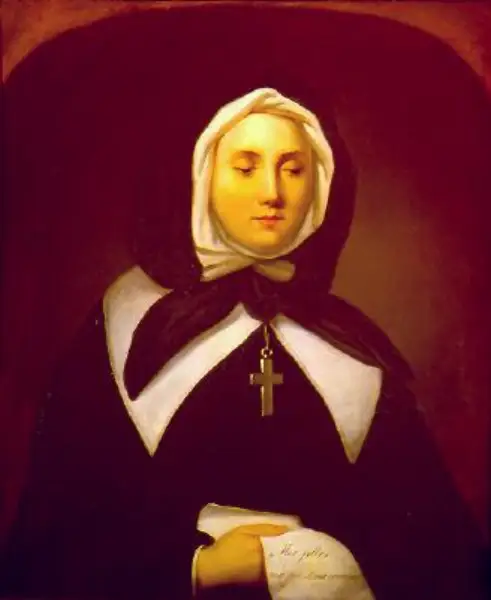
In 1683 Marguerite announced that she would step down, though she remained the figurehead of the Congregation until 1693, surrendering daily leadership while laboring to keep alive the spirit that had formed her sisters. That spirit was precisely what the new bishop, Jean-Baptiste De La Croix de Saint-Vallier, wished to reform away: he sought to impose the cloistered life upon the community by merging it with the Ursulines. Marguerite and her colleagues refused the enclosure, and their resistance was finally confirmed on 1 July 1698, when the Congregation was canonically constituted a community — religious, yet secular in character, exactly as the letters patent of 1671 had promised. Her last two years she spent chiefly at prayer and at the writing of her autobiography, fragments of which survive. She died at Montreal on 12 January 1700, at seventy-nine, in the place that had been a rough palisaded mission when she landed and was by then a town with schools, a stone church, and a congregation of teaching sisters. Pierre Le Ber painted her portrait in that year, the face of the woman who had given New France its classrooms.
§ Final years
The Saint of Canada
The day after her death a priest of the town wrote that if saints were still canonized by the voice of the people and the clergy, Mass would be said the next morning for Saint Marguerite of Canada; Hélène Bernier remarks that popular admiration had canonized her two and a half centuries before her beatification. The convent kept her memory in bodily form: an afternoon visitation open to the public, objects touched to her hands and treasured as spiritual relics, her body kept by the parish of Ville-Marie and her heart preserved by the Congregation. Stories circulated of her final charity — that she had offered her own life to God for a young sister stricken ill, and that the girl recovered while Marguerite sickened and soon died. Her formal cause opened when Pope Leo XIII declared her Venerable in 1878. The two miracles advanced to beatification were cures from gangrene of the foot, granted to Joseph Descoteaux of St. Celestin, Quebec, and John Ludger Lacroix of St. Johnsbury, Vermont; on 12 November 1950 Pope Pius XII beatified her. On 2 April 1982 John Paul II issued the Decree of Miracle for a further cure, and on 31 October of that year he canonized her in Vatican City — the first female saint of Canada.
§ Veneration and canonization in 1982
Honors and Memory
Canada has marked her memory in its own civic language. On 30 May 1975, Canada Post issued an eight-cent stamp, Marguerite Bourgeoys, 1620–1700, designed by Jacques Roy from a painting by Elmina Lachance, perforated 12.5 by 12 and printed by Ashton-Potter Limited — a rare tribute to a religious educator in the national post. Her major shrine is the Notre-Dame-de-Bon-Secours Chapel in Montreal, the church whose first stone she had organized work parties to lay in 1657, and which stands today beside the old harbor of Ville-Marie. The Congregation of Notre Dame of Montreal, the uncloistered community she founded against the current of her century, carried her method of free education for girls — poor girls, settler girls, and First Nations girls alike — deep into Canadian history. Historians of the colony, from the Dictionary of Canadian Biography to Patricia Simpson's study of Marguerite Bourgeoys and Montreal, treat her as one of the decisive builders of the settlement: a woman who arrived in a frontier town of a few dozen souls and left it with its first church, its first public school, its congregation of teaching sisters, and a claim on the gratitude of generations that Rome confirmed at her canonization in 1982.
§ Honours
Timeline
- 17 Apr 1620
Born at Troyes in Champagne, sixth of the twelve children of Abraham Bourgeoys and Guillemette Garnier.
§ Early life
- 1653
Accepted the assignment to found a congregation and mission in New France and sailed from France on the Saint-Nicholas with about 100 colonists.
§ Early life
- 22 Sep 1653
Arrived at the port of Quebec City and declined the Ursulines' hospitality, living instead among poor settlers.
§ Life in the colony
- 1657
Raised the workforce that erected Ville-Marie's first lasting church, the Notre-Dame-de-Bonsecours Chapel.
§ Life in the colony
- Apr 1658
Given a vacant stone stable by de Maisonneuve as a schoolhouse — the beginning of public schooling in Montreal.
§ Life in the colony
- 1669
Received from Apostolic Vicar François de Laval an ordinance authorizing her Congregation to teach anywhere on Montreal island and across the whole colony.
§ Later life
- 1670
Sailed for France a second time, with no money and only a letter of recommendation from Intendant Jean Talon, to seek the King's protection.
§ Later life
- May 1671
Obtained letters patent from Louis XIV securing her community's viability as secular Sisters, beyond the reach of cloister.
§ Later life
- 1678
Established a small school at Kahnawake, the mission village of converted Mohawk and other Iroquois peoples south of Montreal.
§ "Golden Age"
- 1683
Announced that she would step down from leadership of the Congregation.
§ Final years
- 1692
The Congregation opened a school in Québec City catering to girls from poor families.
§ "Golden Age"
- 1 Jul 1698
The Congregation was canonically constituted a community, its secular character preserved against Bishop Saint-Vallier's efforts at cloistering.
§ Final years
- 12 Jan 1700
Died at Montreal after two years devoted chiefly to prayer and her autobiography.
§ Final years
- 1878
Pope Leo XIII declared her Venerable, opening the cause that would end at the altars.
§ Veneration and canonization in 1982
- 12 Nov 1950
Beatified by Pope Pius XII on the strength of two cures from gangrene of the foot.
§ Veneration and canonization in 1982
- 2 Apr 1982
Pope John Paul II promulgated the Decree of Miracle for a healing credited to her prayers.
§ Veneration and canonization in 1982
- 31 Oct 1982
Canonized by Pope John Paul II in Vatican City as the first female saint of Canada.
§ Veneration and canonization in 1982
In Their Own Words
If saints were canonized as in the past by the voice of the people and of the clergy, tomorrow we would be saying the Mass of Saint Marguerite of Canada.
Not only has (Marguerite Bourgeoys) performed the office of schoolmistress by giving free instruction to the young girls in all occupations (...), far from being a liability to the country, she had built permanent buildings (...).
The Record
- Major works
- Congregation of Notre Dame of Montreal·First public school of Montreal (1658)·Boarding school at Ville-Marie·Vocational school for needle-work and artisan trades at Pointe-Saint-Charles·Mission school at Kahnawake (1678)
- Patron of
- against poverty·loss of parents·people rejected by religious orders
- Canonization
- Canonized by Pope John Paul II on 31 October 1982 in Vatican City; first female saint of Canada
Prayer
Bibliography
Show 8 sources
- "Marguerite Bourgeoys (1620–1700) – biography". Vatican News Service.
- Terry N. Jones, "Saint Marguerite Bourgeous", Saints.SQPN.com, 11 January 2010.
- Bernier, Hélène (1979) [1966]. "Bourgeoys, Marguerite, dite du Saint-Sacrement". In Brown, George Williams (ed.). Dictionary of Canadian Biography. Vol. I (1000–1700) (online ed.). University of Toronto Press.
- Simpson, Patricia (1997). Marguerite Bourgeoys and Montreal, 1640–1665. McGill-Queen's University Press. ISBN 978-0-7735-6657-6.
- "Saint Marguerite Bourgeoys", Franciscan Media. Archived from the original on 7 October 2020.
- N.C.W.C. News Service. "Canadian Heroine Beatified at Rites at St. Peter's in Rome", Southern Cross, November 25, 1950.
- Gray, Charlotte. The Museum Called Canada: 25 Rooms of Wonder. New York: Random House, 2004.
- Deignan, Ann (2013). The Love of a Lover: The Mystical Journey of Marguerite Bourgeoys. Schola Ministries. ISBN 978-0-9726-9902-0.
Profile text adapted from the Wikipedia article, licensed CC BY-SA 4.0.
Pray with this saint every day
Save St. Marguerite Bourgeoys to your favorites, read the full profile, and get feast-day reminders in the Saints app.
Get the Saints AppFree on the App Store for iPhone and iPad