
1848 – 1924·Feast May 19
St. Maria Bernarda Bütler
Franciscan missionary foundress of Ecuador and Colombia
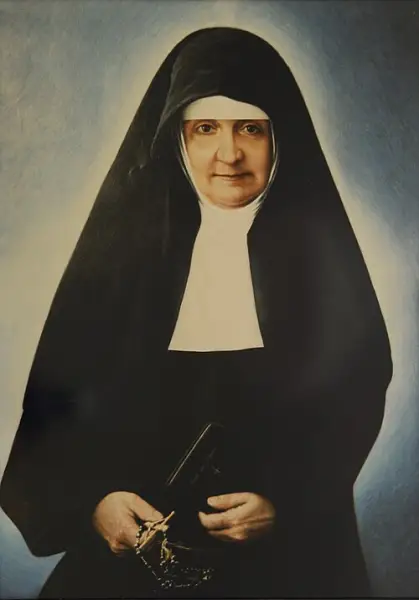
Overview
María Bernarda Bütler, born Verena Bütler, was a Swiss religious sister who founded the Franciscan Missionary Sisters of Mary Help of Sinners and spent nearly four decades in the missions of South America. Born at Auw in the canton of Aargau on 28 May 1848, the fourth of eight children of two farming families, she broke off an engagement to a man she loved after a sudden religious experience turned her toward the convent. After a false start with the Sisters of the Holy Cross Menzingen, she entered the Franciscan Capuchin nuns at Altstätten in 1867, received the habit and her religious name in 1868, and made solemn profession in 1871, eventually serving as novice mistress and as superior of her house. In 1888, at the invitation of Bishop Pedro Schumacher of Portoviejo, she sailed for Ecuador with six companions, and there she founded the congregation that became her life's work. Anti-religious persecution drove her from Ecuador in 1895; Bishop Eugenio Biffi welcomed her and fourteen sisters to Cartagena, Colombia, where she labored for the poor for the rest of her life while her congregation continued to spread. She died at Cartagena on 19 May 1924, mourned by the cathedral pastor's announcement that a saint had died in the city that morning. John Paul II beatified her in 1995, and Benedict XVI canonized her on 12 October 2008.
The Complete Life
A Farmer's Daughter in Aargau
Verena Bütler was born on 28 May 1848 at Auw, in the canton of Aargau, Switzerland, the fourth of eight children of Henry and Catherine, farming people who had her baptized within hours of coming into the world. Jeremias Bütler and Elisabeth Hoffmann were her great-grandparents, and every one of the eight children was a daughter, and one of her sisters, Martina, who lived from 1856 to 1890, later became a Benedictine. Verena's childhood unfolded in the ordinary rhythm of Swiss Catholic rural life: confirmation in 1856, First Communion on 16 April 1860, the end of her schooling in 1862. What altered the course of that life was an engagement. She had promised herself to a man she genuinely loved, but a sudden religious experience intervened, and she broke off the engagement in order to consider whether God was asking more of her than an ordinary married life in Aargau. Her first attempt at an answer came in 1866, when she sought entrance among the Sisters of the Holy Cross Menzingen; the fit was wrong, and after a brief period she returned home to discern more slowly what her true calling was.
§ Life
The Capuchin Cloister at Altstätten
Her local pastor encouraged her toward the Franciscan Capuchin nuns at the convent of Mary Help of Sinners in Altstätten, and there, on 12 November 1867, Verena Bütler found her place. On 4 May 1868 she received the habit and with it a new name, María Bernarda of the Heart of Mary; on 4 October 1871 she made her solemn profession. The community entrusted her with responsibility early: from 1879 to 1880 she served as novice mistress, forming the young sisters who came after her, and from 1880 until 1886 she was superior of the house. By every appearance her life was settled — profession made, office held, a cloister of her own tradition in her own country. It was precisely then that the missionary call arrived. Pedro Schumacher, Bishop of Portoviejo in Ecuador, was seeking religious to serve his vast and needy diocese, and Mother María Bernarda answered. On 19 June 1888 she left Altstätten with six companions for South America, landing on 29 July — a sister in her fortieth year, trading a Swiss superior's security for the uncertainties of a mission coast.
§ Life
Ecuador, Exile, Cartagena
In Ecuador, María Bernarda founded the work that defines her memory: the Franciscan Missionary Sisters of Mary Help of Sinners, a congregation born among the poor of the diocese of Portoviejo and devoted to their care. The mission flourished until politics broke it. In 1895 a wave of anti-religious sentiment swept Ecuador, religious houses were expelled, and María Bernarda with her sisters was forced out of the country — a foundress dispossessed of her first foundation. The exile became a new field. Bishop Eugenio Biffi of Cartagena invited the scattered community to Colombia, and on 2 August 1895 he welcomed María Bernarda and fourteen of her sisters to that Caribbean port city. Cartagena kept her for the rest of her life, and there she served the city's poor while the congregation she had founded in Ecuador took root on Colombian soil and continued to expand under her leadership. Recognition followed the growth: the order was joined by aggregation to the Order of Friars Minor Capuchin on 26 June 1905 and won diocesan approval on 12 January 1912, and after her death earned the decree of praise and full papal approval from Pope Pius XI in 1929 and 1938. By 2005 the congregation counted 788 religious in 125 houses.
§ Life
Death in Cartagena
María Bernarda died on 19 May 1924, in her seventy-sixth year, in the city that had received her as a refugee and had become the permanent home of her congregation. The city's grief was voiced by the pastor of the cathedral, who announced her death to the faithful with the words that a saint had died in Cartagena that morning: the reverend Mother Bernarda. It was the verdict of a community that had watched her for nearly thirty years — the Swiss superior who had arrived in exile and made herself the servant of the city's poor. Her remains were later relocated in 1956, as her cause advanced and her grave became a place of pilgrimage. The congregation she left behind outlived her by generations, carrying her Franciscan mission from its Ecuadorian birthplace through Colombia and beyond, its numbers growing through the twentieth century until, at the dawn of the twenty-first, nearly eight hundred sisters in a hundred and twenty-five houses were doing the work she had begun with six companions on a dock at Portoviejo.
§ Life
Servant of God to Saint
Her sainthood cause unfolded over six decades. An informative process opened at Cartagena in 1949 and closed in 1952; theologians collated and approved her spiritual writings on 8 May 1959; and on 15 July 1974, under Pope Paul VI, the cause was formally introduced, giving her the title Servant of God. An apostolic process ran from 1976 to 1977, and the Congregation for the Causes of Saints validated the proceedings on 26 February 1982. The Positio reached the congregation in 1988, won the theologians' approval on 5 April 1991 and the congregation's vote on 15 October 1991, and on 21 December 1991 John Paul II declared her Venerable, having confirmed her heroic virtue. The beatification miracle — the rebuilding of missing cranial bones of fifteen-day-old Liliana Sanchez in 1969 — was investigated, validated on 4 May 1992, and approved by the medical board on 17 June 1993, by theologians on 26 November 1993, and by the congregation on 18 January 1994; the Pope approved it on 26 March 1994 and beatified her in Saint Peter's Basilica on 29 October 1995, with her grandniece Rosmarie Wicki-Bütler and grandnephew Burkard Bütler on hand for the family. The second miracle, the cure of Myrna Jazime Correa from severe respiratory complications on 2 July 2002, was investigated at Cartagena in 2003, validated in 2004, and approved through 2006 and 2007; Benedict XVI assented on 6 July 2007 and canonized her on 12 October 2008 in Saint Peter's Square.
§ Canonization
Timeline
- 28 May 1848
Born at Auw, Aargau, Switzerland, fourth of the eight children of Henry and Catherine, and baptized right after birth.
§ Life
- 1856
Received the sacrament of confirmation.
§ Life
- 16 Apr 1860
Made her First Communion.
§ Life
- 1862
Finished her schooling.
§ Life
- 1866
Attempted to enter the Sisters of the Holy Cross Menzingen but left after a brief period to discern her calling at home.
§ Life
- 12 Nov 1867
Entered the Franciscan Capuchin nuns at the convent of Mary Help of Sinners in Altstätten, at her pastor's encouragement.
§ Life
- 4 May 1868
Received the habit and with it the religious name María Bernarda of the Heart of Mary.
§ Life
- 4 Oct 1871
Made her solemn profession.
§ Life
- 1879
Began service as novice mistress of the convent.
§ Life
- 1880
Became superior of her house, an office she held until 1886.
§ Life
- 19 Jun 1888
Departed for the Ecuadorian missions with six companions at the invitation of Bishop Pedro Schumacher of Portoviejo.
§ Life
- 29 Jul 1888
Arrived in Ecuador and founded the Franciscan Missionary Sisters of Mary Help of Sinners.
§ Life
- 2 Aug 1895
Forced by anti-religious persecution from Ecuador, she and fourteen sisters were received in Cartagena, Colombia, by Bishop Eugenio Biffi.
§ Life
- 26 Jun 1905
Her order was aggregated to the Order of Friars Minor Capuchin.
§ Life
- 12 Jan 1912
The congregation received diocesan approval.
§ Life
- 19 May 1924
Died at Cartagena, Colombia, aged 75.
§ Life
- 1956
Her remains were relocated.
§ Life
- 15 Jul 1974
Her cause formally introduced under Pope Paul VI, granting her the title of Servant of God.
§ Canonization
- 21 Dec 1991
Pope John Paul II declared her Venerable after confirming her heroic virtue.
§ Canonization
- 29 Oct 1995
Beatified by Pope John Paul II in Saint Peter's Basilica, on the strength of the 1969 rebuilding of the cranial bones of the infant Liliana Sanchez.
§ Canonization
- 12 Oct 2008
Canonized by Pope Benedict XVI in Saint Peter's Square, after the 2002 healing of Myrna Jazime Correa from grave respiratory complications.
§ Canonization
In Their Own Words
A saint has died in this city this morning: the reverend Mother Bernarda!
The Record
- Major works
- Franciscan Missionary Sisters of Mary Help of Sinners
- Canonization
- Canonized by Pope Benedict XVI on 12 October 2008 in Saint Peter's Square
Prayer
Bibliography
Show 4 sources
- "Mary Bernard (Verena) Bütler (1848-1924)". Vatican News Services.
- "Saint Maria Bernarda (Verena Bütler)". Santi e Beati.
- "Mary Bernard Bütler". Saints Resource, RCL Benziger.
- "Saint Verena Bütler". Saints SQPN. 15 May 2016.
Profile text adapted from the Wikipedia article, licensed CC BY-SA 4.0.
Pray with this saint every day
Save St. Maria Bernarda Bütler to your favorites, read the full profile, and get feast-day reminders in the Saints app.
Get the Saints AppFree on the App Store for iPhone and iPad