
1888 – 1922·Feast October 20
St. Maria Bertilla Boscardin
Nurse of sick children in wartime Treviso
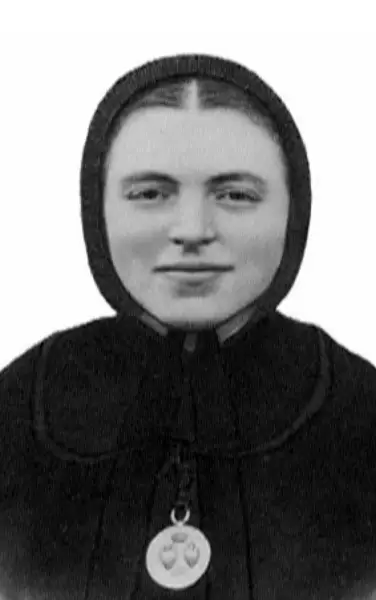
Overview
Maria Bertilla Boscardin was an Italian nun and nurse whose patient competence among sick children and victims of the First World War air raids at Treviso carried a peasant daughter mocked as slow all the way to the altars. Born Anna Francesca Boscardin at Brendola in the Veneto on 6 October 1888, and called Annette at home, she grew up in a peasant household shadowed by her father Angelo's jealousy, violence, and drunkenness — facts he himself confessed at her beatification process. School was irregular; field work and housework came first, and her neighbors dismissed her as dull, a clergyman among them calling her a goose. Rejected by one order for her slowness, she was accepted in 1904 by the Teachers of Saint Dorothy, Daughters of the Sacred Heart at Vicenza, where she took the name Maria Bertilla and spent three years in the kitchen and laundry. Trained as a nurse at the municipal hospital of Treviso, she was assigned to the children's diphtheria ward, and when Austrian air raids struck the town after the Battle of Caporetto she stayed with patients too ill to be moved. Undervalued by her own superioress and exiled to the laundry for four months, she was restored by a higher superior to charge of the children's isolation ward. A long-standing tumor required an operation she did not survive; she died on 20 October 1922, aged thirty-four. Pius XII beatified her in 1952, and John XXIII canonized her on 11 May 1961.
The Complete Life
Annette the Goose of Brendola
Anna Francesca Boscardin was born on 6 October 1888 at Brendola, in the Veneto, into a peasant family that knew her as Annette. The household was hard. Her father Angelo, testifying years later at her beatification process, described himself as jealous, violent, and frequently drunk — an admission that makes the daughter's later gentleness the more remarkable. Annette's schooling was squeezed between the demands of the house and the fields; her attendance was fitful, and she took work as a servant in a house nearby. No talent marked her childhood, and the village had made up its mind: she was thought unintelligent, and the target of insulting jokes. Even a local clergyman joined in, calling her a goose for her slowness. Yet the parish also gave her its better gifts. She was permitted to make her First Holy Communion at eight and a half years old, years before the authorized age of eleven, and at twelve she was accepted into the parish's Children of Mary association. From the parish priest came the gift of a catechism — the little book that would be found still in the pocket of her religious habit when she died at thirty-four.
§ Early life
Accepted at Vicenza
One religious order refused her admission outright on account of her slowness. In 1904, however, the Teachers of Saint Dorothy, Daughters of the Sacred Heart at Vicenza accepted her, and she took the name Maria Bertilla. She had absorbed enough of the village's contempt to repeat it against herself: presenting herself to the novice-mistress, she said she could do nothing, that she was a poor thing, a goose, and begged only to be taught, for she wanted to be a saint. The community assigned her to the kitchen and the laundry, and for three years she was a kitchen maid and laundress — the least conspicuous work a convent contains, and the work at which no one is tempted to pride. She bore it without complaint, and the years of obscurity formed the habit that would define her nursing: obedience first, competence second, glory never. When her superiors finally judged her ready for more, the assignment they gave her was not teaching but nursing — the care of bodies, at which a slow and steady hand is worth more than a clever tongue. She was sent to Treviso to learn it at the municipal hospital her order directed.
§ Vicenza
The Children's Ward at Treviso
At Treviso she trained as a nurse, though during her training period she was set once more to work in a kitchen. Once her training was complete, she was promoted to the hospital's children's ward, nursing victims of diphtheria — children isolated, feverish, and often fighting for breath. Then came the war. After the disastrous Battle of Caporetto, the front collapsed toward the Piave, and Treviso lay within reach of Austrian aircraft; during the air raids that followed, the municipal hospital passed under military control. Sister Bertilla became what her biographers would remember: the nurse who stayed. She was noted for her unwavering care of patients too ill to be carried to shelter, remaining at their sides while the bombs fell. Such steadfastness drew the notice of officials at a nearby military hospital — and the hostility of her own superioress, who did not appreciate her work and reassigned her to the laundry. For four months the nurse of the children's ward washed linens. A higher superior reversed the decision and placed her in charge of the children's isolation ward, where her gifts finally had their proper scope, and where the “goose” of Brendola ran one of the hospital's most demanding rooms.
§ Treviso
The Operation
Sister Bertilla's health had never been robust, and shortly after her appointment to the isolation ward it failed. A painful tumor, present for several years and borne without fuss during years of kitchen work, laundry work, and night nursing, had progressed to the point where an operation was required. She underwent it and did not survive. She died at Treviso on 20 October 1922, thirty-four years old — the age at which most lives are only getting started, and hers was already finished. Those who gathered at her grave knew what the village of Brendola had never guessed: everyone she had served carried away a lasting memory of her simplicity and her tireless, devoted labor. Her first grave at Treviso drew throngs of mourners and visitors, and once a tomb was raised for her at Vicenza, pilgrims made it a destination where several cures were reported. The memorial plaque on her tomb speaks for the patients and colleagues who buried her, honoring a soul chosen for heroic goodness and an angelic reliever of human suffering there. A catechism was found in the pocket of her habit, the priest's gift from her childhood, kept through kitchen, laundry, and air raid to the end.
§ Treviso
From the Laundry to the Altar
The Church's judgment reversed the village's. Pope Pius XII beatified her on 8 June 1952, and on 11 May 1961 — thirty-nine years after her death — Pope John XXIII canonized Maria Bertilla Boscardin a saint of the Catholic Church. The crowd in Saint Peter's that day included members of her own family, among them presumably the aged father who had confessed his violence at her beatification process, and some of her patients, the children of the diphtheria ward and the air raids grown old. Her cult settled into the places that remembered her: her tomb at Vicenza, a destination of pilgrims, and the church of Saints Peter and Paul near Noventa Vicentina, where a statue of Saint Bertilla stands. Devotion to her carried a particular message. Her hard childhood and her tireless tending of the neglected have made her a patron for those who are turned away and mistreated — the patron, precisely, of those whom her own childhood resembled. Her recorded sayings are brief and level: that nothing merely passing deserves our disquiet, and that in every condition of life we should labor to stay held in God's hands. Her feast is kept on 20 October, the anniversary of her death.
§ Veneration
Timeline
- 6 Oct 1888
Born at Brendola, Veneto, and named Anna Francesca; her family called her Annette.
§ Early life
- 1904
Accepted by the Teachers of Saint Dorothy, Daughters of the Sacred Heart at Vicenza, taking the name Maria Bertilla.
§ Vicenza
- 20 Oct 1922
Died at Treviso, aged 34, after an operation on a painful tumor that had progressed over several years.
§ Treviso
- 8 Jun 1952
Beatified by Pope Pius XII.
§ Veneration
- 11 May 1961
Canonized by Pope John XXIII, thirty-nine years after her death, with her family and some of her patients present.
§ Veneration
In Their Own Words
I can't do anything. I'm a poor thing, a goose. Teach me. I want to be a saint.
A chosen soul of heroic goodness ... an angelic alleviator of human suffering in this place.
We should never allow ourselves to be disturbed by things that are transitory and not eternal.
In whatever state we are, let us strive to remain in the hands of God.
The Record
- Patron of
- the rejected·the lonely·the abused
- Canonization
- Canonized by Pope John XXIII on 11 May 1961
Prayer
Bibliography
Show 6 sources
- Attwater, Donald and Catherine Rachel John. The Penguin Dictionary of Saints. 3rd edition. New York: Penguin Books, 1993. ISBN 0-14-051312-4.
- Giorgi, Emanuela. "October 20: Saint Maria Bertilla Boscardin." Home Page Di Vatican State, 20 Oct. 2025.
- Sicari, Antonio. Ritratti Di Santi.
- "St. Patrick Catholic Church: Saint of the Day, October 20". Archived from the original on 2012-11-05.
- Foley OFM, Leonard, "St. Maria Bertilla Boscardin", Saint of the Day: Lives, Lessons, and Feast (revised by Pat McCloskey OFM), Franciscan Media. ISBN 978-0-86716-887-7.
- "Saint Maria Bertilla Boscardin – Patron Saint of the Rejected". The Clarion Herald.
Profile text adapted from the Wikipedia article, licensed CC BY-SA 4.0.
Pray with this saint every day
Save St. Maria Bertilla Boscardin to your favorites, read the full profile, and get feast-day reminders in the Saints app.
Get the Saints AppFree on the App Store for iPhone and iPad