
1813 – 1855·Feast December 15
St. Maria Crocifissa di Rosa
Founder of the Handmaids of Charity in Brescia
Overview
Maria Crocifissa di Rosa, born Paola Francesca Di Rosa, was an Italian religious sister who founded the Ancelle della carità, the Handmaids of Charity, at Brescia in 1839. The daughter of a wealthy industrialist and a noble mother, she was educated by the Visitation Sisters until her mother's death in 1824, after which she went to work in her father's spinning mill at Acquafredda. Made manager at nineteen, she devoted herself with her father's encouragement to the material and spiritual welfare of the women workers, and began gathering other women for the care of the poor — the seed of her congregation. When cholera struck Brescia in 1836 she nursed the sick in the local hospital, and she directed a home for deaf and mute women. Her institute, approved by the Bishop of Brescia in 1843 and by Pope Pius IX in 1850, gave priority to the care of the ill in hospitals and of soldiers leaving for the front. She made her profession and took the religious name Maria Crocifissa in 1852, and died in Brescia on 15 December 1855 after a long illness. Pius XII beatified her in 1940 and canonized her in 1954.
The Complete Life
A Daughter of Brescia's Mills
Paola Francesca Di Rosa first saw the light at Brescia on 6 November 1813, when the city belonged to the Napoleonic Kingdom of Italy, into a family of striking contrasts. Her father, Clemente Di Rosa, was a rich industrialist; her mother, Countess Camilla Albani, came from the ancient noble line of the Albani. Paola was one of nine children. Her education was entrusted to the Visitation Sisters, who taught her in their convent in Brescia, but it was cut short in 1824 when her mother died and she left school. Her father's wealth meant that she might have expected a life of comfort and marriage into her own class, and he would in fact look for suitors for her in the years that followed. Instead, the death of her mother pushed her toward the working world of her father's enterprises. She went to the large spinning mill he owned at Acquafredda, and what she found there — the hard conditions of the women who worked the machines — began to shape the course of her life long before she conceived of founding anything.
§ Life
Manager of the Mill, Servant of the Workers
At the Acquafredda spinning mill Paola took an immediate notice of the working conditions of the female employees, and with her father's encouragement she began to tend to their spiritual and material needs. By nineteen she had become manager of the mill, a position of real authority for a young unmarried woman, and she used it as a form of pastoral care: watching over the welfare, dignity, and souls of the women under her charge. Her father, for his part, began searching for a husband for her, but she turned down each suitor he proposed. The pressure of these marriage negotiations distressed her, and she confided her disappointment to the priest Faustino Pinzoni. Pinzoni went to Clemente Di Rosa himself and explained that his daughter felt called toward a different path. For the decade that followed, Paola remained under the family roof, deepening her involvement in works of charity and social service around Brescia. The pattern of these years is striking: a wealthy daughter who declined the marriage her family arranged, not out of rebellion against her father but through a mediator who made her purpose plain, and who spent the years that might have been spent as a wife in serving the working poor.
§ Life
Cholera, Hospitals, and the Handmaids of Charity
In 1836 Brescia suffered a cholera epidemic, and Paola went to the local hospital to tend the sick, exposing herself to a disease that killed its victims in hours. At about the same period she ran an institution for women deprived of hearing and speech, extending her care to those whom society barely noticed. In 1840 she began gathering a small group of women for the collective care of the poor — a fellowship first entitled a Pious Union — and out of this group grew the congregation for which she is remembered, the Ancelle della carità, the Handmaids of Charity. The community devoted itself chiefly to nursing the ill in hospitals and to caring for troops departing for the front, alongside the service of the poor. Its progress through the church's structures was remarkably rapid: diocesan approval came from the Bishop of Brescia, Carlo Domenico Ferrari, in 1843, and papal approval from Pope Pius IX in 1850. Only in 1852 did Paola herself undergo formation, make her profession, receive the religious habit, and take the name Maria Crocifissa — Mary of the Crucified — the name under which her compassion for the suffering would be remembered. To her colleagues she once explained the spirit of the congregation by saying that she suffered from seeing suffering.
§ Life
Death in the City She Served
The last years of Maria Crocifissa's life were shortened by illness. After a prolonged sickness, borne while she continued to lead the congregation she had founded, on 15 December 1855 she died in a Brescia hospital, forty-two years old. It was fitting that she died in a hospital, for the care of the sick had been the first priority of her apostolate from the cholera wards of 1836 onward. Her funeral monument and altar were placed in the chapel of the Handmaids of Charity in Brescia, where her body rests in the city of her birth, her work, and her death. She had lived only forty-two years, but within them she had moved from the spinning mills of Acquafredda through the plague houses of Brescia to the government of a religious congregation approved by the pope — a range of achievement that her contemporaries would have thought impossible for a girl who left school at eleven, and that she accomplished by treating every post, from mill manager to foundress, as a form of service to those who suffered. The span was short, but it proved long enough for her to see the congregation approved by the pope and securely established in its double work of hospitals and charity.
§ Life
From Servant of God to Saint of Brescia
The recognition of Maria Crocifissa's holiness followed the formal path of the modern canonization process, stage by stage. Pope Pius X opened the cause on 10 December 1913, conferring on her the title Servant of God. Once her heroic virtue had been confirmed, Pius XI pronounced her Venerable on 10 July 1932. Two miracles accepted as worked through her intercession received papal confirmation on 25 February 1940, and on 26 May 1940 Pope Pius XII presided over her beatification in Saint Peter's Basilica. The cause for canonization was opened on 7 January 1951, and on 17 January 1954 Pius XII confirmed two additional miracles worked through her intercession. On 12 June 1954, in Saint Peter's Basilica, the same pope canonized her — a little more than fourteen years after her beatification, and just under a century after her death. The daughter of Brescia's industrialists and the servant of its mill workers and hospital patients had become one of the notable saints of Lombardy, honored in the city whose poor and sick she had made her life's charge. From the first inquiry to the final ceremony her passage through the stages of holiness took just over forty years — swift, by the measure of Roman causes, and a measure of how vividly her service was still remembered in Brescia.
§ Sainthood
The Handmaids Continue the Work
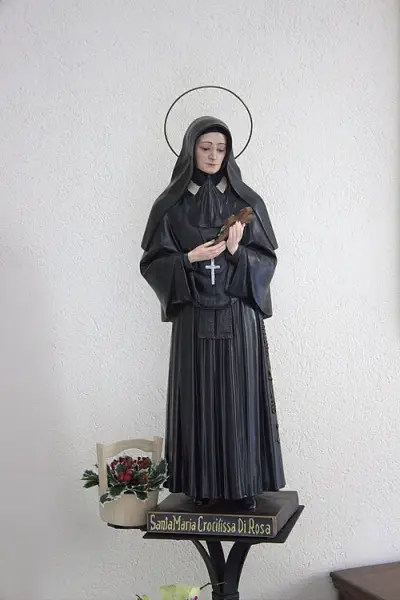
The congregation Maria Crocifissa founded remains the chief bearer of her memory and the object of her patronage. The Ancelle della carità of Brescia continue the apostolate she gave them: the care of the poor and the sick, service in hospitals, and attention to those in danger — the priorities she set when she told her sisters that she suffered from seeing suffering. Devotion to her is strongest in Brescia and the surrounding region, where her altar and funeral monument stand in the congregation's chapel and where a statue of the saint was erected at Bagolino, unveiled in 2014. In the iconography of the congregation she is remembered in the religious habit she finally received in 1852, late in a life that had been lived as a foundress long before it was lived as a professed sister. Her story is often told as an example of lay charity preceding religious life: nearly twenty years of service to factory workers, cholera patients, deaf women, and the poor came before her profession, so that when she finally took the habit she was not beginning a work but clothing in religious form a mercy that had already proven itself.
§ Life
Timeline
- 6 Nov 1813
Born Paola Francesca Di Rosa at Brescia, one of nine children of the industrialist Clemente Di Rosa and Countess Camilla Albani.
§ Life
- 1824
Left her schooling with the Visitation Sisters after the death of her mother.
§ Life
- 1836
Nursed victims of the cholera epidemic in a Brescia hospital and ran a home for women left deaf and mute.
§ Life
- 1840
Began gathering a small group of women, first entitled a Pious Union, that would evolve into her religious congregation.
§ Life
- 1843
Received diocesan approval for her institute from the Bishop of Brescia, Carlo Domenico Ferrari.
§ Life
- 1850
Her congregation received papal approval from Pope Pius IX.
§ Life
- 1852
Made her religious profession, was vested in the habit, and took the name Maria Crocifissa.
§ Life
- 15 Dec 1855
Died at a hospital in Brescia after a prolonged illness, aged forty-two.
§ Life
- 10 Dec 1913
The canonization process was opened under Pope Pius X, and she received the title Servant of God.
§ Sainthood
- 10 Jul 1932
Declared Venerable by Pope Pius XI after confirmation of her heroic virtue.
§ Sainthood
- 26 May 1940
Beatified by Pope Pius XII in Saint Peter's Basilica after papal confirmation of two miracles.
§ Sainthood
- 7 Jan 1951
The cause for her canonization was formally opened.
§ Sainthood
- 17 Jan 1954
Pius XII confirmed two further miracles attributed to her intercession.
§ Sainthood
- 12 Jun 1954
Canonized by Pope Pius XII in Saint Peter's Basilica.
§ Sainthood
In Their Own Words
I suffer from seeing suffering
The Record
- Major works
- Ancelle della carità (Handmaids of Charity), founded at Brescia·Care of women workers at her father's spinning mill in Acquafredda·Direction of a home for mute and deaf women
- Patron of
- Ancelle della carità·Brescia
- Symbols
- Religious habit
- Canonization
- Beatified by Pope Pius XII on 26 May 1940; canonized by Pope Pius XII on 12 June 1954
Prayer
Bibliography
Show 7 sources
- Time (magazine), 21 June 1954.
- "St. Maria Crocifissa Di Rosa - Saints & Angels". Catholic Online. Retrieved 1 November 2018.
- "Saint Mary di Rosa". Saints SQPN. 19 April 2019. Retrieved 5 July 2019.
- "St. Maria Crocifissa di Rosa". Pilgrim Center of Hope. 23 May 2012.
- Index ac status causarum beatificationis servorum dei et canonizationis beatorum (in Latin). Typis polyglottis vaticanis. January 1953, p. 156.
- Le Ancelle della Carità di Brescia: Per la Beatificazione della loro Madre Fondatrice Maria Crocifissa di-Rosa nel I° Centenario della Congregazione 1840–1940.
- Fossati, Luigi. Beata Maria Crocifissa Di-Rosa - Fondatrice delle Ancelle della Carità in Brescia. 1940.
Profile text adapted from the Wikipedia article, licensed CC BY-SA 4.0.
Pray with this saint every day
Save St. Maria Crocifissa di Rosa to your favorites, read the full profile, and get feast-day reminders in the Saints app.
Get the Saints AppFree on the App Store for iPhone and iPad