
1230 – 1290·Feast September 19
St. Maria de Cervelló
First superior of the Mercedarian third order
Overview
Maria de Cervelló (1230 – 19 September 1290), also called Mary of Cervellon, was a Catalan noblewoman who became the first superior of the Third Order of Our Lady of Ransom, the third order of the Mercedarians. Born at Barcelona, the daughter of the Spanish nobleman William de Cervellon, she was baptized in the church of Santa Maria del Mar and gave her youth to the service of the sick at the Hospital of Saint Eulalia near the sea. Through that hospital she came to know the Mercedarians, the order founded by Peter Nolasco to redeem Christian slaves held captive by the Saracens of Spain and North Africa. A sermon by Bernardo de Corbera, superior of the Brotherhood of Our Lady of Ransom at Barcelona, so moved her that she resolved to labor for the captives. Resisting her family's plans for an advantageous marriage, she joined in 1265 a small community of pious women near the Mercedarian monastery; they received permission to constitute a third order and wear its habit, promising also to pray for the Christian slaves. Maria was elected their first superior. So constant was her charity toward the needy that she was called Maria de Socos, Mary of Help, and sailors credited her with aiding ships in peril at sea.
The Complete Life
A Noble Daughter of Barcelona
Maria de Cervelló was born at Barcelona on 1 December 1230, daughter of a Spanish nobleman named William de Cervellon. Eight days later she was baptized on 8 December in the church of Santa Maria del Mar — Saint Mary of the Sea — the great parish of Barcelona's sailors and shipwrights, a setting that proved prophetic for a woman whom mariners would one day invoke against shipwreck.
Rather than settle into the life of a noble household, she gave her energies to the poor and the sick. She gave her days to Saint Eulalia's hospital at Villanova by the sea, an institution that owed its existence chiefly to Raimundo de Plagamans, a rich layman who served the crown. There the sick of the coast were cared for, and there returning ransomed captives would one day find shelter as well.
Her service at the hospital placed her at a crossroads of Barcelona's charity. The Mercedarian friars, whose whole existence was organized around the ransom of Christian slaves from the Saracens of Spain and North Africa, moved through the same world of mercy, and through her hospital work Maria came into contact with their founder, Peter Nolasco.
§ Life
A Sermon That Changed Everything
The decisive moment of Maria's life came through a sermon. One day Bernardo de Corbera, superior of the Brotherhood of Our Lady of Ransom at Barcelona, preached, and his words went to her heart: she pledged her strength to the cause of the captives. Her family's ambitions collided with that pledge at once, for her relatives pressed upon her one socially brilliant marriage after another, and she refused them every time.
With Bernardo's help she found her place in 1265 among a small band of devout women living beside the Mercedarians' monastery, whose days were given to prayer and good works. The group then obtained permission to constitute a Third Order of Our Lady of Ransom and to wear the habit of the Brotherhood. Beyond the usual vows of tertiaries, the women added a promise peculiar to their purpose: they would pray for the Christian slaves, those whom the friars ransomed with money and negotiation would be sustained by the sisters with intercession.
From among them Mary was elected the first superior of the new third order, giving institutional form to the resolve first kindled by a preacher's words.
§ Life
Mary of Help
The sisters were devoted to prayer, but they were not a contemplative order; their vocation kept one foot in the cloister and one in the street. Mary de Cervellione herself continued to work at Saint Eulalia's hospital, which served a purpose bound up with the redemption of captives: it was there that the ransomed stayed once they returned, broken men restored to freedom and in need of care until they could stand again.
Her charity toward the poor and those in need became so conspicuous that the people gave her a new name, calling her Maria de Socos — Mary of Help. It was a title earned at the bedside and the doorway, among the freed and the famished of thirteenth-century Barcelona.
But her help, the faithful came to believe, did not stop at the shore. Both in her lifetime and after it, the faithful credited her with rescuing vessels threatened at sea, enabling them to hold their course and bring the Christian prisoners aboard safely to port. The noblewoman who had been baptized in the church of Saint Mary of the Sea had become, in popular devotion, the patroness of the vessels themselves.
§ Life
From Veneration to Altar
Maria died at Barcelona on 19 September 1290, aged fifty-nine, as the first superior of the third order she had helped to found. Her veneration began immediately after her death — the people who had called her Mary of Help did not wait for any tribunal to tell them what they had seen in her — and the feast was fixed on the day of her death.
The Church's formal recognition came four centuries later. Pope Innocent XII approved her cult on 15 February 1692, confirming the devotion of Barcelona and of the Mercedarian family in her honor. Her remains lie in the Basilica of La Merced in Barcelona, the great church of Our Lady of Mercy from which her order took its name, where pilgrims still honor the first mother of the Mercedarian tertiaries.
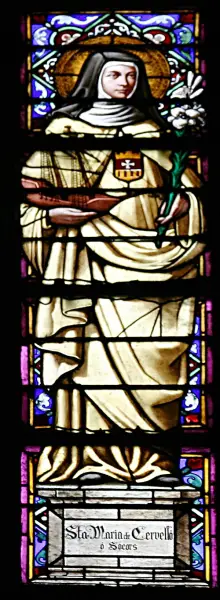
In art she is depicted holding a ship, the emblem of her protection over those who sail; her attributes also include the lily of virginity and the stormy sea she was believed to calm. She is invoked especially against shipwreck, and her feast is celebrated on 19 September, with navigators claiming her as their patron.
§ Veneration
Timeline
- 1 Dec 1230
Born at Barcelona, daughter of the Spanish nobleman William de Cervellon.
§ Life
- 1265
With Bernardo de Corbera's help, joined the little community of pious women near the Mercedarian monastery, defying her family's marriage plans.
§ Life
- 19 Sep 1290
Died at Barcelona, her veneration beginning immediately afterward.
§ Veneration
- 15 Feb 1692
Pope Innocent XII approved her cult, recognizing her as a saint.
§ Veneration
The Record
- Major works
- Third Order of Our Lady of Ransom (co-founded, Barcelona, 1265)
- Patron of
- navigators·against shipwreck
- Symbols
- lily·boat·stormy sea
- Canonization
- Her cult, immediate after her death, was approved by Pope Innocent XII on 15 February 1692
Prayer
Bibliography
Show 6 sources
- "St. Maria de Cervellon", Mercedarian Friars.
- Ott, Michael. "St. Mary de Cervellione." The Catholic Encyclopedia Vol. 9. New York: Robert Appleton Company, 1910.
- Peterson, Larry. "St. Mary de Cerevellon", Aleteia, September 6, 2017.
- Acta Sanctorum, September, VII, 152–171.
- Dunbar, Dictionary of Saintly Women II (London, 1905), 56–7.
- Corbera, Vida y hechos maravillosas de d. Maria de Cerveilon, clamado Maria Socos (Barcelona, 1639).
Profile text adapted from the Wikipedia article, licensed CC BY-SA 4.0.
Pray with this saint every day
Save St. Maria de Cervelló to your favorites, read the full profile, and get feast-day reminders in the Saints app.
Get the Saints AppFree on the App Store for iPhone and iPad