
1891 – 1974·Feast December 11
St. María de las Maravillas de Jesús
Discalced Carmelite founder of Spanish convents
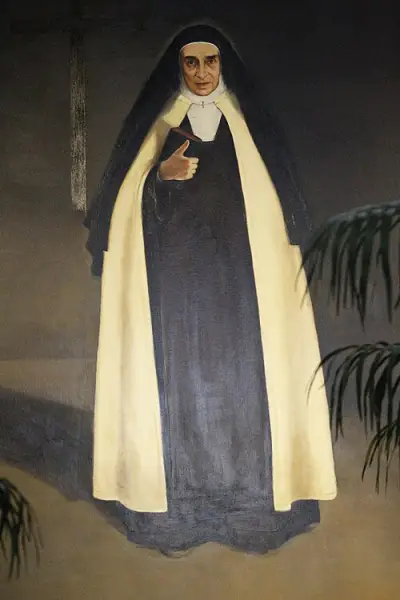
Overview
María de las Maravillas Pidal Chico de Guzmán was born into an aristocratic Madrid family on 4 November 1891, the youngest of four children. Her father, the second Marquis of Pidal, served as Spain's first Minister of Development and later as ambassador to the Holy See. Raised on the lives of the saints as told by her grandmother, she made a private vow of chastity as a child and entered the Discalced Carmelites at El Escorial in 1919, taking the name María de las Maravillas de Jesús. Her life's work became the founding and restoration of Carmelite houses: a convent at the Cerro de los Ángeles, beside the monument that marks the very midpoint of Spain, followed by foundations across the country and a house at Kottayam in India. When religious persecution swept Spain in the 1930s, she led her community through expulsion, house arrest and exile, re-establishing it at Las Batuecas in Salamanca. Elected prioress again and again, she governed with firmness and gentleness and founded the Association of Saint Teresa in 1972. She died at La Aldehuela on 11 December 1974. Pope John Paul II beatified her in 1998 and canonized her in Madrid on 4 May 2003.
The Complete Life
A Childhood Among Saints
The future Carmelite was born María de las Maravillas Pidal Chico de Guzmán in Madrid on 4 November 1891, the last of four children in a family of standing. Her father, Luis Pidal i Mon, the second Marquis of Pidal, had served as Spain's first Minister of Development and would later represent the kingdom as ambassador to the pontifical see; her mother was Cristina Chico de Guzmán i Muñoz. Baptized in the parish church of San Sebastián on 12 November, the girl was known affectionately in the family as Mavi. Her earliest religious formation came from her maternal grandmother, who recounted the lives of the saints until the child, moved by the example of Saint Agnes, made a private vow of chastity in 1896, the year she also received confirmation. She made her first communion in 1902, and a year later took the Jesuit priest Juan Francisco López as her spiritual director, a companionship of guidance that lasted until her entrance into religious life. The deaths of her father in late 1913 and of her grandmother at the beginning of 1914 stripped away her two closest supports, and in the autumn of 1918 her mother, walking with her daughter, gave her the blessing that set her free to become a nun.
§ Life
Entrance into Carmel
On 12 October 1919 María entered the Discalced Carmelites at El Escorial near Madrid and and took in religion the name María de las Maravillas de Jesús, a phrase meaning Mary of the marvels of Jesus. On 7 May 1920 came her first profession, by which she bound herself to a life of prayer and enclosure. A new horizon opened in 1923, when she resolved to establish a convent at Getafe, on the Cerro de los Ángeles beside the monument marking the geographical centre of Spain. The Bishop of Madrid welcomed the plan gladly, and on 19 May 1924 she moved with three sisters of El Escorial into a house at Getafe while the convent was being raised. Eleven days later she made her solemn profession at El Escorial. In June 1926 she was appointed prioress of the new foundation, and on 31 October of that year the convent of El Cerro opened its doors. From that point forward her life assumed the pattern that would define her: a founder and superior, endlessly beginning again, planting Carmelite houses where the Church needed them and shepherding the communities that grew within their walls.
§ Life
Founder in War and Peace
Her founding zeal reached beyond Spain early on. On 15 September 1932 a request reached her from the Bishop of Vijayapuram, who wanted a Carmelite house founded in his Indian diocese; on 11 September 1933 eight of her nuns travelled to Kottayam to found it, since her superiors would not permit her to leave Spain herself. The persecution that began in 1931 soon tested her own community. An armed band tried to storm the convent by scaling its walls on 1 May 1936, and that July the sisters were expelled and placed under watch as guests of the Ursulines at Getafe. She moved them secretly to an apartment on the Calle Claudio Coello in Madrid, where they hid for fourteen months before slipping out of the capital in September 1937, passing through Lourdes and reaching the house at Las Batuecas in Salamanca on 28 September. The Bishop of Coria-Cáceres then asked for a convent in his diocese, and she built one there. Peace brought no rest: she returned in March 1939 to restore the Cerro de los Ángeles, and in the following decades founded houses at Mancera de Abajo (1944), Duruelo (1947), Arenas de San Pedro (1954), San Calixto in the Córdoba mountains (1956), Aravaca in Madrid (1958), La Aldehuela (1961), Toledo (1960) and Málaga (1964).
§ Life
A Heart Given Entirely
The spirituality of Mother Maravillas was that of Carmel: silence, sacrifice, and a tenderness toward Christ that expressed itself in concrete courage. When the religious persecution of the 1930s intensified, she spent countless hours of the night in reflection, and she sought and obtained permission from Pope Pius XI for her community to leave their group if necessary, so that they might give up their lives rather than allow the sacred image at the Cerro de los Ángeles to be violated. This readiness for martyrdom was never put to the ultimate test, but it shaped the spirit of her foundations. Her writings and governance returned always to fidelity to the rule of the order, which she is depicted holding in her iconography. In 1972, near the end of her life, she established the Association of Saint Teresa, binding her convents more closely together in the Teresian tradition. Those who knew her described a superior who combined firmness with gentleness, and her long decades as prioress were marked by a practical charity: she built, rebuilt, and sustained communities of prayer in a century that repeatedly tried to tear them down.
§ Life
The Last Years at La Aldehuela
From 1961 Mother Maravillas lived at the convent of La Aldehuela in Madrid, the last of her foundations, where the community elected her prioress and where she would spend her remaining years. Her body slowly gave way under the weight of her labours. She suffered a first heart attack on 7 November 1962, and a bout of pneumonia on Good Friday 1967 confined her to bed for rest. A second heart attack on 27 October 1972 left her in a weakened condition from which she never fully recovered. Yet she continued to direct her daughters until the end. On 8 December 1974 the Anointing of the Sick was administered to her, with her final Communion, and three days afterward, on 11 December, she died at her convent at the age of eighty-three. Her last recorded words were an act of gratitude for her vocation: joy at dying a Carmelite. Her remains were interred at La Aldehuela, the house she had founded, and quickly became a place where the faithful sought her intercession. The woman who had spent fifty-five years founding and restoring convents ended her life in the enclosure she loved best.
§ Life
From Servant of God to Saint
The cause of Mother Maravillas moved swiftly through the modern machinery of canonization. It opened on 19 June 1980, when the Congregation for the Causes of Saints granted the nihil obstat and she received the title Servant of God; the diocesan process in Madrid ran from 1981 to 1983 and was validated in Rome on 5 October 1984. The Positio followed in 1994, and after approval by theologians on 24 May 1996 and by the Congregation on 1 October 1996, Pope John Paul II declared her Venerable on 17 December 1996. The miracle for beatification, a healing examined in Spain, cleared the medical board on 24 April 1997, the theologians on 30 September, and the Congregation on 16 December; the Pope approved it on 18 December and beatified her in Saint Peter's Square on 10 May 1998. A second miracle, worked in Argentina, was validated on 21 January 2000, approved by the medical board on 10 May 2001 and by the theologians that November, and ratified by the Pope on 23 April 2002. On 4 May 2003, during his apostolic visit to Spain, John Paul II canonized her in the Plaza de Colón in Madrid, before the nation whose Carmels she had built.
§ Sainthood
A Living Chain of Carmels
Mother Maravillas left behind a network of Discalced Carmelite houses stretching from the Cerro de los Ángeles to the mountains of Córdoba and as far as Kottayam in India, together with the Association of Saint Teresa that binds them in common purpose. Her feast is kept on 11 December, the anniversary of her death, and she is shown in sacred art as a Discalced Carmelite, the order's rule held in her hands. Her memory is honoured with particular devotion in the convent of La Aldehuela, where her remains rest. Curiously, her sanctity was recognized even before Rome completed its process: the Palmarian Catholic Church, based at El Palmar de Troya in Andalusia, canonized her on 17 September 1978, its Pope Gregory XVII recalling two visits she made to him before his ordination, in which she told him with serenity that he would one day guide the sacred destinies of the Church. For the wider Church, however, her legacy is simpler and more durable: an example of institutional creativity in the service of contemplative prayer, and a witness that a life of enclosure can radiate far beyond the cloister wall.
§ Sainthood
Timeline
- 4 Nov 1891
Born in Madrid, the last of four children of the Marquis of Pidal.
§ Life
- 1896
Made a private vow of chastity after hearing the lives of the saints from her grandmother.
§ Life
- 1903
Took the Jesuit Juan Francisco López as her spiritual director, who guided her until she entered religious life.
§ Life
- 1918
Received her mother's blessing to become a nun during an autumn walk together.
§ Life
- 12 Oct 1919
Entered the Discalced Carmelites at El Escorial, taking the name María de las Maravillas de Jesús.
§ Life
- 7 May 1920
Made her first profession as a Discalced Carmelite.
§ Life
- 1923
Resolved to found a convent at the Cerro de los Ángeles in Getafe, near the geographical centre of Spain.
§ Life
- 19 May 1924
Settled with three nuns at Getafe while the new convent was being built.
§ Life
- 30 May 1924
Made her solemn profession at El Escorial.
§ Life
- 31 Oct 1926
The convent of El Cerro, of which she had been appointed prioress that June, was opened.
§ Life
- 15 Sep 1932
The Bishop of Vijayapuram asked her to found a Carmelite convent in India.
§ Life
- 11 Sep 1933
Eight nuns departed to establish the convent at Kottayam in India on her behalf.
§ Life
- 1 May 1936
An armed band tried to scale the walls of her convent during the religious persecution.
§ Life
- 22 Jul 1936
She and her sisters were expelled from their convent and taken in by the Ursulines at Getafe.
§ Life
- 16 Sep 1937
Reached Lourdes in France with her community after fleeing Madrid.
§ Life
- 28 Sep 1937
Settled her community at Las Batuecas in Salamanca, where she founded a new convent.
§ Life
- Mar 1939
Went back to the Cerro de los Ángeles to rebuild her war-damaged convent.
§ Life
- 1944
Founded a convent at Mancera de Abajo in Salamanca.
§ Life
- 1961
Founded the convent at La Aldehuela in Madrid, where she was elected prioress and lived until her death.
§ Life
- 27 Oct 1972
Suffered a heart attack that left her weakened; that same year she founded the Association of Saint Teresa.
§ Life
- 11 Dec 1974
Died at her convent in La Aldehuela and was buried there.
§ Life
- 19 Jun 1980
The beatification process opened in Madrid after the Congregation for the Causes of Saints issued its nihil obstat.
§ Sainthood
- 17 Dec 1996
Pope John Paul II declared her Venerable in recognition of her heroic virtue.
§ Sainthood
- 10 May 1998
Beatified by Pope John Paul II in Saint Peter's Square.
§ Sainthood
- 4 May 2003
Canonized by Pope John Paul II in Plaza de Colón, Madrid, during his apostolic visit to Spain.
§ Sainthood
In Their Own Words
What happiness to die a Carmelite!
The Record
- Major works
- Foundation of the Carmelite convent at the Cerro de los Ángeles·Foundations at Mancera de Abajo, Duruelo, Arenas de San Pedro, San Calixto, Aravaca, La Aldehuela, Toledo and Málaga·Carmelite convent at Kottayam, India·Association of Saint Teresa
- Symbols
- habit of a Discalced Carmelite·holding the rule of the order
- Canonization
- Canonized by Pope John Paul II in Plaza de Colón, Madrid, on 4 May 2003.
Prayer
Bibliography
Show 5 sources
- "The Pontifical Documents of His Holiness Pope Gregory XVII" (PDF). Magnus Lundberg. Retrieved on 9 November 2023.
- "Saint María Maravillas de Jesús". Saints SQPN. 7 December 2015. Retrieved 24 October 2016.
- "Spiritual Newsletter". Abbey of Saint-Joseph de Clairval. 18 October 2000. Retrieved 24 October 2016.
- "Saint Maria Maravillas of Jesus". Discalced Carmelites of the Australia-Oceania Region. Archived from the original on 13 March 2016. Retrieved 24 October 2016.
- "María de las Maravillas Pidal Chico de Guzmán". Santi e Beati. Retrieved 24 October 2016.
Profile text adapted from the Wikipedia article, licensed CC BY-SA 4.0.
Pray with this saint every day
Save St. María de las Maravillas de Jesús to your favorites, read the full profile, and get feast-day reminders in the Saints app.
Get the Saints AppFree on the App Store for iPhone and iPad