
1805 – 1866·Feast February 4
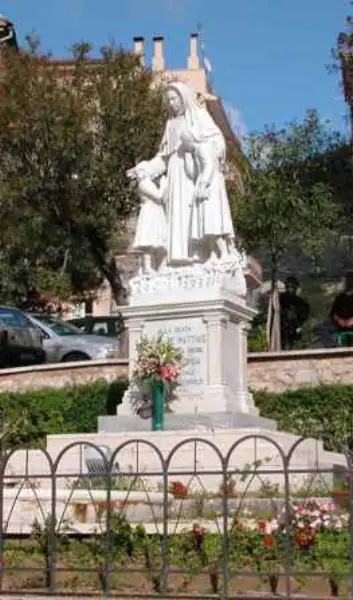
St. Maria De Mattias
Foundress of the Sisters Adorers of the Blood of Christ
Overview
Maria Matilda De Mattias was an Italian religious foundress who established the Sisters Adorers of the Blood of Christ and became one of the great women evangelizers of nineteenth-century Italy. Born on 4 February 1805 at Vallecorsa, in the Province of Frosinone, into a pious upper-class family, she grew up amid the banditry and feuding that plagued the hill towns of the Papal States, taught herself to read and write, and in her mid-teens was a vain girl absorbed in her appearance. A mystical vision at sixteen redirected her life. In 1822 she heard Gaspar del Bufalo preach on the Precious Blood of Christ, and on 4 March 1834, under the guidance of his successor Giovanni Merlini, she founded the Sisters Adorers of the Blood of Christ at Anagni — an active teaching congregation rather than a cloistered one. For more than thirty years she traveled across Italy, often on foot or by donkey, preaching Christ's redemptive love and founding over seventy communities, many of them desperately poor and sharing what little they had. She died in Rome on 20 August 1866. Pius XII beatified her in 1950, and John Paul II canonized her on 18 May 2003.
The Complete Life
The Vain Girl of Vallecorsa
Maria De Mattias was born on 4 February 1805 in Vallecorsa, a town in the Province of Frosinone, into a religious and upper-class family that valued education. Her parents, Giovanni de Mattias and Ottavia de Angelis, had four children, and she was the second born. The times were violent: the small kingdoms and republics of the Italian peninsula were chronically at war, civil life in Vallecorsa was torn by feuding factions, and young men who could find no steady work joined the bands of outlaws holed up in the mountain enclaves, whose romanticized leaders lived by raiding the villages below. with property to its name, her family dared not let Maria and her brothers play outdoors — kidnapping children for ransom was a common practice among the brigand bands. Girls received no formal schooling, and Maria educated herself, learning to read and write unaided. In her middle teens she was still withdrawn and worldly, caring more for her appearance than for religion: proud of her long blond hair, she spent hours before her mirror arranging her clothes. At the age of sixteen a mystical vision broke through this sheltered, self-absorbed adolescence and began to turn her outward, toward a life that would spend itself for others.
§ Early years
The Precious Blood and a New Foundation
A mission preached at Vallecorsa in 1822 by Gaspar del Bufalo, who had founded the Missionaries of the Precious Blood, fixed the direction of Maria's life: his theme was devotion to the Precious Blood of Jesus. She came to see the mystery of Christ's blood as a model for self-sacrifice, and she resolved to devote herself to the needy and to the spread of the word of God. The administrator of Anagni, Bishop Giuseppe Maria Lais, called upon the self-taught young woman to teach the girls of his diocese. On 4 March 1834, aged twenty-nine and guided by Merlini, del Bufalo's successor, she brought the Sisters Adorers of the Blood of Christ into being for this work. Significantly, she established it as an apostolic, active teaching order rather than a monastic one — a community meant to go out to people, not to be enclosed from them. As a sign of her consecration she made a public vow of chastity and received from Merlini — her spiritual director and, later, superior general of the Missionaries of the Precious Blood — a golden heart stamped with three drops of blood. That symbol is still worn by her sisters around the world, cast now in silver.
§ Religious life
Thirty Years on the Roads of Italy
For more than thirty years Maria De Mattias traveled throughout Italy to establish communities of her sisters, undertaking journeys that ranged from long treks on foot to perilous rides on donkey back across the mountain country she knew from childhood. Her longing to announce the redemptive love of Jesus, poured out for us in his Precious Blood, drove her to preach in every town through which she passed — an itinerant woman evangelist at a time when female preaching was almost unheard of. The congregations she planted were often desperately poor, sometimes without food in their cupboards, yet she and her sisters made it their habit to share all they possessed with the poor living around them, so that the poverty of the communities became itself part of their mission. By the time of her death the Congregation had established over seventy communities across Europe, and in 1855 the young order had received papal approval. Her achievement is measured not only in houses founded but in distances covered: a woman who began as a shut-in adolescent, afraid to leave her own courtyard because of bandits, spent her maturity on the roads of a divided and dangerous peninsula for the sake of the Gospel.
§ Religious life
The Mystery of the Precious Blood
The spiritual center of Maria De Mattias's life was the devotion to the Precious Blood of Christ that she absorbed from the preaching of Gaspar del Bufalo. Where other spiritualities might have centered on the infancy of Christ, the Passion in general, or the hearts of Jesus and Mary, hers fixed on the blood shed for the redemption of the world — the concrete price of salvation, poured out in the agony of Gethsemane, the scourging, and the cross. She drew from this mystery a whole program of life: if Christ's blood was given for others, then the Christian life is self-sacrifice for others, and the measure of love is what it costs. This was the burden of her own preaching as she moved from town to town, and it explains her impatience to be on the road, since every un-evangelized village seemed to her a place where the value of that Blood went unrecognized. It also explains the emblem she wore: the heart marked with three drops of blood, given her by Giovanni Merlini, which condensed her spirituality into a single image. The sisters who inherited it carried the same symbol into hospitals, schools, and missions, teaching that the Christian vocation is to let one's own life be poured out in the pattern of Christ's.
§ Religious life
Death in Rome
Maria De Mattias died in Rome on 20 August 1866, at the age of sixty-one, after more than three decades of travel, foundation, and preaching. She was buried in Rome's Campo Verano Cemetery, in a tomb donated by Pope Pius IX — a sign of the esteem in which her work was held at the highest level of the church. In 1950, when Pius XII beatified her, her body was moved from the cemetery into the Precious Blood chapel of her congregation's general motherhouse in Rome, so that the foundress now rests at the spiritual center of the congregation she began with a handful of women in Anagni. Her feast day preserves a personal signature: while saints are ordinarily commemorated on the day of their death, her feast is kept on 4 February, the day of her birth — a fitting arrangement for a woman whose whole life was a second birth, beginning in earnest on the day a vision turned a vain girl of Vallecorsa into an apostle. The transfer gave the congregation a shrine at its own center, where the sisters could pray beside the foundress whose preaching had once carried them out onto the roads of Italy.
§ Veneration
From Cause to Canonization
The path to Maria De Mattias's canonization began less than thirty years after her death. On 28 June 1896, once the required waiting period had elapsed, Caterina Pavoni — by then Superior General of the congregation — asked that the process be opened. More than half a century passed before the next step: on 1 October 1950 Pope Pius XII beatified her, in the same act transferring her remains to the motherhouse chapel in Rome. It fell to Pope John Paul II, whose long pontificate raised so many foundresses to the altars, to canonize her: the ceremony took place on 18 May 2003, alongside the canonization of Virginia Centurione Bracelli, and the pope afterward addressed the pilgrims who had come for the two causes. One hundred and thirty-seven years separate her death in 1866 from her canonization in 2003 — a span across which her congregation itself changed, spreading from the hill towns of central Italy to four continents. The cause that a successor began in devotion was concluded by a pope in a ceremony attended by sisters from every country where her daughters had planted communities.
§ Veneration
A Congregation on Every Continent
Today the Sisters Adorers of the Blood of Christ, some two thousand strong, carry on their foundress's work across the world. The seventy-odd European communities Maria De Mattias established in her lifetime, the congregation has spread far beyond Italy: houses exist in Bolivia, Brazil, China, Guatemala, Liberia, South Korea, the United States, and Vietnam, carrying her teaching charism and her devotion to the Precious Blood into cultures she never saw. The congregation's history has also known martyrdom: in October 1992 five American Adorers were killed amid the civil war consuming Liberia, dying in the country they had entered to serve, as their foundress had given her life in service. Her spiritual legacy endures in the emblem her sisters still wear — the silver heart marked with three drops of blood descended from the gold heart Giovanni Merlini gave her — and in the pattern of her vocation: a self-educated woman from a violent provincial town who turned personal conversion into an institution of education and evangelization for those, especially girls and the poor, whom no one else was teaching. In each of these lands her charism travels ahead of her sisters, a reminder that the blood of Christ was shed for every nation alike.
§ Legacy
Timeline
- 4 Feb 1805
Born at Vallecorsa, in the Province of Frosinone, second of the four children of Giovanni de Mattias and Ottavia de Angelis.
§ Early years
- 1822
Heard Gaspar del Bufalo, founder of the Missionaries of the Precious Blood, preach a mission in her town, and resolved to devote her life to God and the needy.
§ Religious life
- 4 Mar 1834
Founded the Congregation of the Sisters Adorers of the Blood of Christ at Anagni, under the guidance of Giovanni Merlini.
§ Religious life
- 1855
The young congregation received papal approval.
§ Religious life
- 20 Aug 1866
Died in Rome, aged sixty-one, and was buried in the Campo Verano Cemetery in a tomb donated by Pope Pius IX.
§ Religious life
- 28 Jun 1896
Caterina Pavoni, who had succeeded her as Superior General, asked that her cause be opened.
§ Veneration
- 1 Oct 1950
Beatified by Pope Pius XII; the same day, her body was moved to the Precious Blood chapel of the congregation's Roman motherhouse.
§ Veneration
- Oct 1992
Five Sisters Adorers from the United States were murdered during the civil war in Liberia.
§ Legacy
- 18 May 2003
Canonized by Pope John Paul II.
§ Veneration
The Record
- Major works
- Sisters Adorers of the Blood of Christ, founded 1834·Over seventy communities founded across Europe·Preaching missions on the Precious Blood in the towns of Italy
- Symbols
- Foundress·A heart imprinted with three drops of blood
- Canonization
- Beatified by Pope Pius XII on 1 October 1950; canonized by Pope John Paul II on 18 May 2003
Prayer
Bibliography
Show 7 sources
- "St Maria de Mattias - 1805-1866".
- "Maria De Mattias". Vatican News Service.
- "History of the Adorers of the Blood of Christ". Newman University.
- "Maria de Mattias". The Adorers of the Blood of Christ.
- Colacino, John A., C.PP.S. "At the Heart of the Christian Life: The Charism of Gaspar del Bufalo as the Basis for a Lay Spirituality". 1993.
- Riley, Corbin (2018-02-08). "The intriguing history behind the Feast Day of St. Maria De Mattias". Newman Today.
- "The Five Martyrs of the Congregation".
Profile text adapted from the Wikipedia article, licensed CC BY-SA 4.0.
Pray with this saint every day
Save St. Maria De Mattias to your favorites, read the full profile, and get feast-day reminders in the Saints app.
Get the Saints AppFree on the App Store for iPhone and iPad