
1837 – 1881·Feast May 13
St. Maria Domenica Mazzarello
Co-foundress of the Salesian Sisters
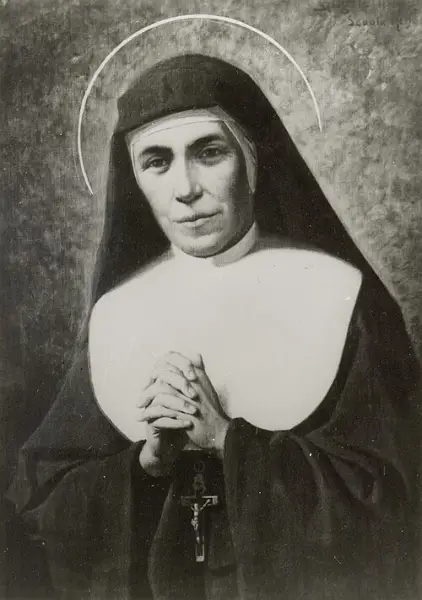
Overview
Maria Domenica Mazzarello was an Italian religious sister who co-founded the Daughters of Mary Help of Christians, the Salesian Sisters of Don Bosco. Born on 9 May 1837 at Mornese in Piedmont, the eldest of ten children of a peasant family that worked a vineyard, she joined the parish Association of the Daughters of Mary Immaculate at fifteen. At twenty-three she nursed her relatives through a typhoid epidemic, caught the disease herself, and recovered only as an invalid, robbed of the strength for field labor. Trained instead as a seamstress, she received a vision of a building full of girls at play and heard the words: I entrust them to you. She gathered the girls of her village and taught them dressmaking and the faith, and in 1872, with John Bosco, she brought the community to religious profession as the Daughters of Mary Help of Christians, becoming their first Mother. In 1877 she accompanied the first missionaries to their port at Genoa and visited the sisters in France, collapsing with fever on the journey home. She died at Nizza Monferrato on 14 May 1881, aged forty-four. She was beatified in 1938 and canonized in 1951.
The Complete Life
The Vineyard at Mornese
Maria Domenica Mazzarello came into the world at Mornese, in today's province of Alessandria in northern Italy, on 9 May 1837, born to a peasant family who worked a vineyard. She was the eldest of the ten children of Joseph and Maddalena Calcagno Mazzarelli, and the habits of the oldest child in a large rural household — responsibility, physical labor, care for the younger ones — marked her from the beginning. Her education was simple, but her spiritual life found an early form: at fifteen she joined the Association of the Daughters of Mary Immaculate, a parish group known for its charitable works, run by the parish priest Domenico Pestarino. The association would later be acknowledged as a forerunner of the Salesian Sisters, and the girl who joined it at fifteen was, without knowing it, joining the first stage of her own congregation. She grew up strong and capable, able to sustain the heavy field work of a Monferrato farm, and nothing in her surroundings suggested that within a decade her body would be broken, her trade changed from agriculture to needlework, and her name known around the world.
§ Life
Typhoid, Convalescence, and a Vision
When Maria Domenica was twenty-three, a typhoid epidemic swept through Mornese and carried off many of the villagers. Her uncle and aunt fell ill, and she offered herself as their nurse and as caretaker of their many children; within a week her nursing had brought them through, but on returning home she herself came down with the disease, and her condition was grave enough that she received the last rites of the church. She survived, but the illness left her permanently weakened: the strength that had sustained her in the fields was gone, and the robust farm worker became thin and frail. Agricultural labor now beyond her, she apprenticed to the seamstress trade in town and applied herself diligently to it — a change of fortune that, like so much of her life, would be turned to the service of others, for the skills of the loom and needle learned in convalescence became the trade she would teach to generations of girls. Walking through her village one October day after her recovery, she beheld an astonishing sight: a great building with a courtyard where girls laughed and played, while a voice told her, I entrust them to you. From that hour she gave herself to the education of girls, and persuaded her friends to join her; fifteen young women now made up the Daughters of Mary Immaculate, housed in community by Pestarino and taught dressmaking alongside the faith.
§ Life
Don Bosco Comes to Mornese
Domenico Pestarino, who trained the young women of Mornese in the spiritual life, had himself become a Salesian under John Bosco, and he told Bosco of the Daughters of Mary Immaculate. Bosco, whose own picture of girls at play matched what Maria Domenica had seen, wondered whether a female branch of his congregation might be drawn from this very community. Under cover of a fundraising tour with his boys, he came to Mornese; what he really wanted was to take the measure of the community. In 1867, after meeting them and receiving their enthusiastic response to his proposal, he drew up their first rule of life. Maria Domenica was the obvious first superior, for her own good spirits, humor, optimism, and charity were the community's wellspring — and obedience prevailed over her reluctance: at thirty she became the first Mother of the young community. On 31 July 1872 the fifteen young women, led by her, professed vows before Bosco, Pestarino, and the Bishop of Acqui, giving official birth to the Daughters of Mary Help of Christians — a date remembered as the birthday of the new religious family, called to do for girls what the Salesian priests and brothers were doing for boys in Turin. As Mother General she insisted that the sisters learn to read and write, and in 1877 she sent the first missionaries to Uruguay, accompanying them to Genoa and sailing on to visit the sisters' house and orphanage at St. Cyr in France.
§ Institute of the Daughters of Mary Help of Christians
Mother Mazzarello's Way
The sisters of the first generation gave their Mother a name that has outlived her: Mother Mazzarello. Her spirituality was unpretentious and domestic — expressed less in writings than in the daily example the community recognized as its source of good spirit, humor, optimism, and charity. She believed that the sisters needed practical competence as part of the spiritual life: as Mother General she pressed for them all to learn to read and write, skills many had never had the opportunity to acquire, because ignorance was an obstacle both to their work and to their prayer. Her dedication went beyond intellectual formation into the personal and spiritual development of each sister, and the community's affection answered in kind. The hardships she accepted with this cheerfulness were real. On the journey to France in 1877 her ship broke down and had to be dry-docked at Marseille; the promised lodging fell through; and she stuffed the sisters' sheets with straw to make makeshift beds for the whole company, then could not rise the next morning for the fever ravaging her body. Even then her first concern, the account records, was not to worry her exhausted companions, and she got up, saw the missionaries off, and continued the journey. Trust in Providence, hard work offered gladly, and joy under suffering: this was the doctrine she taught without writing a book.
§ Life
The Journey Home and a Holy Death
At St. Cyr Maria Domenica collapsed, and pleurisy kept her bedridden for forty days. Determined to breathe her last among her own sisters, she set out for Italy against her doctor's advice, breaking the journey into easy stages out of regard for her frailty. On one of the stops, providentially, John Bosco was near, and the founders of the Salesian family bade each other farewell. Early in April 1881 she reached Nizza Monferrato, where the sisters' motherhouse stood. Nizza's air seemed to revive her at first, and she stubbornly kept the community's timetable and her ordinary tasks — more than her weakened frame could bear. She relapsed, and as April closed death was plainly at hand. Her final agony began in the hours before dawn on 14 May 1881; having received the last rites, she murmured her farewell — Good-bye. I am going now — and promised the sisters weeping beside her that they would meet again in heaven. Death came soon after, when she was forty-four, having led the congregation she co-founded for less than nine years — years in which it had already crossed the ocean to South America.
§ Death
Honors of the Church
Recognition of Maria Domenica Mazzarello came within living memory of her sisters. She was beatified on 20 November 1938 by Pope Pius XI in Saint Peter's Basilica, and canonized on 24 June 1951 by Pope Pius XII, in the same basilica — the peasant of Mornese raised to the altars of the universal church less than seventy years after her death. Her incorrupt body is venerated in the Basilica of Our Lady Help of Christians in Turin, the great Salesian church of Don Bosco, where the co-foundress of his congregation rests at the center of the family she helped to build. In Rome a church in the southeast of the city bears her name, Santa Maria Domenica Mazzarello. Her memory has also passed into popular culture: the 2012 Italian biopic Maìn - La casa della felicità (The House of Happiness), which casts Gaia Insenga as Mazzarello under Simone Spada's direction, told her story under the family nickname by which her childhood home was known. Feast, basilica, church, and film keep alive the woman the Salesian family numbers among its principal saints, beside Don Bosco himself.
§ Veneration
The Sisters of Don Bosco
The Daughters of Mary Help of Christians, the congregation Maria Domenica co-founded with John Bosco in 1872, grew out of fifteen professed sisters gathered in a Mornese house to become the feminine branch of the Salesian family, doing for girls across the world what the priests and brothers did for boys in Turin. The first missionaries had already sailed for Uruguay in her lifetime, and the congregation she governed continued to expand after her death along the lines she set: schools, oratories, and trades taught to girls — farm girls, servants, factory workers, and street vendors — whom the nineteenth century exposed to the dangers of street life and juvenile prostitution, and whom she resolved to educate and to save. Her method anticipated her order's characteristic spirit: teach a trade, teach the faith, and surround the young with kindness rather than harshness. Within the Salesian constellation she holds a fixed place, listed among the great figures of the family from Francis de Sales, its patron, to the saints and blesseds of its missionary history. For women religious who began with no education and no dowry, and for all who are forced by illness to begin again, her path from the vineyard to the motherhouse remains an abiding example.
§ Institute of the Daughters of Mary Help of Christians
Timeline
- 9 May 1837
Born at Mornese, in today's province of Alessandria, firstborn among the ten children of Joseph and Maddalena Calcagno Mazzarelli.
§ Life
- 1852
Joined the Association of the Daughters of Mary Immaculate at the age of fifteen.
§ Life
- 1860
Nursed her uncle and aunt through the typhoid epidemic that struck Mornese, then fell ill herself and received the last rites.
§ Life
- 1867
John Bosco drew up the first rule of life for the Daughters of Mary Immaculate after meeting the community.
§ Institute of the Daughters of Mary Help of Christians
- 31 Jul 1872
Professed religious vows with fourteen companions before the Bishop of Acqui, John Bosco, and Domenico Pestarino, founding the Daughters of Mary Help of Christians.
§ Institute of the Daughters of Mary Help of Christians
- 1877
Accompanied the first missionary sisters to their port of call at Genoa, then traveled to France to visit the sisters there.
§ Life
- 14 May 1881
Died at Nizza Monferrato, aged forty-four, after a relapse of pleurisy contracted on the return journey from France.
§ Death
- 20 Nov 1938
Beatified by Pope Pius XI in Saint Peter's Basilica.
§ Veneration
- 24 Jun 1951
Canonized by Pope Pius XII in Saint Peter's Basilica.
§ Veneration
In Their Own Words
I entrust them to you
Good-bye. I am going now. I will see you in heaven.
The Record
- Major works
- Daughters of Mary Help of Christians (Salesian Sisters), co-founded 1872·Dressmaking school and boarding house for girls at Mornese
- Canonization
- Beatified by Pope Pius XI on 20 November 1938; canonized by Pope Pius XII on 24 June 1951
Prayer
Bibliography
Show 6 sources
- "Mary Mazzarello". Salesian Sisters of St John Bosco. 1 April 2007.
- "Santa Maria Domenica Mazzarello su santiebeati.it". Retrieved 17 November 2016.
- Farmer, David, ed. "Maria-Domenica Mazzarello". The Oxford Dictionary of Saints, 5th ed. Oxford University Press, 2011. ISBN 9780199596607.
- "MARIA DOMENICA Mazzarello, santa in Dizionario Biografico". Retrieved 17 November 2016.
- Aronica, Paul, SDB. "Gold Without Alloy: A Brief Account of the Life of St. Mary Mazzarello". Salesians of Don Bosco - USA West.
- "Mary Domenica Mazzarello". Instituto Figlie di Maria Ausiliatrice.
Profile text adapted from the Wikipedia article, licensed CC BY-SA 4.0.
Pray with this saint every day
Save St. Maria Domenica Mazzarello to your favorites, read the full profile, and get feast-day reminders in the Saints app.
Get the Saints AppFree on the App Store for iPhone and iPad