
1890 – 1902·Feast July 6
St. Maria Goretti
The child martyr of purity and forgiveness
Overview
Maria Teresa Goretti was born on 16 October 1890 at Corinaldo in the Marche region of Italy, the third of seven children of Luigi Goretti and Assunta Carlini. Her childhood was shaped by unrelenting poverty: the family gave up its farm, moved twice in search of field work, and finally settled at Le Ferriere near Nettuno, sharing a house with the Serenelli family. When Maria was nine her father died of malaria, and while her mother and older brothers and sisters labored in the fields she kept the household, cooking, sewing, and minding her youngest sister. On 5 July 1902 the Serenellis' twenty-year-old son Alessandro attempted to assault her. Maria resisted, protesting that what he intended was a mortal sin, and he stabbed her fourteen times. Carried to the hospital at Nettuno, she forgave her attacker during the night and died the following day, aged eleven. Alessandro was sentenced to thirty years in prison, repented, and after his release knelt before Assunta to ask her pardon, which she freely gave; he afterward entered the Capuchins as a lay brother. Maria was beatified in 1947 and canonized on 24 June 1950 by Pope Pius XII, becoming one of the youngest saints in the Church's history.
The Complete Life
A Childhood of Fields and Want
Maria Teresa Goretti was born at Corinaldo in the Province of Ancona on 16 October 1890, the third of seven children of Luigi Goretti and Assunta Carlini. Her earliest years were bounded by hard work and deepening want. By the time she was five the family could no longer keep its own farm, gave it up, and took employment on other people's land. In 1896 their search for field work brought them to Colle Gianturco, in country near Paliano and Frosinone some fifty miles outside Rome; three years afterward they settled at Le Ferriere, near modern Latina and Nettuno in Lazio, in a building known as La Cascina Antica. There they shared quarters with the Serenelli family, whose head, Giovanni, lived there with his son Alessandro.
Misfortune followed the household. Luigi fell ill with malaria and died when Maria was only nine years old. With her mother and older brothers and sisters at work in the fields, Maria took charge of the home: she cooked, sewed, cleaned, and watched over her little sister Teresa. She received little schooling, but the Passionist priests guided her early religious formation, and the faith they planted in her would soon be tested in the starkest way imaginable.
§ Biography
A Faith That Refused to Compromise
Maria's faith was quiet, practical, and unfailingly earnest. Her religious formation was guided by the Passionists, who later directed her cause for sainthood, and she grew to womanhood within their orbit of prayer and preaching. When Alessandro Serenelli threatened her on that July afternoon, she answered him not with pleading for her own safety but with a catechist's clarity: what he intended, she told him, was a mortal sin, and he would go to Hell for it. She fought him while crying out against the sinfulness of his purpose, insisting that she would rather die than submit.
The same moral seriousness marked her final hours. Halfway through an operation performed without anesthesia, she woke and spoke gently with the pharmacist who attended her, telling him she would gladly think of him in Paradise when he urged her to remember him there. She worried for her mother's welfare, and in a dying deposition before the chief of police she described the harassment she had endured and two earlier attempts upon her, so that the truth would stand on record. Above all, she forgave: she died expressing pardon for Alessandro and saying she wanted him with her in Heaven.
§ Death
The Afternoon of 5 July 1902
On 5 July 1902 Maria sat on the steps outside her home, sewing one of Alessandro Serenelli's shirts and watching her young sister while he worked in the barnyard. Knowing the household would be empty, the twenty-year-old returned and threatened her with an awl, intending to force himself upon her. Maria refused and resisted desperately, screaming that his intention was sinful. He choked her, stabbed her fourteen times, and then, when she tried to reach the door, struck her three more times before fleeing.
Her cries roused little Teresa, and when the adults came they found her bleeding on the floor and carried her to the hospital at Nettuno. Surgeons operated without anesthesia and were astonished that she had survived wounds that pierced her throat and injured her heart, lungs, and diaphragm. During the night she told her mother of Serenelli's harassment and of two previous attempts, explaining that she had kept silent because he had threatened to kill her. Having forgiven her attacker and expressed the wish to have him in Heaven with her, she died of her injuries the next day, 6 July 1902, at the age of eleven.
§ Death
From the Square to the Altar
Maria's cause moved with unusual speed. She was beatified on 27 April 1947 in Saint Peter's Basilica, with Pope Pius XII presiding and her mother, Assunta, present in the congregation. The Pope greeted Assunta that evening; she later recalled fainting with emotion when he laid his hand on her head and called her the mother of a Blessed, and both were seen with tears in their eyes.
The canonization followed three years afterward: on 24 June 1950 Pius XII raised Maria to the altars in a ceremony transferred to Saint Peter's Square, so vast were the crowds expected. Some five hundred thousand people, most of them young, gathered from around the world. The Pope spoke in Italian rather than Latin, declared her worthy of veneration as a saint, enrolled her in the canon of the saints, and called her the Saint Agnes of the twentieth century. Turning to the young people before him, he asked whether they were resolved to resist any attack on their chastity with the help of God's grace, and the square rang with their answering yes.
Contrary to newspaper reports of the day, Alessandro Serenelli attended neither ceremony; he and his fellow Capuchins judged that his presence would distract from the occasion. Maria's brothers testified that she had intervened in their lives, directing Angelo to emigrate and sparing Mariano in a First World War charge of which he alone survived.
§ Beatification and canonization
Patroness of a Forgiving Heart
At Nettuno, south of Rome, pilgrims venerate Maria's remains in the crypt of the Passionists' Basilica of Nostra Signora delle Grazie, named for her as well; they lie there in a wax figure within a glass casket — an arrangement that has fed the persistent but mistaken claim that her body remained incorrupt. Her July 6 feast day was added to the general calendar of the Church in the 1969 revision, and she is honored as patroness of chastity, purity, forgiveness, rape victims, girls, youth, and those living in poverty.
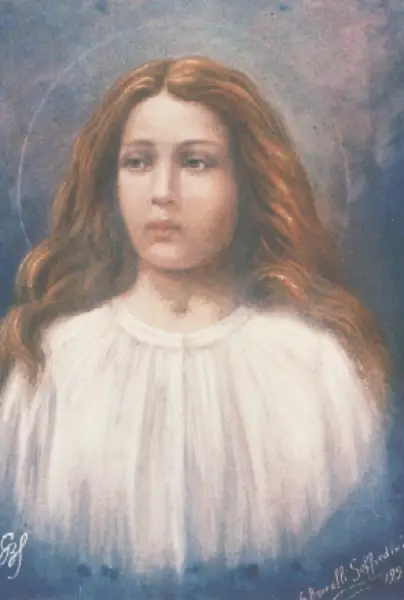
In art she appears as a girl with wavy hair, dressed as a peasant or clothed in white, carrying lilies — in Catholic iconography, classic emblems of virginity — and the Passionists reckon her among their own number. Her story, though, has gone far beyond Italy. Heaven over the Marshes, a 1949 film directed by Augusto Genina, won a prize at the Venice exhibition for its contribution to humanity's spiritual and moral betterment, and a 2003 RAI television film retold her life to critical acclaim. Schools from South Philadelphia to Toronto bear her name, and a radiophonic opera by Marcel Delannoy carried her memory further still.
§ Feast day
Timeline
- 16 Oct 1890
Born at Corinaldo in the Province of Ancona, third child of Luigi Goretti and Assunta Carlini.
§ Biography
- 1896
Her family left its farm and moved to Colle Gianturco near Paliano to work for other farmers.
§ Biography
- 1899
Her family settled at Le Ferriere near Nettuno, sharing the house with the Serenelli family.
§ Biography
- 5 Jul 1902
Alessandro Serenelli attacked her and stabbed her repeatedly when she refused to submit to him.
§ Death
- 6 Jul 1902
Died of her wounds at the hospital in Nettuno after forgiving her attacker.
§ Death
- 27 Apr 1947
Beatified by Pope Pius XII in Saint Peter's Basilica, with her mother Assunta present.
§ Beatification and canonization
- 24 Jun 1950
Canonized by Pope Pius XII before some 500,000 people gathered in Saint Peter's Square.
§ Beatification and canonization
- 1969
Her July 6 feast day was added to the general calendar in that year's revision.
§ Feast day
- 1970
Alessandro Serenelli died at the age of eighty-seven as a Capuchin lay brother, long reconciled.
§ Alessandro's imprisonment
In Their Own Words
Well, who knows, which of us is going to be there first?
We order and declare that the blessed Maria Goretti can be venerated as a Saint, and we introduce her into the Canon of Saints.
Young people, pleasure of the eyes of Jesus, are you determined to resist any attack on your chastity with the help of the grace of God?
The Record
- Patron of
- chastity·purity·forgiveness·victims of rape·girls·youth·teenage girls·poverty·Children of Mary
- Symbols
- lily·farmer's clothing·martyr's palm·white dress
- Canonization
- Canonized 24 June 1950 by Pope Pius XII in Saint Peter's Square
Prayer
Bibliography
Show 6 sources
- Hugo Hoever, ed. (1955). Lives of the Saints, For Every Day of the Year. New York: Catholic Book Publishing Co. pp. 259–260.
- Poage, Rev. Godfrey (1977). In Garments All Red. Boston: Daughters of St. Paul. ISBN 978-0-89555-615-8.
- Ruef, Vinzenz (1992). Die Wahre Geschichte von der hl. Maria Goretti. Jestetten: Miriam. ISBN 978-3-87449-101-3.
- Crusz, Noel. Maria Goretti – Saint Under Siege, July 7, 2002, The Sunday Times of Sri Lanka.
- O'Grady, Desmond. Maria Goretti: A Rush to Judgment?, 25 February 1985 in The Age newspaper of Melbourne, Australia.
- Engel, Charles D. (2020). Alessandro Serenelli: A Story of Forgiveness. Huntington, Indiana: Our Sunday Visitor. ISBN 978-1-68192-558-5.
Profile text adapted from the Wikipedia article, licensed CC BY-SA 4.0.
Pray with this saint every day
Save St. Maria Goretti to your favorites, read the full profile, and get feast-day reminders in the Saints app.
Get the Saints AppFree on the App Store for iPhone and iPad