
1826 – 1887·Feast October 11
St. Maria Soledad Torres y Acosta
Foundress of the Servants of Mary
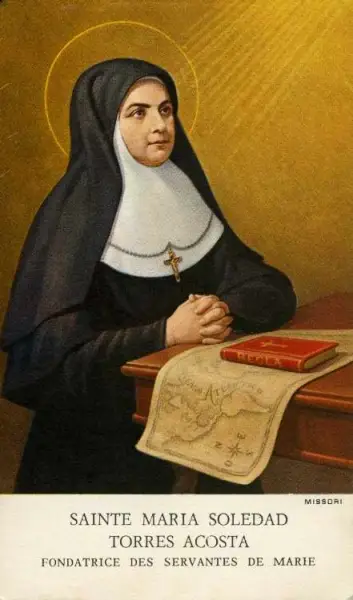
Overview
María Soledad Torres y Acosta, born Manuela on 2 December 1826 in Madrid, was a Spanish religious and the founder of the Servants of Mary, a congregation dedicated to nursing the sick and the poor in their own homes. Educated by the Vincentian Sisters and accustomed from girlhood to visiting the ill of her neighborhood, she tried in about 1850 to enter an enclosed Dominican convent but was refused because of her frail constitution. In 1851 she offered herself to Fr. Miguel Martínez Sanz, a parish priest of Chamberí who sought seven women to serve the sick poor of his parish, and on 15 August of that year she received the habit with the name María Soledad. Her leadership was repeatedly contested. Left superior when Martínez departed for the missions in 1856, she was twice removed from office — once amid chaos that nearly dissolved the young community, and again as the victim of slander — and twice reinstated after investigation. The congregation, named the Servants of Mary, became famous across the city for the sisters' tireless nursing through the cholera epidemic of 1865, served in Havana from 1875, and received definitive papal approval from Pius IX in 1876. She died of pneumonia in Madrid on 11 October 1887. Beatified in 1950, she was canonized by Paul VI in 1970.
The Complete Life
A Businessman's Daughter in Madrid
Manuela Torres Acosta was born in Madrid on 2 December 1826, the second of five children of Francisco Torres and Antonia Acosta, who ran a small business from their home near the Plaza de España. She was baptized with the names Antonia Bibiana Manuela, though the world would come to know her by another.
Her education was entrusted to the Vincentian Sisters, and the practical charity of that congregation left its mark early. The girl often visited the sick of her neighborhood and assisted in a free school the sisters ran for poor children. From childhood, too, she carried the desire to belong entirely to God in religious life.
When she was about twenty-four she sought to answer that desire in the way then open to her: entrance into an enclosed order. She applied to a Dominican convent near her home and was asked to wait until a place opened. The wait never ended in admission — her frail constitution told against her, and the Dominicans refused her. The closed door of the cloister, however, proved the opening of another path: the parish of Chamberí was about to ask for exactly the kind of woman Madrid's streets had formed her to be.
§ Life
The Seventh Member
News reached Manuela in 1851 of Miguel Martínez Sanz, a Servite tertiary who served as pastor of Chamberí. His dream was to gather seven women who would nurse the sick poor of the parish where they lay, since a hospital bed was beyond their means. It was an unglamorous idea — nursing the destitute where they lay — and it demanded women of sturdy charity rather than rank or means.
Manuela offered herself for the work. Martínez hesitated at first, yet he received her as the seventh and last of his volunteers. On 15 August 1851 the seven bound themselves to this service as a religious body, and that day she was clothed in the habit under the name by which history remembers her: María Soledad, Mary of Solitude, after the sorrowful Mother who stood faithfully at the cross.
Five years later the young community lost its founder to the missions. In 1856 Martínez departed for Fernando Pó with six of the twelve religious, leaving María Soledad as superior and as the only original member who remained.
§ Life
Superior Under Trial
The office María Soledad inherited in 1856 nearly destroyed her. The remaining religious soon removed her from the post, and the congregation fell into such disorganization that the local bishop threatened to dissolve it altogether. Summoned before him, she was examined together with the circumstances of her removal, and the bishop decided to re-appoint her as superior. With the support of her spiritual director, Gabino Sánchez, an Augustinian Recollect, she pressed on, and it was in this period that the community received the name Servants of Mary.
Public recognition followed suffering. During the cholera epidemic of 1865 the sisters' extensive and notable care of the sick made the congregation's dedication known throughout Madrid. Further trials came: slander cost her the office a second time until another investigation ended with Fr. Sánchez securing her reinstatement. While she was establishing a new foundation in Valencia, the Revolution of 1868 brought a liberalizing government to power and new dangers for religious houses, and several of the nuns left the congregation. Yet the order continued to grow, opened a mission in Havana in 1875, and received definitive papal approval from Pope Pius IX in 1876.
§ Life
Mary of Solitude
The name she took at profession — María Soledad, after Our Lady of Solitude — gathered the whole of her spiritual character into a word. Solitude marked her path from the beginning: refused by the Dominicans, she entered a work that began with only seven women; made superior at a stroke, she was left the sole survivor of the founding group; attacked by slander and twice stripped of office, she endured seasons in which almost no one stood beside her. In all of it she kept the disposition of the Mother standing quietly beneath the cross — present, unrevengeful, unmoved from her task.
Her spirituality was also utterly practical. The Servants of Mary existed to nurse the sick poor in their own homes because the poor could not buy hospital beds, and María Soledad's holiness was worked out at those bedsides, in epidemics and revolutions alike. She leaned on the sacramental guidance of her directors, especially the Augustinian Recollect Gabino Sánchez, whose interventions restored her twice; she accepted investigation after investigation without protest; and she led a congregation that grew through every humiliation. Perseverance under misrepresentation became, in her hands, a way of sanctity as demanding as any cloister.
§ Life
Death and First Translation
María Soledad died of pneumonia in Madrid on 11 October 1887, at sixty years of age, having led the Servants of Mary through three decades of internal conflict, epidemic, and political upheaval. Her liturgical feast falls, by the usual custom, on the anniversary of her death.
The story of her remains belongs to the vocabulary of nineteenth-century Catholic piety. Buried at first in a simple plot among the religious of her own congregation, she was exhumed and transferred on 18 January 1893 to the chapel of the congregation's motherhouse, which remains her major shrine. At that first exhumation her remains were found intact, and it was reported that they exuded a blood-like liquid and gave off a sweet odor. A later inspection, however, found the remains reduced to bones — decomposition had apparently advanced after the first exhumation and transfer. For her daughters the motherhouse chapel became the place where the foundress who had been cast out and restored so many times now lay in the heart of the congregation she had refused to let die. Pilgrims still come to that chapel seeking the help of a woman the city once cast out and could not spare.
§ Life
The Long Road to the Altar
The cause of María Soledad unfolded with methodical Roman patience over more than four decades. Two informative processes opened in Madrid to gather the documentation of her life, and on 21 November 1920 the theologians charged with reviewing her writings gave them their approval, and on 26 November 1924 came the title Servant of God. Rome received the acts; the Congregation of Rites approved them on 18 December 1929; an antepreparatory committee endorsed the cause on 28 July 1936, the preparatory committee on 6 July 1937, and the general committee on 11 January 1938. On 23 January 1938 Pius XI signed the decree declaring her Venerable.
Beatification required two miracles. The Congregation for Rites validated the two informative processes on those cases on 24 April 1942, and its committees approved the healings in 1943, 1949, and November 1949; among them was the cure of Sister Lucia Santiago Allende from grave tuberculosis and severe gastric complications on 10 November 1915. Both cures received the Pope's approval on 27 November 1949, and on 5 February 1950 she was beatified in Saint Peter's Basilica. Two further miracles, approved by the Congregation for the Causes of Saints on 29 October 1968 and confirmed by Paul VI on 10 November 1969, led to her canonization on 25 January 1970.
§ Canonization
The Servants of Mary Today
The congregation María Soledad raised from seven women in a Madrid parish carried her charism across the world, from Fernando Pó to Havana and beyond, and it continues under the name she gave it: the Servants of Mary, servants of the sick poor in their own homes. Her major shrine is the general motherhouse at Plaza de Chamberí in Madrid, a short distance from the parish where Fr. Martínez first gathered his seven volunteers, and there her remains rest beneath the chapel.
Her story reached a new audience in 2016, when the Spanish film Luz de Soledad portrayed her vocation and the struggles of the congregation's early years under her contested leadership. For her sisters she remains the model of authority exercised under injury: a superior twice deposed, twice vindicated, and never known to have retaliated. For the wider Church she stands among the great nineteenth-century foundresses who turned nursing the poor into a religious vocation, and her canonization in 1970, among the first of Paul VI's reign, confirmed that sanctity can be woven from endurance as surely as from genius — from showing up, day after day, at the bedsides of people the world has forgotten.
§ Canonization
Timeline
- 2 Dec 1826
Born in Madrid, the second of five children of Francisco Torres and Antonia Acosta, and baptized Antonia Bibiana Manuela.
§ Life
- 1850
Applied for admission to a Dominican convent near her home but had to wait, and was never accepted because of her frail constitution.
§ Life
- 15 Aug 1851
Committed herself with six companions to serving the sick poor of Chamberí, taking the habit and the name María Soledad.
§ Life
- 1856
Fr. Martínez left for the missions of Fernando Pó with six of the twelve religious, leaving her superior of the congregation.
§ Life
- 1865
The sisters' tireless nursing through the cholera epidemic won the young congregation renown throughout Madrid.
§ Life
- 1868
While establishing a new foundation in Valencia, she confronted the liberal government that took power in the Revolution of 1868.
§ Life
- 1875
The congregation began serving in Havana.
§ Life
- 1876
Pope Pius IX granted the Servants of Mary definitive papal approval.
§ Life
- 11 Oct 1887
Died of pneumonia in Madrid.
§ Life
- 18 Jan 1893
Her body was taken up from its grave and placed in the motherhouse chapel.
§ Life
- 26 Nov 1924
Titled a Servant of God after the theologians approved her writings in 1920.
§ Canonization
- 23 Jan 1938
Pius XI signed the decree declaring her Venerable upon confirmation of her heroic virtue.
§ Canonization
- 5 Feb 1950
Beatified by Pope Pius XII in Saint Peter's Basilica after two healing miracles were confirmed.
§ Canonization
- 25 Jan 1970
Canonized by Pope Paul VI in Saint Peter's Square.
§ Canonization
The Record
- Major works
- Servants of Mary (Servants of Mary, Madrid, 1851)
- Patron of
- Servants of Mary
- Symbols
- religious habit
- Canonization
- Canonized 25 January 1970 by Pope Paul VI in Saint Peter's Square
Prayer
Bibliography
Show 6 sources
- "Torres Acosta, María Soledad, St". Encyclopedia.com. 2003. Retrieved 13 March 2017.
- "Saint Maria Soledad Torres Acosta". Saints SQPN. 17 October 2016. Retrieved 13 March 2017.
- Gianpierro Pettiti. "Saint Maria Soledad Torres Acosta". Santi e Beati. Retrieved 13 March 2017.
- Guiley, Rosemary (2001). The Encyclopedia of Saints. Infobase Publishing. p. 223. ISBN 978-1-4381-3026-2.
- "Santa Maria Soledad", Archdiocese of Madrid. Retrieved 2018-06-15.
- "Luz de Soledad (2016)". Internet Movie Database (IMDb).
Profile text adapted from the Wikipedia article, licensed CC BY-SA 4.0.
Pray with this saint every day
Save St. Maria Soledad Torres y Acosta to your favorites, read the full profile, and get feast-day reminders in the Saints app.
Get the Saints AppFree on the App Store for iPhone and iPad