
1618 – 1645·Feast May 26
St. Mariana de Jesús de Paredes
The Lily of Quito who offered herself for her city
Overview
Mariana de Jesús de Paredes (October 31, 1618 – May 26, 1645) was a laywoman of Quito and the first saint ever raised from the land that is now Ecuador. Born to aristocratic parents — her father Jerónimo de Paredes Flores y Granobles was a nobleman of Toledo, her mother Mariana Jaramillo descended from a leading conquistador — she was orphaned at the age of four and raised by her older sister Jerónima and her husband, Cosme de Caso. In their house she lived as a recluse, leading an ascetical life often compared to that of Rose of Lima, while centering her prayer on the nearby Jesuit church and its Sodality of Our Lady. At her director's suggestion she joined the Third Order of St. Francis, taking the religious name Mariana of Jesus. Witnesses swore that her fasting was so severe as to be sustained, like Catherine of Siena's, by the Eucharist alone, and that she read hearts, foresaw distant events, and cured the sick with the sign of the cross. When earthquake and pestilence laid Quito low in 1645, she publicly gave herself as an offering for the city, and within weeks she was dead at twenty-six. Beatified by Pius IX in 1853, she was canonized by Pius XII on July 9, 1950, and declared a national heroine by Ecuador. A pure white lily, said to have sprung from her blood at death, gave her the title Lily of Quito.
The Complete Life
Orphan of the Conquistadors
Mariana de Paredes Flores y Granobles y Jaramillo was born in Quito on October 31, 1618, then a city of the Viceroyalty of Peru in the Spanish Empire. Her lineage was distinguished on both sides: Jerónimo de Paredes Flores y Granobles, her father, came of the nobility of Toledo, while her mother, Mariana Jaramillo, counted a leading conquistador among her forebears. She was the youngest of eight children, and popular devotion has long claimed that her birth was accompanied by unusual phenomena in the heavens, juridically attested during the process of her beatification.
Her childhood was cut short: she had lost both parents before her fifth birthday, and her sister Jerónima de Paredes, together with Jerónima's husband, Cosme de Caso, took the child into their home and brought her up. In their home the girl turned early toward a spiritual life, and her guardians indulged her: they allowed her to live in seclusion within the house, following an ascetical discipline often compared with that of Rose of Lima. Urged by her brother-in-law to enter a monastery, she refused; her vocation was to be a hidden one, inside the city rather than beyond its walls, mortified in body — with the aid of her Indian servant — and anchored in the Jesuit church nearby.
§ Life
A Recluse in the City
Mariana did not live in total seclusion. Her spiritual life was centered on the nearby Jesuit church, where she joined the Sodality of Our Lady, the lay association the Society of Jesus established in its churches to help ordinary believers deepen their interior lives. Her fasting became legendary. Witnesses reported that across eight or ten days she might take no more than an ounce of dry bread; what nourished her instead, they swore, was the Eucharist, received each morning at Mass — the same marvel attributed to Catherine of Siena and Rose of Lima.
Though the Jesuits formed her spirit, her official status came from the Franciscans. Her director advised her to enroll in the Third Order of St. Francis — counsel given, it seems, because the Franciscan tertiary habit conferred on her penitential life an official standing in colonial society that the Jesuits could not provide. She took the religious name Mariana of Jesus, a plain statement of where her heart lay. Fittingly for a recluse, the scapular and cord of her profession were not collected by her own hands; another went in her place to receive them. Both orders would later claim her: the Friars Minor counted her among their saints, while her Jesuit hagiographer insisted the Society had nurtured her spiritual life.
§ Life
Mystic of the Eucharist
Mariana possessed what her chroniclers call an ecstatic gift of prayer. Witnesses testified that she could foretell things to come and watch far-off happenings as though present, that she could look into hidden hearts, and that the sign of the Cross or a sprinkling of holy water from her hand was enough to drive out sickness — with at least one reported raising of the dead to life. In the religious imagination of colonial Quito, these were the credentials of a living saint, and they explain why her city watched her so closely.
Her spirituality drew its strength from two fountains: the Eucharist, received daily and, by the sworn account of witnesses, alone sustaining her life through extremes of fasting; and the humanity of Christ, to which her chosen name bore witness. The devotional world of Quito preserved her connection to a seventeenth-century image of the Christ Child crucified — the Holy Child of Mount Pichincha, whose appearance to Mariana made the crucified infancy of Jesus the center of a devotion that endured for centuries. Mortification of the body, Eucharistic adoration, and intercession for sinners composed a single ascetical program, one she shared with the great penitent women of the Americas, Rose of Lima above all, to whom she is constantly compared.
§ Life
Victim for the City
In 1645 calamity fell upon Quito. Earthquakes shook the city, and pestilence followed in their wake. Mariana answered as the great victim-souls answered: she stood before God and offered her own life in exchange for her neighbors', a public offering for the city's deliverance. Before long she fell ill, and on May 26, 1645, at twenty-six years of age, she died.
The day of her death brought, so it was told, a revelation of her holiness: from her spilled blood there rose a spotless white lily, which opened into bloom — the prodigy from which Ecuador has ever since called her the Lily of Quito. The Jesuit church that had anchored her hidden life received her body for burial. There the priest Alonso de Rojas preached on her austerities and her renunciation of the flesh, setting her before the women of the city as one to imitate: holiness over beauty, virtues over show. That funeral discourse would stand among the chief documents of the long cause that ended in her beatification and, finally, her canonization.
§ Life
Three Centuries to the Altar
The cause began at once. Scarcely was she buried when, at the Jesuits' urging, Alfonso de la Peña y Montenegro, bishop of Quito, opened the earliest inquiries — directed to her cause and to that of her niece, Sebastiana de Caso — gathering testimony to her life, virtues, and miracles. King Charles II of Spain took up the cause, eager both to bind the native-born colonists of the Americas to the Spanish nation and to prove the faith of the colonial population.
Rome moved slowly but steadily. Pope Benedict XIV signed the commission for formally introducing the cause on December 17, 1757. When the Society of Jesus was suppressed throughout the Spanish Empire in 1767, the Spanish Crown took over the cause and appointed a Chilean priest as postulator to the Holy See, while her veneration spread through the colonies of South America. The decree declaring her virtues heroic was ordered published by Pius VI, and the two cures demanded for beatification passed through the hands of all three congregations, winning papal approval on January 11, 1817, from Pius IX. The Jesuits' Superior General, Peter Jan Beckx, then petitioned for publication of the beatification Brief; on November 10, 1853, Pius IX beatified her in the Basilica of St Peter. An additional miracle, confirmed by the General Congregation, opened the way to Pius XII's canonization, celebrated in 1950.
§ Canonization
The Lily of Quito Today
Mariana's relics rest in the Church of the Society of Jesus in Quito, the Jesuit church that anchored her hidden life, and there Ecuador honors the first of its children to be raised to the altars. Since her beatification, many parishes and schools across Latin America have placed themselves under her patronage, and the teaching congregation of Religious Sisters that bears her name — begun in 1873 by Mercedes de Jesús Molina — carries her spirit into classrooms throughout the continent. The Republic of Ecuador has declared her a national heroine, a civil honor that matches her role as the country's patroness saint.
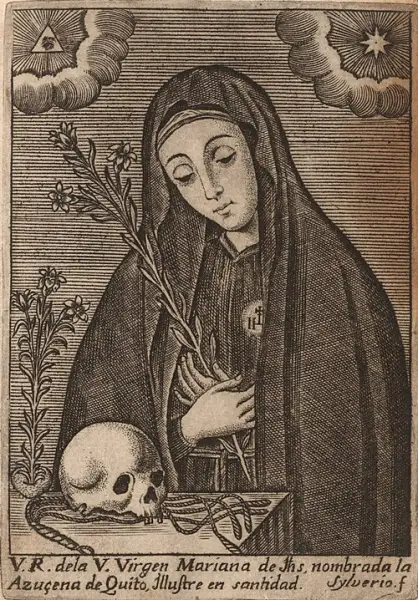
Her memory lives also in art and scholarship. An eighteenth-century engraving by Francisco Sylverio de Sotomayor fixed her image — the lily in hand, the black habit embroidered with the Christogram — and Víctor Mideros's circa 1926 painting of her levitation belongs to a rich Ecuadorian iconography. The Church keeps her feast on May 26, while the Franciscan Order observes it on May 28. Retellers of her life run from her Jesuit hagiographer Jacinto Morán de Butrón, whose life of the saint first appeared in 1732, to Frances Parkinson Keyes and Ronald Morgan have retold the story of the recluse who died so that her city might live.
§ Veneration
Timeline
- 31 Oct 1618
Born in Quito, the youngest of eight children of Jerónimo de Paredes and Mariana Jaramillo.
§ Life
- 1645
As earthquake and pestilence struck Quito, publicly presented herself as an offering for the city.
§ Life
- 26 May 1645
Died in Quito shortly after her offering; a white lily was said to have sprung up from her blood.
§ Life
- 17 Dec 1757
Pope Benedict XIV signed the commission for the formal introduction of her canonization cause.
§ Canonization
- 11 Jan 1817
Two miracles worked through her intercession were formally approved by Pope Pius IX.
§ Canonization
- 10 Nov 1853
Solemnly beatified by Pope Pius IX in the Basilica of St Peter in Rome.
§ Canonization
- 1873
A congregation of teaching sisters named for her was founded by Mercedes de Jesús Molina.
§ Veneration
- 9 Jul 1950
Canonized by Pope Pius XII in Vatican City after a further confirmed miracle.
§ Canonization
In Their Own Words
Learn girls of Quito, from your fellow countrywoman, [to prefer] holiness over beauty, virtues over ostentation.
The Record
- Patron of
- Ecuador·Quito
- Symbols
- lily·black religious habit embroidered with the Christogram
- Canonization
- Canonized 9 July 1950 by Pope Pius XII in Vatican City
Prayer
Bibliography
Show 7 sources
- López Molina, Hector. "Santa Mariana de Jesús". Enciclopedia de Quito.
- "CATHOLIC ENCYCLOPEDIA: Bl. Mary Anne de Paredes". www.newadvent.org. Retrieved 2018-08-12.
- Morgan, Ronald J. Spanish American Saints and the Rhetoric of Identity, 1600-1810. Tucson: University of Arizona Press 2002.
- Morán de Butrón, Jacinto, S.J. Vida de Santa Mariana de Jesús. Quito: Imprenta Municipal 1955. First published in 1732.
- Espinosa Pólit, Aurelio, S.J. Santa Mariana de Jesús, hija de la Compañía de Jesús. Quito: La Prensa Católica 1956.
- Keyes, Frances Parkinson. The Rose and the Lily. New York: Hawthorn 1961.
- "Biografía de Santa Mariana de Jesús Paredes". ACI Prensa.
Profile text adapted from the Wikipedia article, licensed CC BY-SA 4.0.
Pray with this saint every day
Save St. Mariana de Jesús de Paredes to your favorites, read the full profile, and get feast-day reminders in the Saints app.
Get the Saints AppFree on the App Store for iPhone and iPad