
1838 – 1918·Feast January 23
St. Marianne Cope
Franciscan nurse of Molokai's leper colony
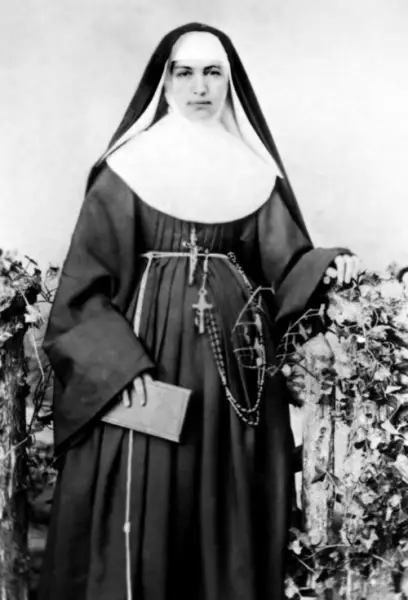
Overview
Marianne Cope, born Barbara Koob on January 23, 1838 in Heppenheim in the Grand Duchy of Hesse, was a German-born American Franciscan and one of the great hospital administrators of nineteenth-century America. Her family emigrated to Utica, New York the following year; left school after eighth grade to work in a textile factory when her father became disabled, she entered the Sisters of the Third Order Regular of Saint Francis in Syracuse after his death in 1862, taking the name Marianne. She led schools for German-speaking immigrant children, sat on her congregation's governing council by 1870, and governed Syracuse's first public hospital, St. Joseph's, from 1870 to 1877, having founded two Catholic hospitals whose charters promised care to all regardless of race or creed. In 1883, as Superior General, she answered King Kalākaua's plea for nurses to care for victims of leprosy in Hawaii, after more than fifty congregations had refused. She managed the receiving hospital on Oʻahu, opened Maui's first general hospital, founded the Kapiolani Home for the children of patients, and in November 1888 moved to Kalaupapa on Molokaʻi, where she took over the burdens of the dying Father Damien and cared for the colony's women, girls, and boys. She died at Kalaupapa on August 9, 1918, never having contracted the disease. Beatified in 2005, she was canonized by Benedict XVI in 2012.
The Complete Life
From Hesse to Utica
Barbara Koob first saw the world in Heppenheim, a town of the Grand Duchy of Hesse, where she was born on 23 January 1838 to Peter Koob and Barbara Witzenbacher. She was still an infant when her parents crossed the Atlantic; the Koobs made their home in Utica, a smoking industrial city of upstate New York, joined the parish of St Joseph, and in due course took out American citizenship under a name the new country found easier to say: Cope.
Poverty taught her responsibility early. Her father's health failed while she was still in grade school, and as the eldest child she abandoned her own classes for the looms of a textile mill so that the family could eat. Her sacramental life took shape at Utica's Old St. John's Church, where she made her First Communion and was confirmed. Only in 1862, when her father died and the younger Koobs could fend for themselves, could she follow the call she had carried for years. She entered the Franciscan Sisters' novitiate in Syracuse; a year of formation later she was clothed in the habit and given the name she would carry across an ocean: Sister Marianne.
§ Birth and vocation
Builder of Hospitals
The young Sister Marianne was assigned to education, teaching and then directing the congregation's new schools for the children of German-speaking newcomers, whose numbers had swelled after the upheavals of 1848. Administrative gifts surfaced quickly: by 1870 she sat on the governing council of the congregation itself.
Her energies then turned to healing. She took part in establishing Central New York's first two Catholic hospitals, and she insisted on charters carrying a pledge that bordered on the radical: admission and treatment for everyone, whatever their race or creed. From 1870 until 1877 she ran St. Joseph's, Syracuse's first public hospital, on assignment from the Superior General.
She proved equally farsighted in medical training. When Geneva Medical College, then attached to Hobart College, relocated to Syracuse as the university's new medical school, Marianne signed an agreement taking its students onto her wards for clinical experience — on one non-negotiable condition. Any patient who did not want a student's hands upon him could refuse. In an era when teaching hospitals too easily treated the poor as material, that clause was almost unheard of. Years spent wrangling with doctors, boards, and governments on behalf of people with no leverage of their own became the apprenticeship for what awaited her in the middle of the Pacific.
§ Birth and vocation
Hungry for the Work
The letter that changed her life arrived in 1883 over the signature of King Kalākaua of Hawaii, begging for someone — anyone — to nurse his people afflicted with leprosy. More than fifty congregations had already said no; the disease was thought to be a death sentence for those who touched it. Marianne answered yes, and said so in writing: her whole heart, she told him, was in the work, and no disease held any terror for her. She sailed from Syracuse with six companions aboard the Mariposa and landed at Honolulu on 8 November 1883.
Their assignment was the Kakaʻako Branch Hospital on Oʻahu, the clearing station where patients gathered from every island were examined before the worst cases were shipped on to Molokaʻi. She soon displayed the spine that had made her a formidable administrator at home. An official appointed by the government mistreated the patients; she informed the authorities that he must go, or her Sisters would pack for Syracuse. He went. At the government's request she opened Maui's first general hospital at Malulani in 1884. The king decorated her with the Royal Order of Kapiolani, and in November 1885 she founded the Kapiolani Home, built on hospital land for daughters orphaned or abandoned by the disease — for no one but her Sisters would take charge of children so tainted in the public mind.
§ Call to Hawaii
Molokai
Political change altered the colony's fate in 1887: the new administration abolished forced transportation to Molokai and shut down the Oahu receiving hospital. The next year officials came with one more request — a home on the Kalaupapa peninsula for the colony's women and girls. Marianne understood what acceptance meant: the likelihood that she would never see New York again. Her reply was tranquil and characteristic — the work would be accepted, and accepted gladly. In November 1888 she took up residence at the Bishop Home on Kalaupapa.
Father Damien was already a figure of world fame, and now he was dying. Marianne had made his acquaintance soon after landing in the islands; now she stood at his bedside and, little by little, took up the loads he could no longer carry. When he died on 15 April 1889, the government formally transferred to her the care of the colony's boys, in addition to the women already under the Sisters. Joseph Dutton handled the boys' daily routine at Kalawao, where the Board of Health furnished the Sisters a carriage for the journey between settlements. A gift from the businessman Henry Perrine Baldwin in 1892 raised a new home bearing his name; once four Brothers of the Sacred Heart landed in 1895, she drew her Sisters back to the Bishop Home, leaving the boys to the Brothers' care.
On 9 August 1918 she died there as she had lived there — peacefully, and untouched by the disease she had served for thirty-five years.
§ Molokai
Venerable, Blessed, Saint
A healed life opened the cause. In 1993 Katherine Dehlia Mahoney, dying of multiple-organ failure, prayed for the Franciscan sister she had never met and recovered. Rome moved step by step: the Congregation for the Causes of Saints pronounced her virtues heroic in October 2003; John Paul II declared her Venerable the following April; and on 20 December 2004, with the Congregation's unanimous assent, he authenticated the Mahoney cure as a genuine miracle. Benedict XVI, who had succeeded John Paul weeks earlier, beatified her on 14 May 2005. Hawaiʻi sent more than a hundred pilgrims to the ceremony and Syracuse three hundred sisters; as the Mass proceeded, with Cardinal José Saraiva Martins presiding, the choir sang Makalapua, the old Hawaiian song Marianne had loved.
The second cure followed with unusual speed. On 6 December 2011 the Congregation attributed one more healing to her intercession; thirteen days later Benedict signed the canonization decree, and on 21 October 2012 she was raised to the altars. History recorded her twice over: the second saint of the Hawaiian Islands after Damien himself, the first to be beatified by Benedict, and the last canonized during his reign. Waldery Hilgeman served as postulator of the cause.
§ Canonization
An Honor Roll of Firsts
Marianne's memory is written in institutions. Saint Francis Hospital was founded in Honolulu in 1927 as a community hospital in her memory, training nurses to work with Hansen's disease patients; it later opened a child development center and the first home-health service in Hawaii specializing in care for Hawaiian people. The Saint Francis School, a girls' school founded in her honor in 1924, still carries her name, and the community she planted on Molokai continues to minister to the last Hansen disease patients, while Franciscan Sisters serve in schools and parishes across the Hawaiian Islands.
Honors accumulated in her final century. She was inducted into the National Women's Hall of Fame in 2005. A statue was dedicated in Honolulu on her feast day, January 23, in 2010, and another raised in 2007 at St Joseph's Church in her native Utica. Her remains, moved to Syracuse in 2005 and interred in a marble sarcophagus by 2009, were returned in 2014 to the Cathedral Basilica of Our Lady of Peace in Honolulu, where Damien had been ordained and where she had sometimes attended Mass. Since 2022 the Episcopal Church has honored her jointly with Damien of Molokaʻi on April 15, and Paul Cox's 1999 film Molokai: The Story of Father Damien introduced her, in the person of actress Alice Krige, to movie audiences.
§ Legacy and honors
Timeline
- 23 Jan 1838
Born Barbara Koob in Heppenheim in the Grand Duchy of Hesse.
§ Birth and vocation
- 1839
Her family crossed the Atlantic and made its new home in Utica, New York.
§ Birth and vocation
- 1862
Entered the Syracuse novitiate of the Franciscan Third Order Regular after her father's death.
§ Birth and vocation
- 1870
Joined the governing council of her congregation and was appointed to govern St. Joseph's Hospital, Syracuse's first public hospital.
§ Birth and vocation
- 8 Nov 1883
Arrived in Honolulu with six sisters aboard the SS Mariposa to answer King Kalākaua's plea for care of leprosy patients.
§ Call to Hawaii
- 1884
Opened Malulani Hospital on Maui, that island's first general hospital, at the government's request.
§ Call to Hawaii
- Nov 1885
Opened the Kapiolani Home to shelter homeless female children of leprosy patients.
§ Call to Hawaii
- 1887
A change of government abolished the policy of exiling patients to Molokai by force and shut the Oahu specialty hospital.
§ Call to Hawaii
- Nov 1888
Settled at Kalaupapa to lead the Bishop Home, a refuge for girls and women with the disease.
§ Molokai
- 15 Apr 1889
Father Damien died, and the government gave her official charge of the care of the colony's boys.
§ Molokai
- 1892
Henry Perrine Baldwin donated money for a new home, which was named after him.
§ Molokai
- 1895
With the Sacred Heart Brothers now on site, the Sisters withdrew to the Bishop Home to serve the women and girls alone.
§ Molokai
- 9 Aug 1918
Died peacefully at Kalaupapa; laid to rest within the Bishop Home's grounds.
§ Death
- 19 Apr 2004
Pope John Paul II issued a decree declaring her Venerable.
§ Beatification
- 14 May 2005
Beatified in Vatican City by decision of Pope Benedict XVI.
§ Beatification
- 21 Oct 2012
Canonized by Pope Benedict XVI in Vatican City.
§ Canonization
- 2014
Her remains were returned to Honolulu and enshrined at the Cathedral Basilica of Our Lady of Peace.
§ Death
In Their Own Words
I am hungry for the work and I wish with all my heart to be one of the chosen Ones, whose privilege it will be, to sacrifice themselves for the salvation of the souls of the poor Islanders... I am not afraid of any disease, hence it would be my greatest delight even to minister to the abandoned 'lepers.'
The Record
- Major works
- St. Joseph's Hospital, Syracuse·Malulani Hospital, Maui·Kapiolani Home, Honolulu·Charles R Bishop Home for Unprotected Leper Girls and Women, Kalaupapa
- Patron of
- leprosy patients·Hawaiʻi·outcasts
- Symbols
- Franciscan habit
- Canonization
- Canonized 21 October 2012 by Pope Benedict XVI in Vatican City
Prayer
Bibliography
Show 8 sources
- Hanley, Mary Laurence; Bushnell, O. A. (January 1992). Pilgrimage and Exile: Mother Marianne of Molokai. University of Hawaii Press. ISBN 978-0-8248-1387-1.
- Pope Benedict XVI (May 14, 2005). "Apostolic Letter by which he raised to the glory of the altars the Servants of God: Ascensión Nicol Goñi and Marianne Cope". The Holy See.
- Karch, Krista J. (May 11, 2005). "The road to sainthood: Mother Marianne worked years in Utica mills before joining convent". The Utica Observer-Dispatch.
- "Biography of St Marianne Cope". Sisters of St Francis of the Neumann Communities. Retrieved September 3, 2011.
- "Biography - Marianne Cope (1838-1918)". Official Vatican website. Retrieved March 19, 2010.
- Adamski, Mary (May 5, 2005). "'Blessed' Mother Cope: The Kalaupapa nun reaches the second step to sainthood". Honolulu Star-Bulletin.
- Lesser Feasts and Fasts 2018. Church Publishing, Inc. December 1, 2019. ISBN 978-1-64065-234-7.
- Downes, Patrick (October 26, 2012). "A Second Saint for Molakai" (PDF). Hawaii Catholic Herald. ISSN 1045-3636.
Profile text adapted from the Wikipedia article, licensed CC BY-SA 4.0.
Pray with this saint every day
Save St. Marianne Cope to your favorites, read the full profile, and get feast-day reminders in the Saints app.
Get the Saints AppFree on the App Store for iPhone and iPad