
1817 – 1898·Feast March 10
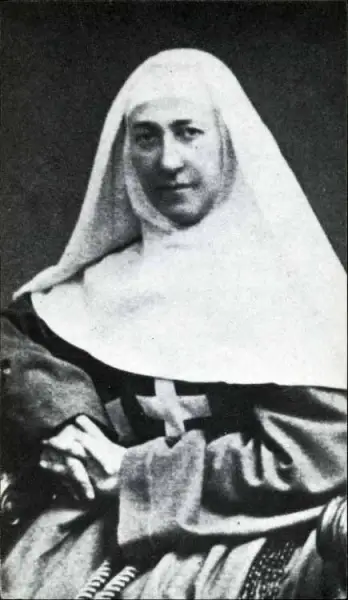
St. Marie-Eugénie de Jésus
Foundress of the Religious of the Assumption
Overview
Marie-Eugénie de Jésus — in baptism Anne-Eugénie Milleret de Brou, born at Metz on August 25, 1817 — was a French nun who brought the Religious of the Assumption into being and ranks among the modern Church's saints of education. Raised in a wealthy but irreligious family, she was marked at her First Communion in 1829 by an experience of God she called the original grace of her life. Bankruptcy, revolution, and the death of her mother from cholera stripped away her childhood security, and in 1836 the Lenten preaching of Abbé Lacordaire at Notre-Dame de Paris brought about her profound conversion. In 1839, in a small apartment near Saint-Sulpice, she founded the Religious of the Assumption, a congregation both contemplative and apostolic, given over to the transformative education of young girls in view of the transformation of society. Over fifty-five years as superior she founded thirty religious communities in nine countries, gave the congregation Constitutions modeled on the Rule of St. Augustine, and encouraged the foundation of the Assumptionists. She died at Auteuil on March 10, 1898, was beatified by Pope Paul VI in 1975, and canonized by Pope Benedict XVI on June 3, 2007.
The Complete Life
A Childhood of Revolution and Loss
The birth of Anne-Eugénie Milleret de Brou took place in the night of August 25, 1817, at Metz, the second of the five children of Jacques Milleret and his wife Eleonore-Eugénie de Brou. Her father, a liberal admirer of Voltaire, made his fortune in banking and politics; her mother, without her husband's indifference to religion, cared for the poor and drew her children into that service. The family was not religious, yet at her First Communion on Christmas Day 1829 the girl was seized with the immensity of God and bound to him, as she put it, by a bond of love, an experience she would name for the rest of her life as the primal grace from which all else flowed. Prosperity collapsed in 1830, when the financial shock of the July Revolution bankrupted her father and forced the sale of the family château; Anne-Eugénie went with her mother to Paris while Mr. Milleret stayed behind in Metz to rebuild. Her mother died of cholera in 1832, and the orphaned girl passed into the household of a wealthy family friend, then in 1835 to Parisian relatives whose narrow piety stifled her. Profoundly alone, she began to question the meaning of life and happiness.
§ Childhood
Conversion at Notre-Dame
In 1836 she attended the series of Lenten conferences at Notre-Dame de Paris preached by Abbé Lacordaire, the great Dominican apologist of the age. His preaching reached the desolate young woman at the center of her questioning and produced a profound conversion that oriented the rest of her life. She told him so herself in a later letter: his words had answered all her thoughts, completed her understanding, given her a generosity and a faith nothing would ever make waver again. Hungry to know God more fully, she read the contemporary writers who treated the great questions of society and faith, among them Bourdaloue and Joseph de Maistre. Then in 1837, the year following her conversion, her path crossed that of Father Combalot, who spoke to her of founding a congregation devoted to the education of young girls, envisaging a social renewal enlightened by the values of the Gospel. To prepare herself she spent time boarding with the Benedictines of the Blessed Sacrament and then passed through a brief noviciate among the Sisters of the Visitation, gathering in those houses the formation a foundress would need.
§ Conversion
The Foundress of the Assumption
On April 30, 1839, Anne-Eugénie established the Religious of the Assumption in a modest apartment close to the Paris church of Saint-Sulpice. At the young congregation's first Mass in November of that year she and three companions received their religious names, and Anne-Eugénie became Marie-Eugénie de Jésus. She made initial vows on August 14, 1841, and perpetual profession on Christmas Day 1844 into the hands of Mgr Affre, archbishop of Paris. To secure the vitality of her institute she labored on Constitutions drawn from the Rule of St. Augustine; in 1867 her institute was raised to the rank of one of pontifical right, and in 1888 Leo XIII approved its final Constitutions. A tireless foundress, she established thirty religious communities across nine countries, encouraged the foundation of the Assumptionists, and gave initial formation to the other congregations of the Assumption family. Her first care was always her sisters, their happiness, formation, and work, and her letters track with anxiety their health, for more than two hundred of them died before her, often young and of tuberculosis. Beside her stood Father Emmanuel d'Alzon, her spiritual director from 1841 and her friend until his death in 1880, and Mother Thérèse-Emmanuel O'Neill, novice mistress of the congregation for over forty years.
§ Foundation of the Religious of the Assumption
The Last Years and the Tomb in Paris
In 1894, after fifty-five years of service, Marie-Eugénie resigned the office of Superior on account of ill health, leaving to others the government of the congregation she had raised from a Paris apartment to an international institute. Her last illness drew around her the Church's final rites: she received the Last Rites on February 13, 1898, and the Viaticum on March 9, dying at three in the morning of March 10, 1898, at the age of eighty. Her funeral on March 12 was celebrated by Benoît-Marie Langénieux, Cardinal Archbishop of Reims. She was buried at the Mother House of her congregation in Paris, at number 17 rue de l'Assomption, where her tomb became a place of recourse for the religious who called her mother and for the lay faithful who had learned her name. More than a century later her communion with the Church of France found a striking emblem: one of her relics was enclosed within the new altar of Notre-Dame de Paris when the cathedral, renovated after the catastrophic fire of 2019, was restored to worship. To the religious who outlived her she left the pattern of a governance wholly given to the welfare of her sisters, and the memory of a foundress who had carried them, one by one, to the threshold of their profession.
§ Death
From Servant of God to Saint
The cause of Marie-Eugénie advanced through the twentieth century with methodical Roman regularity. An informative process opened in the archdiocese of Paris under Cardinal Jean Verdier ran from 1934 to 1936, and her writings received theological approval twice, on February 1, 1939, and July 8, 1949. Pope Pius XII formally introduced the cause on April 17, 1940, giving her the title Servant of God. The apostolic process, directed by Cardinal Emmanuel Célestin Suhard, ran from 1941 to 1943, and the Congregation for Rites validated both processes on December 14, 1945. The antepreparatory committee approved the cause on May 9, 1951, the preparatory committee on June 7, 1960, and the general committee on June 6, 1961; on June 21, 1961, Pope John XXIII confirmed her heroic virtue and declared her Venerable. Pope Paul VI beatified her in Saint Peter's Square on February 9, 1975. The canonization miracle came from Manila, where in 2003 the cause of Risa Bondoc, a Filipina born with a rare brain defect that had left the hemispheres of her brain unjoined, was opened and closed; after her adoptive mother laid the child on Marie-Eugénie's tomb in Paris, the girl who could not walk or talk grew into an adult who does both, though the two halves of her brain remain unjoined. Pope Benedict XVI approved the miracle on December 16, 2006, and canonized her on June 3, 2007.
§ Sainthood
Transformative Education for the World
Marie-Eugénie's enduring monument is a congregation that carries her vision of education as an instrument of social transformation to the ends of the earth. The Religious of the Assumption she founded in 1839 remains dedicated to transformative education, staffed by the religious names and the spirit she gave it, and honored with her as its patron in its schools and houses; under her patronage also stand students, for whose formation she spent her life. Her friendship with Emmanuel d'Alzon bore fruit beyond her own institute, for she stood behind the founding of the Assumptionists and gave a first formation to the wider Assumption family of congregations, so that her influence spread through several religious orders rather than one. The thirty communities she planted in nine countries made her one of the great international foundresses of the nineteenth century, a woman who read the disorders of a France exhausted by revolution and answered them with schools. Canonized in 2007 as a saint of the universal Church, she is remembered for teaching that the transformation of society begins with the education of the young, especially girls, and for a faith that, by her own testimony, nothing could ever shake.
§ Religious life
Timeline
- 25 Aug 1817
Is born during the night at Metz, one of five children born to Jacques Milleret and his wife Eleonore-Eugénie de Brou
§ Childhood
- 25 Dec 1829
Receives her First Communion on Christmas Day and is seized by the immensity of God, the grace she regards as the source of all that follows
§ Childhood
- 1830
Sees her father bankrupted by the financial fallout of the July Revolution; the family château is sold and the household separates
§ Childhood
- 1832
Loses her mother to cholera and is entrusted afterward to a wealthy family friend
§ Childhood
- 1836
Attends the Lenten lectures of Abbé Lacordaire at Notre-Dame de Paris and undergoes the conversion that orients her whole life
§ Conversion
- 30 Apr 1839
Brings the Religious of the Assumption to birth in a modest apartment beside Saint-Sulpice in Paris
§ Foundation of the Religious of the Assumption
- 14 Aug 1841
Makes her initial vows, clothed with the religious name Marie-Eugénie de Jésus at the first Mass her congregation celebrated in November 1839
§ Foundation of the Religious of the Assumption
- 25 Dec 1844
Professes her perpetual vows into the hands of Mgr Affre
§ Foundation of the Religious of the Assumption
- 1867
Sees her congregation officially erected an institute of pontifical right
§ Foundation of the Religious of the Assumption
- 1888
Receives papal approval of the congregation's final Constitutions from Pope Leo XIII
§ Foundation of the Religious of the Assumption
- 1894
Resigns as Superior after fifty-five years of service, her health failing
§ Religious life
- 10 Mar 1898
Dies at Auteuil at three in the morning, the day after receiving the Viaticum
§ Death
- 21 Jun 1961
Is declared Venerable after Pope John XXIII confirms she lived a life of heroic virtue
§ Sainthood
- 9 Feb 1975
Is beatified in Saint Peter's Square by Pope Paul VI
§ Sainthood
- 3 Jun 2007
Is canonized in Saint Peter's Square by Pope Benedict XVI
§ Sainthood
In Their Own Words
Your words answered all my thoughts. They completed my understanding of things; they gave me a new generosity, a faith that nothing would ever be able to make waver again. I was truly converted!
The Record
- Major works
- Religious of the Assumption, founded 1839·Constitutions of the Religious of the Assumption, inspired by the Rule of St. Augustine
- Patron of
- Religious of the Assumption·students
- Canonization
- Canonized 3 June 2007, Saint Peter's Square, Vatican City, by Pope Benedict XVI; beatified 9 February 1975 by Pope Paul VI
Prayer
Bibliography
Show 6 sources
- "Saint Marie-Eugénie de Jésus". Saints SQPN. 8 March 2017. Retrieved 1 April 2017.
- "Blessed Marie-Eugénie de Jésus". Holy See. Retrieved 1 April 2017.
- "3 June 2007: Canonization of the Blesseds: Giorgio Preca, Szymon di Lipnica, Karel van Sint Andries Houben and Marie Eugénie de Jésus". Holy See. 3 June 2007.
- "Marie Eugénie Milleret, Foundress of the Religious of Assomption". Religious of the Assumption. March 1993.
- "Qui était sainte Marie-Eugénie ?". La Croix (in French). Retrieved 2 April 2025.
- "Savez-vous pour quel miracle une Messine a été canonisée ?". Le Républicain Lorrain (in French). Retrieved 25 March 2025.
Profile text adapted from the Wikipedia article, licensed CC BY-SA 4.0.
Pray with this saint every day
Save St. Marie-Eugénie de Jésus to your favorites, read the full profile, and get feast-day reminders in the Saints app.
Get the Saints AppFree on the App Store for iPhone and iPad