
1756 – 1846·Feast July 16
St. Marie-Madeleine Postel
Foundress of the Sisters of Christian Schools
Overview
Marie-Madeleine Postel, born Julie Françoise-Catherine Postel at Barfleur in Normandy on November 28, 1756, was a French Catholic religious who brought the Sisters of Christian Schools into being. The daughter of a fisherman, she was educated by the Benedictine nuns at Valognes and there discerned a call to the religious life, sealing it with a private vow of chastity. In 1774 she opened a school for girls at Barfleur that became, during the French Revolution, a center of underground religious activity: her school was shut down at the Revolution's beginning, and she used it instead to house fugitive priests at the risk of her life, while carrying the Blessed Sacrament on her person to bring the Viaticum to the dying. After the Revolution she taught some 300 children at Cherbourg, professed vows in the Franciscan Third Order in 1798, and on September 8, 1807, established the Sisters of the Christian Schools at Cherbourg. The congregation prospered after she acquired a derelict convent at Saint-Sauveur-le-Vicomte in 1832. She died there on July 16, 1846, was beatified in 1908, and was canonized by Pope Pius XI on May 24, 1925.
The Complete Life
The Fisherman's Daughter of Barfleur
The birth of Julie Françoise-Catherine Postel took place on November 28, 1756, at Barfleur on the Cotentin coast of Normandy, the daughter of Jean Postel, a fisherman, and Thérèse Levallois. From her mother's line would come another religious vocation in the family, for she was the aunt of Placide Viel, who would herself win renown as a religious. After her first schooling Julie was sent to the Benedictine nuns at Valognes, who oversaw the further education that shaped her mind and piety. It was during those years under the Benedictines that she came to discern a call to give herself wholly to God in the religious life, and she bound herself by a private vow of chastity as a first step toward the dream not yet within reach. The Revolution would postpone any formal consecration for years, but the resolve formed in the convent school at Valognes never faltered, and it expressed itself first in the work she chose while still a laywoman: the instruction of girls in her native port town. Barfleur in the mid-eighteenth century was a hardy fishing port whose families knew the risks of the sea, and the faith of such communities was sturdy, practical, and deeply rooted.
§ Life
Teacher and Concealer of Priests
In 1774 Julie founded a school for girls at Barfleur, an enterprise that within fifteen years became entangled with the fate of the Church in France. When the Revolution broke out the school was shut down at its beginning, but the closed schoolhouse found a new and more perilous use: it became a center of underground religious activity for those who would not support the new regime, and Julie housed fugitive priests within it despite the great risk such hospitality posed to her life. As the conflict went on she received permission to keep the Blessed Sacrament in her home, and at times she carried it on her person, bringing the Viaticum to the sick who stood at the brink of death. The Jacobins of the district often suspected her of these activities but never brought allegations and left her alone. In 1798, with the Terror past, she professed vows in the Third Order of Saint Francis and assumed the religious name under which history would know her, Marie-Madeleine. Few lives of the period joined such contrasting trials: schoolmistress in peacetime, shelterer of hunted priests in revolution, and bearer of the Eucharist to the dying.
§ Life
The Sisters of the Christian Schools
When the Revolution ended, Postel resumed her teaching, this time at Cherbourg, where she catechized and instructed around 300 children. Out of this pedagogical work grew the institute with which her name is forever joined: on September 8, 1807, she founded the Sisters of the Christian Schools at Cherbourg, a congregation intended to carry Christian education to the daughters and sons of ordinary families. The early years met with little success, and the congregation might have dwindled had not its foundress, already advanced in age, taken a decisive step: in 1832, at seventy-five, she acquired a derelict convent at Saint-Sauveur-le-Vicomte to serve as the order's headquarters, and from that house the congregation at last flourished. The Bishop of Coutances, Claude-Louis Rousseau, granted diocesan approval to the institute, which in 1859, after the foundress's death, was granted the decree of praise by Pope Pius IX and its full papal approval in 1901. Drawing its first rule from the Franciscan Third Order, the congregation adopted in 1837 that of the De La Salle Brothers, a change that also brought a modification of its name.
§ Life
The Convent at Saint-Sauveur
Postel closed her long life at Saint-Sauveur-le-Vicomte in the Manche, the town whose derelict convent she had reclaimed for her congregation fourteen years earlier. She died there on July 16, 1846, at the age of eighty-nine, having survived the Revolution that had hunted her, the Napoleonic settlement that had constrained the Church, and the Restoration and July Monarchy that followed, outliving by decades nearly everyone who had shared her first school at Barfleur. The burial place prepared for her in the church of Saint-Sauveur-le-Vicomte became the visible center of her memory. The congregation she left behind carried on the work of Christian education she had begun with a single girls' school in a fishing port, and in time it extended far beyond the Normandy coast: her congregation works on in countries that include Romania and Mozambique, numbering in 2005 some 442 religious in 69 different locations worldwide. The woman who died as the Revolution's fugitive-priest harborer had become the mother of an international teaching congregation. She had governed her congregation into her late eighties, an age at which most founders have long since died and left their work to other hands.
§ Life
Honors of the Altar
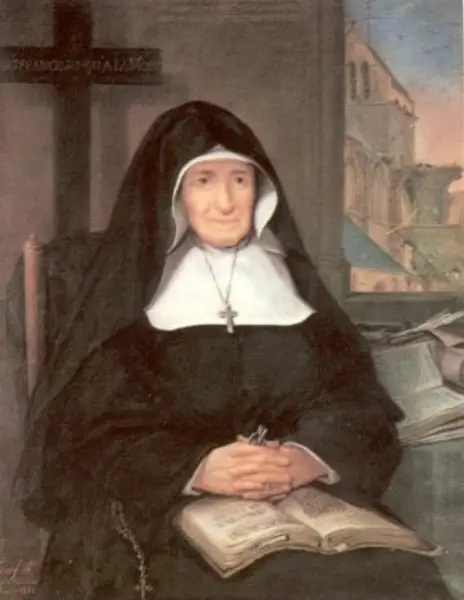
The cause of Marie-Madeleine Postel was formally begun under Pope Leo XIII, who on July 27, 1897, opened the process by which she became titled a Servant of God. The same pope, on May 31, 1903, confirmed that her life displayed heroic virtue and declared her Venerable. Pope Pius X, on January 22, 1908, gave his approval to two healings, carefully investigated and credited to her intercession, and beatified her on May 17, 1908, in Saint Peter's Basilica. Two additional miracles were confirmed for Pope Pius XI, who canonized her on May 24, 1925, in the same basilica, raising to the altars a woman who had died less than eighty years before as a diocesan religious of the Normandy coast. Her feast is kept on July 16, the anniversary of her death. She is represented in religious habit with a crucifix, the emblems of a life that carried the cross through revolutionary France, and she is honored in a special way by the Sisters of Christian Schools, the congregation she founded, who claim her as their patron and mother. The rapidity of those honors, coming within a single lifetime of her death, tells how vivid the memory of the Revolution's survivors still was in the France of the early twentieth century.
§ Canonization
A Congregation Without Borders
The legacy of Marie-Madeleine Postel is measured in the endurance of the institute she raised from the ruins of a Norman convent. The Sisters of the Christian Schools, grounded after 1837 on the pedagogical rule of the De La Salle Brothers, outlived their foundress by nearly two centuries and carried her commitment to Christian schooling far from the Manche: the congregation works today in countries such as Romania and Mozambique, and as recently as 2005 counted 442 religious in sixty-nine locations worldwide. Her own family continued her tradition of consecrated service through her niece Placide Viel, and the foundress's memory is entwined with the whole narrative of the French Church's survival of the Revolution, for the schoolhouse that hid priests and the hands that carried the Viaticum to the dying have become emblematic of the quiet heroism of the women who kept the faith alive when its public exercise was outlawed. Canonized in 1925 as a saint of Christian education, she stands for the Church as a witness that the faith is transmitted less by institutions than by individuals willing to risk everything for it.
§ Life
Timeline
- 28 Nov 1756
Is born at Barfleur, Normandy, to Jean Postel, a fisherman, and Thérèse Levallois
§ Life
- 1774
Founds a school for girls at Barfleur that will later shelter fugitive priests during the Revolution
§ Life
- 1798
Makes her religious profession in the Third Order of Saint Francis and assumes her religious name
§ Life
- 8 Sep 1807
Founds the Sisters of the Christian Schools at Cherbourg
§ Life
- 1832
Acquires a derelict convent at Saint-Sauveur-le-Vicomte for her congregation's headquarters, prompting its growth
§ Life
- 1837
Sees the congregation's rule changed from that of the Franciscan Third Order to that of the De La Salle Brothers, with a change of name
§ Life
- 16 Jul 1846
Dies at Saint-Sauveur-le-Vicomte, Manche, at the age of eighty-nine
§ Life
- 27 Jul 1897
Her cause is opened under Pope Leo XIII and she becomes titled a Servant of God
§ Canonization
- 31 May 1903
Pope Leo XIII confirms her heroic virtue and declares her Venerable
§ Canonization
- 17 May 1908
Is beatified by Pope Pius X in Saint Peter's Basilica after his approval of two healed miracles
§ Canonization
- 24 May 1925
Is canonized by Pope Pius XI in Saint Peter's Basilica on the confirmation of two further miracles
§ Canonization
The Record
- Major works
- Sisters of the Christian Schools, founded 1807·School for girls at Barfleur, founded 1774
- Patron of
- Sisters of Christian Schools
- Symbols
- religious habit·crucifix
- Canonization
- Canonized 24 May 1925, Saint Peter's Basilica, by Pope Pius XI; beatified 17 May 1908 by Pope Pius X
Prayer
Bibliography
Show 4 sources
- "Saint Marie-Madeleine Postel". Saints SQPN. 21 August 2017. Retrieved 4 October 2017.
- "Santa Maria Maddalena Postel". Santi e Beati. Retrieved 4 October 2017.
- "Saint Mary Magdalen Postel". Roman Catholic Saints. Retrieved 4 October 2017.
- Abbé François-Augustin Delamare, Vie édifiante de la très honorée supérieure Marie-Madeleine, née Julie Postel, réédition le Livre d'histoire, 2005; ISBN 2-8437-3726-5
Profile text adapted from the Wikipedia article, licensed CC BY-SA 4.0.
Pray with this saint every day
Save St. Marie-Madeleine Postel to your favorites, read the full profile, and get feast-day reminders in the Saints app.
Get the Saints AppFree on the App Store for iPhone and iPad