
1701 – 1771·Feast October 16
St. Marie-Marguerite d'Youville
Widow, Foundress of the Grey Nuns of Montreal
Overview
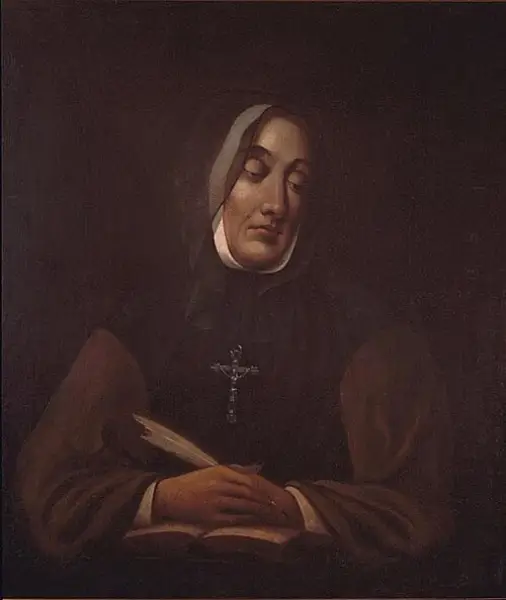
Marie-Marguerite d'Youville, born Marie-Marguerite Dufrost de Lajemmerais at Varennes in New France on October 15, 1701, was a French Canadian widow whose foundation of the Sisters of Charity of Montreal — the congregation known everywhere as the Grey Nuns — carried her to the altars as the first person born on Canadian soil to be raised to sainthood. Orphaned young and married at twenty-one to François d'Youville, a bootlegger who traded liquor illegally with Indigenous peoples for furs, she endured the death of her husband in 1730 and of four of her six children in infancy, and turned her grief into an unshakable trust in God's compassionate love. In 1737, with three companions, she founded an association to shelter the poor of Montreal, mocked by contemporaries as les grises yet firmly established by 1744 as a religious congregation with a rule. In 1747 her sisters took charge of the ruined General Hospital of Montreal, restoring its finances and rebuilding it after the fire of 1765. She died at the hospital on December 23, 1771. Beatified by Pope John XXIII in 1959, hailed as the mother of universal charity, she was canonized by Pope John Paul II on December 9, 1990.
The Complete Life
The Girl from Varennes
Marie-Marguerite Dufrost de Lajemmerais first saw the light on October 15, 1701, in the parish of Varennes, Quebec, eldest child of Christophe du Frost, lord of la Gesmerays, and of Marie-Renée Gaultier de Varennes; colonial custom meant she went through life simply as Marguerite. The family lost its head while the children were small, and poverty followed; yet two years of schooling were found for the eleven-year-old Marguerite with the Ursulines at Quebec City, after which she came home and took charge of educating her younger brothers and sisters. Her hopes of a distinguished match foundered when her mother took as second husband Timothy Sullivan, an Irish physician whom French Canadian opinion judged a disreputable foreigner of inferior rank, and the promised engagement of the young Marguerite to a leading man of Varennes society dissolved. Instead, on August 12, 1722, in Montreal's Notre-Dame Basilica, she gave her hand to François d'Youville, a trafficker in illegal liquor who bartered brandy to Indigenous peoples for furs and was often absent from home for long stretches, his whereabouts unknown. Six children were born of the marriage before François died in 1730, four of them lost in infancy.
§ Early life and marriage
Renewal in Sorrow
By her thirtieth year Marguerite d'Youville had buried her father, her husband, and four of her six children, a catalogue of losses that might have embittered a less resilient soul. Instead her marriage years had brought a profound religious renewal. The testimony the Church preserves of her relates that every one of these afflictions deepened Marguerite's conviction that God stood present in her life, loving each human person tenderly; her answer was to labor for others in works of charity, leaning on the Father she trusted without reserve. This turn from private grief to public charity was the true beginning of her vocation. The widow who had known the indifference of colonial society and the unkindness of fortune would now spend herself for those society neglected, and the theological virtue of trust, forged in bereavement, became the mark by which her spiritual children would recognize her. It was this inward conversion, accomplished before any foundation, that made the association of 1737 possible. In an age that read widowhood as misfortune, she made of it a vocation, and the suffering that might have closed her in upon herself opened her outward toward the poor of her city.
§ Early life and marriage
The Grey Nuns and the General Hospital
In 1737 Marguerite joined with three other women to found an association that would give Montreal's poor a home, at first a modest household of four or five members sustained by the funds the women raised. Their way of life flouted the social conventions of the day, and they paid for it in ridicule: friends, relatives, and even the poor they served mocked them, and some called them les grises, a phrase that could mean the grey women but also carried the coarser sense of the drunken women, a barb aimed at the bootlegging of Marguerite's late husband. The mockery failed to stop what the work had begun. By 1744 the group had been constituted as a religious congregation, living under a rule with formal common life; a charter of 1747 then put the General Hospital of Montreal into their hands, an establishment then derelict and crushed by debt. D'Youville and her fellow workers restored its financial security, and when fire destroyed the hospital in 1765 the congregation rebuilt it soon after. As the sisters spread to other cities the congregation became known simply as the Grey Nuns, the insult transfigured into an honored name.
§ Grey Nuns of Montreal
Death at the General Hospital
Marguerite d'Youville died on December 23, 1771, at the age of seventy, in the General Hospital she had rescued from ruin, the institution that stood as the proof of her life's work. The hospital of her last years was not unmarked by the moral compromises of the colonial age: historians have ranked her among the more prominent slave owners of Montreal, and she and the Grey Nuns relied on enslaved laborers within the hospital, purchasing and selling both Indian slaves and British war prisoners, among them an English captive bought from the Indigenous holders. This record, soberly examined by modern historians, belongs to the whole truth of her story and of the institution she governed. After her death her status only increased, as the faithful who prayed for her intervention testified to the aid they received. In the next century her memory ripened into a cause, and the congregation she founded carried her spirit, and her hospital, into the modern age, expanding to other cities under the name the mockers had given and never disowning. Whatever judgment history renders upon that economy of bound labor, her career cannot be read apart from the colonial world that formed it and its methods of work.
§ Slave owner
Mother of Universal Charity
The path to the altars began formally after theologians had given their approval to her spiritual writings on February 1, 1888, and her cause for beatification was formally inaugurated on April 28, 1890, conferring the title Servant of God. Pope Pius XI declared her Venerable on June 16, 1931. In 1959 Pope John XXIII beatified her, acclaiming her the mother of universal charity, a title that gathered into two words the widow's charism of trust and mercy. The review process for canonization included examination of a healing of acute myeloid leukemia that medicine could not account for, in a woman whose disease had returned after remission and who remains the only known long-term survivor of that condition in the world, alive more than forty years after a condition that typically kills within eighteen months. On December 9, 1990, Pope John Paul II canonized her in Saint Peter's Basilica, making her the first native-born Canadian elevated to the honors of the altar. Her feast is kept on October 16, and a shrine built in 1961 at her birthplace of Varennes preserves the memory of the girl of that riverside village who became a saint of the universal Church.
§ Veneration
An Honored Name in Two Countries
The congregation Marguerite d'Youville founded carried her name and her work across Canada and beyond, and institutions by the hundred honor her: churches, schools, shelters for women, charity shops, and many other works in Canada and worldwide, most notably D'Youville University in Buffalo, New York, the Catholic institution of higher learning that bears her name. The D'Youville Academy, opened in 1860 at Plattsburgh in New York State, was listed on the United States National Register of Historic Places in 1978. In 2010 her remains left the Grey Nuns Motherhouse and were brought to Varennes, the village of her birth, where the shrine of 1961 now keeps a permanent exhibit about her life and works. The honor of the state has joined that of the Church: on September 21, 1978, Canada Post issued a postage stamp in her honor, designed by Antoine Dumas and printed by the Canadian Bank Note Company, and Lady Jetté, wife of a Lieutenant Governor of Quebec, wrote her biography. First native-born Canadian saint, foundress whose congregation outlived the ridicule that named it, she remains the mother of universal charity whose charity had also, as historians now record, its own compromised shadows.
§ Recognition
Timeline
- 15 Oct 1701
Is born at Varennes, New France, first child of Christophe du Frost, lord of la Gesmerays, and of Marie-Renée Gaultier de Varennes
§ Early life and marriage
- 12 Aug 1722
Marries François d'Youville at Notre-Dame Basilica in Montreal
§ Early life and marriage
- 1730
Is left a widow by the death of François d'Youville, having borne six children and buried four of them in infancy
§ Early life and marriage
- 1737
Joins three companions in founding the association that will shelter Montreal's poor
§ Grey Nuns of Montreal
- 1744
Sees her little company constituted a religious congregation, ruled and formally formed in common life
§ Grey Nuns of Montreal
- 1747
Takes over with her sisters Montreal's General Hospital under charter, a ruin buried in debt
§ Grey Nuns of Montreal
- 1765
Sees the General Hospital destroyed by fire, and rebuilds it soon after with her congregation
§ Grey Nuns of Montreal
- 23 Dec 1771
Dies at the General Hospital of Montreal at the age of seventy
§ Veneration
- 1 Feb 1888
Has her spiritual writings approved by theologians
§ Veneration
- 28 Apr 1890
Has her beatification process formally opened and receives the title Servant of God
§ Veneration
- 16 Jun 1931
Is declared Venerable by Pope Pius XI
§ Veneration
- 3 May 1959
Is beatified by Pope John XXIII, who hails her as the mother of universal charity
§ Veneration
- 9 Dec 1990
Is canonized by Pope John Paul II, becoming the first native-born Canadian declared a saint
§ Veneration
- 2010
Has her remains relocated from the Grey Nuns Motherhouse to her birthplace of Varennes
§ Final resting place
In Their Own Words
In all these sufferings Marguerite grew in her belief of God's presence in her life and His tender love for every human person.
Mother of universal charity
The Record
- Major works
- Sisters of Charity of Montreal (the Grey Nuns), founded 1737·General Hospital of Montreal, administered from 1747
- Symbols
- religious habit
- Canonization
- Canonized 9 December 1990, Saint Peter's Basilica, Vatican City, by Pope John Paul II; beatified 3 May 1959 by Pope John XXIII
Prayer
Bibliography
Show 5 sources
- Herbermann, Charles, ed. (1910). "Grey Nuns". Catholic Encyclopedia. Vol. 7. New York: Robert Appleton Company.
- Jaenen, Cornelius J. (March 4, 2015) [March 2, 2008]. "Marie-Marguerite d'Youville". The Canadian Encyclopedia (online ed.). Historica Canada.
- Lacelle, Claudette (1979). "Dufrost de Lajemmerais, Marie-Marguerite". In Halpenny, Francess G. (ed.). Dictionary of Canadian Biography. Vol. IV (1771–1800) (online ed.). University of Toronto Press.
- Lindsay, Lionel (1912). "Marie-Marguérite d'Youville". In Herbermann, Charles (ed.). Catholic Encyclopedia. Vol. 15. New York: Robert Appleton Company.
- Foster, William Henry (2003). The Captors' Narrative: Catholic Women and Their Puritan Men on the Early American Frontier. Cornell University Press.
Profile text adapted from the Wikipedia article, licensed CC BY-SA 4.0.
Pray with this saint every day
Save St. Marie-Marguerite d'Youville to your favorites, read the full profile, and get feast-day reminders in the Saints app.
Get the Saints AppFree on the App Store for iPhone and iPad