
c. 119 – 139·Feast July 18
St. Marina of Aguas Santas
Virgin martyr of Aguas Santas in Galicia
Overview
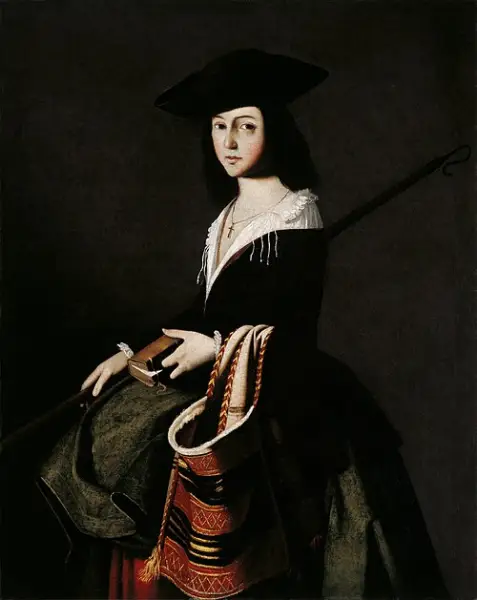
Marina of Aguas Santas, also honored as Marina of Ourense, is remembered as a Christian virgin martyr of the Roman province whose shrine at Aguas Santas in the province of Ourense remains a center of devotion. The traditional account places her birth at Xinzo de Limia, on the Roman road that linked Braga with Astorga, in a family of local standing. Raised by a nurse after her mother died in childbirth, she was baptized within a small community served by a priest named Teotimo, a choice that estranged her from her Roman father. At about fifteen, while tending cattle, she attracted the attention of the prefect Olibrio, who sought her as wife, concubine, or slave; her repeated refusals moved him to denounce her as a Christian. Imprisoned and tortured, she stood firm at trial, offering no incense to the Roman gods, and was condemned to death by beheading. A spring of water was said to have flowed where her severed head touched the ground, and the site of her martyrdom came to be called Aguas Santas, the Holy Waters. The story as it has come down is a mingling of history and legend, yet it has shaped devotion across Galicia, Castile, Andalusia, and northern Portugal since late antiquity.
The Complete Life
A Birth at the Edge of Empire
Marina of Aguas Santas is traditionally said to have been born at Xinzo de Limia, in the Romanized region of La Limia known in antiquity as Forum Limicorum. The Vía Nova, the imperial road linking Bracara, modern Braga in Portugal, with Asturica, now Astorga, ran through this country, and her family belonged to its provincial world. Her father, remembered as Theudio or Teódulo, was a man of some standing; her mother died giving birth to her, leaving the infant in need of a nurse. Following the counsel of physicians, Theudio entrusted the child to a woman called Aya, who came from a farm at Pinnitus. The small community where Marina was raised was served by a priest named Teotimo, and under her nurse's guidance the girl came to know the Christian faith. She received baptism, a decision that estranged her from her father, whose outlook remained Roman and pagan. The record of these early years is woven with legend, yet it consistently presents a child formed in the faith by a foster mother's devotion rather than by her own household, and a family divided by the daughter's conversion.
§ Legend
The Refusal of Olibrio
Raised within the rural community at Pinnitus, Marina lived the ordinary life of a countryside household, occupied with farming and the grazing of cattle. Her youth was a quiet one, spent in labor that left room for the practice of the faith she had embraced at baptism. That peace broke when she was about fifteen years old. Minding the cattle one day near the road, she caught the eye of Olibrio, a young Roman prefect, who was struck by the beauty of the stranger. He resolved to possess her, offering to take her as his wife, his concubine, or his slave according to whatever rank he judged her to hold. Marina rejected his overtures again and again, and her constancy turned his admiration into hostility. Unable to win her consent, the prefect denounced her as a Christian, a charge that under Roman law carried the threat of death. Her refusal, repeated in the face of mounting danger, is the trait by which her legend defines her: a young woman without worldly power who would not bargain away her faith to purchase safety or comfort.
§ Legend
Trial and Martyrdom
Marina was imprisoned and made to endure tortures designed to break her resistance. Because the decree of Trajan was then in force, the judges could condemn any Christian to die who would not renounce the faith. Brought to trial, she would not disown her Christianity, nor did any incense touch her hands in honor of the deities of Rome; for this constancy she was sentenced to beheading, the execution allotted to a Roman citizen. She was led to an open field, set at the required distance from the town, where the sentence was carried out. The account preserves a sign said to have followed: when the executioner's blade had fallen and her head touched the ground, water flowed from the spot. Her death was localized at Aguas Santas, in the vicinity of Ourense, where her remains were afterwards kept in a church bearing her name. An alternate tradition numbers her among nine sisters, daughters of the governor Lucius Catilius Severus and his wife Calcia, ordered drowned in the Miñor River, rescued by a Christian servant, baptized by Saint Ovidius of Braga, and at last put to death together, a spring gushing from the ground where they were beheaded.
§ Legend
The Growth of Her Cult
Marina's cult is ancient, though the facts of her life resist verification. After the Edict of Milan in 313, when Christians could once more honor their dead openly, the place of her burial near the Ribeira Sacra is thought to have been inhabited by anchorites or monks who guarded her memory and welcomed the pilgrims drawn to the grave of the martyr. Around 800, devotion to Marina took root at Aguas Santas, and it eventually received monumental form in the Romanesque church of Santa Mariña de Aguas Santas raised there in the late twelfth century. The historian friar Juan Muñoz de la Cueva proved a zealous champion of her cause after consulting a thirteenth-century manuscript in which the friar Egidio de Zamora testified that the saint's story had been copied from a writing by the priest Teotimus, an authority likewise cited in the Palencia breviary. In 1586 Cardinal Caesar Baronius inscribed Marina in the Roman Martyrology; from that year forward, the eighteenth of July has been kept as her feast. The present Roman Martyrology no longer lists her, and medieval writers occasionally confused her with Margaret of Antioch, who was also sometimes called Marina.
§ Veneration
Patroness of Ourense and Wider Spain
Marina of Aguas Santas is honored as patroness of Ourense, and the breadth of her devotion shows itself in the countless churches and shrines that bear her name across the dioceses of Galicia and Astorga, and farther off in Córdoba and Seville. Her relics are believed to rest in the church of Santa Marina de Aguas Santas, in the town of that name some fifteen kilometres from Ourense and not far from Allariz. Pilgrims still make their way to the spot, where the waters tied to her passion are believed to possess healing power. Córdoba honors her at its parish church of Santa Marina, and Fernán Núñez likewise keeps a church under her invocation; Seville preserves a Gothic-Mudéjar church of Santa Marina, built in the thirteenth century on San Luis street. From Vizcaya and Asturias to Aragon and the villages of Castile, parishes and chapels keep her feast, including Villarcayo, Cigales, Magán, and Estopiñán del Castillo. In Portugal she is patroness of the parish of Santa Marinha e São Pedro da Afurada in Vila Nova de Gaia, while Galician municipalities such as Rubiá, Teo, Cambados, Las Nieves, and her native Xinzo de Limia venerate her as their protector.
§ Patronage
Timeline
- 119
Born at Xinzo de Limia in the Romanized region of La Limia, according to the traditional account.
§ Legend
- 139
Beheaded near Aguas Santas after refusing to deny Christ or offer incense to the Roman gods.
§ Legend
- 313
Following the Edict of Milan, anchorites were believed to keep vigil at her tomb and care for pilgrims.
§ Veneration
- 800
A formal cult in her memory began to take shape at Aguas Santas.
§ Veneration
- 1586
Baronius inscribed her name in the Roman Martyrology, fixing her feast on July 18.
§ Veneration
The Record
- Major works
- Romanesque church of Santa Mariña de Aguas Santas, built at her shrine in the late twelfth century
- Patron of
- Patroness of Ourense·Patroness of Santa Marinha e São Pedro da Afurada, Vila Nova de Gaia·Patroness of Galician municipalities including Rubiá, Teo, Cambados, and Xinzo de Limia
- Symbols
- A spring of holy water
- Canonization
- Ancient pre-congregation martyr; Baronius added her to the Roman Martyrology in 1586.
Prayer
Bibliography
Show 6 sources
- Fuentes Varela, Arturo R., "Santa Marina de Aguas Santas", Real Academia de la Historia
- "Santa Marina de Aguas Santas - Orense", La Guía Digital del Arte Románico
- José María Castroviejo, Galicia: Guía Espiritual de una Tierra (Madrid: Espasa-Calpe, 1960), 340
- Fernández Alonso, Justo. "Santa Marina di Orense Martire", Santi e Beati, July 30, 2002
- "Santa Marina de Aguas Santas (R)", Prerrománico Tourismo, Asociación de Amigos del Arte Altomedieval Español
- "The fortress church", España es Cultura, Ministry of Culture and Sport
Profile text adapted from the Wikipedia article, licensed CC BY-SA 4.0.
Pray with this saint every day
Save St. Marina of Aguas Santas to your favorites, read the full profile, and get feast-day reminders in the Saints app.
Get the Saints AppFree on the App Store for iPhone and iPad