
c. 5th century·Feast June 18
St. Marina the Monk
Ascetic of Qannoubine who lived as Marinos
Overview
Marina the Monk, also called Marinos, is a saint of Byzantine hagiography generally located in present-day Lebanon, probably in the fifth century, whose story is among the most retold of the disguised female monks. Born to a wealthy Christian family at Al-Qalamoun near Tripoli, she lost her mother early and was raised devoutly by her father Eugenius. When he prepared to arrange her marriage and withdraw to the Monastery of Qannoubine in the Kadisha Valley, she asked to join him instead; she shaved her head, dressed as a man, took the name Marinos, and entered the monastery at his side. After her father's death she lived on in hiddenness, and her trial came when she falsely accepted blame for fathering a child, bearing expulsion and public disgrace in silence for years while raising the boy at the monastery gates. Her sex was discovered only when monks prepared her body for burial after her death at forty, and her innocence in the affair came to light beside her grave, where a blind monk was said to have recovered sight by touching her remains. Her cult spread through Syriac, Coptic, Latin, Arabic, and other translations across East and West.
The Complete Life
A Childhood at Al-Qalamoun
Marina was born at Al-Qalamoun, near Tripoli in what is now Lebanon, the child of wealthy Christian parents. Her mother died while Marina was still very young, and the girl was brought up in devout Christianity by her father, Eugenius, who filled for her the place of both parents. The household possessed means and standing, and as Marina approached the age considered suitable for marriage, Eugenius naturally looked toward finding her a husband. Yet the father had formed another purpose for his own life: he meant to settle his daughter's future and then retire from the world to the Monastery of Qannoubine, in the Kadisha Valley of Lebanon, to prepare his soul for God. The prospect of this double parting — a wedding for the daughter, a cloister for the father — set the stage for the decision that would define Marina's life. The tradition preserved at Qannoubine and among the Maronites holds her to be a daughter of this Lebanese soil, though her story traveled so widely that many lands later claimed her as their own. From that mountain village the road of her legend would run to Alexandria, Constantinople, Venice, and the monasteries of the whole Christian world.
§ Legend
Together into the Kadisha Valley
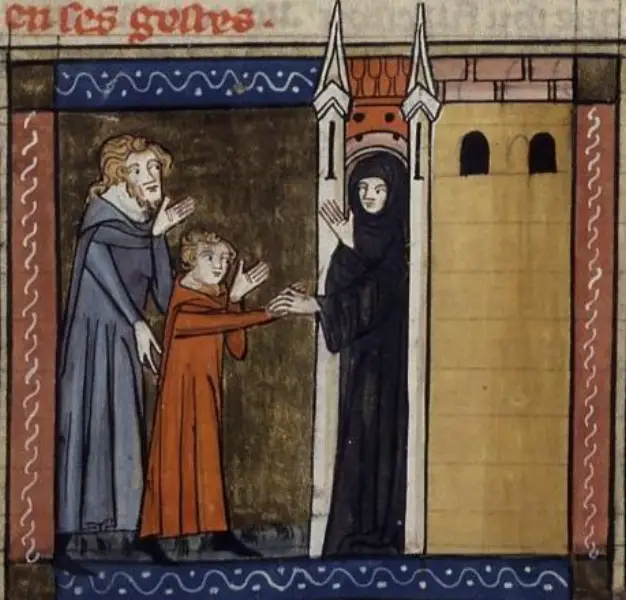
When Marina learned of her father's intention to place her in marriage and retire to a monastery, she questioned why he meant to save his own soul while, as she put it, destroying hers. Eugenius answered that he did not know what to do with her, since she was a woman; Marina replied that they would live as monks together. Her resolve settled the matter. She shaved her head, exchanged her clothing for that of a man, and took the name Marinos. Her father, convinced by such unshakable resolve, distributed everything he owned among the poor and set out with Marinos for the Kadisha Valley, where the two entered the monastic community and shared a single cell. The monks noticed nothing amiss in their new brother; the softness of Marinos' voice was explained away as the effect of long hours in prayer, or else the community concluded that the newcomer was a eunuch. In this manner the disguise held, and father and child pursued their common calling side by side in the Lebanese mountain monastery. The choice she had forced upon Eugenius — that a daughter could be given to God as wholly as a son — stands at the origin of one of the most beloved tales of Eastern monasticism.
§ Legend
Hidden Asceticism and a False Charge
For ten years Eugenius and Marinos prayed, fasted, and worshiped together, until the father died and Marinos was left alone. Solitude only deepened the ascetic resolve: Marinos applied herself more intently than before to the disciplines of the monastery and continued to conceal her sex with complete success. The trial that tested this hiddenness came through an act of another's sin. Sent with three fellow monks on business for the monastery, Marinos lodged with them at an inn, where a soldier of the eastern Roman frontier seduced the innkeeper's daughter and told her to name the young monk, Father Marinos, if she conceived. When her pregnancy was discovered and the accusation reported, the abbot sternly reprimanded Marinos, who fell to the floor in tears and confessed to a sin never committed, judging it better to be thought a sinful man than to be revealed an honorable woman. Expelled from the monastery, Marinos lived for years as a beggar outside its gates, raised the innkeeper's child on sheep's milk from local shepherds, and returned only when the monks prevailed on the abbot — who imposed hard labor as the price of readmission.
§ Legend
Death and Vindication
Marinos bore the double burden of harsh penances and the care of the child until the age of forty, when illness struck and death followed three days later. The abbot directed that the body be washed, clothed in fresh garments, and carried to the church for the funeral prayers, and in performing these offices the monks discovered that their brother Marinos had been a woman. Grief seized the community, and the abbot came to the body and wept bitterly over the wrongs his severity had heaped upon the innocent. The innkeeper, summoned and told the truth, stood before the body and wept likewise for the suffering his credulity had caused. During the funeral prayers a monk blind in one eye was said to have regained his sight after touching the remains. God was believed also to have allowed a tormenting spirit to drive the innkeeper's daughter and the soldier to the saint's burial place, where before the assembled brothers they confessed their deceit and begged forgiveness. Thus the liar was honored and the slander undone, though only when Marina could no longer hear it.
§ Legend
A Cult Known East and West
Marina is venerated in the Eastern Orthodox churches, the Coptic Orthodox Church, and the Maronite Catholic Church, and her feast is kept on June 18 in the Roman Martyrology, which records her passion at Alexandria as a virgin; the Maronite Synaxarion remembers the nun of Qannoubine on July 17, the same date marking the translation of her relics at Venice. Coptic Christians commemorate her departure on Mesra 15 and claim that her body, kept at Saint Mary Church, remains incorrupt and is shown to the public on her feast. She is honored even beyond Christianity: the Druze venerate her as Al-Sitt Sha'wani', whose shrine stands at Amiq on the slopes of Mount Barouk, overlooking the Bekaa Valley toward Mount Hermon. In 2022 the Episcopal Church added her to its liturgical calendar with a feast on 17 June. The availability of her life in Syriac, Coptic, Latin, Arabic, Ethiopic, French, German, Greek, and Armenian versions made her known to believers East and West, and in modern times her story has drawn renewed attention as part of transgender history and LGBTQ+ Christian reflection.
§ Veneration
Timeline
- 525
The first biographical account of Marinos was composed sometime in the period between 525 and 650.
§ Legend
- 2022
Officially added to the Episcopal Church liturgical calendar in the United States with a feast on 17 June.
§ Veneration
The Record
- Patron of
- Pregnant women·Girls
- Canonization
- No formal canonization record; venerated since antiquity by the Maronite, Eastern Orthodox, Coptic Orthodox, and Episcopal churches.
Prayer
Bibliography
Show 10 sources
- "Saint Marina of Bithynia", CatholicSaints.info
- Snelders, Bas; Immerzeel, Mat (2012–2013). "From Cyprus to Syria and Back Again: Artistic Interaction in the Medieval Levant". Eastern Christian Art. 9 (79): 79–106. doi:10.2143/ECA.9.0.3044824
- "Venerable Mary (who was called Marinus)", Orthodox Church in America
- Khūrī, Fuʼād Isḥāq (2004). Being a Druze. Routledge. p. 39. ISBN 9781904850014
- Roman Martyrology: "At Alexandria, the passion of St. Marina, virgin."
- Synaxarion: "Saint Marina the nun of Qannoubeen (North of Lebanon)"
- Hourani, Guita G. (January–June 2000). "Saint Marina the Monk". The Journal of Maronite Studies. 4 (1).
- Constantinou, Stavroula (2005). Female corporeal performances: reading the body in Byzantine passions and lives of holy women. Uppsala: Uppsala University. p. 95. ISBN 91-554-6292-8
- Talbot, Alice-Mary (1996). Holy women of Byzantium: ten saints' lives in English translation. Washington, D.C.: Dumbarton Oaks. p. 2. ISBN 978-0-88402-248-0
- Bolich, Gregory G. (2007). Crossdressing in Context. Vol. 4: Transgender & Religion. Raleigh, North Carolina: Psyche's Press. pp. 86–87. ISBN 978-0-615-16767-1
Profile text adapted from the Wikipedia article, licensed CC BY-SA 4.0.
Pray with this saint every day
Save St. Marina the Monk to your favorites, read the full profile, and get feast-day reminders in the Saints app.
Get the Saints AppFree on the App Store for iPhone and iPad