
c. 1392 – 1444·Feast January 19
St. Mark of Ephesus
Defender of Orthodoxy at the Council of Florence
Overview
Mark of Ephesus, born Manuel Eugenikos around 1392, was a Byzantine theologian, monk, and hymnographer who served as Metropolitan of Ephesus and became the most celebrated opponent of the Council of Ferrara–Florence. Educated in Constantinople under John Chortasmenos and the philosopher Gemistus Pletho after his father's early death, he embraced the hesychast tradition of Gregory Palamas and produced a large body of liturgical poetry and dogmatic writing. Chosen to assist in preparations for the union council with the Latin Church, he traveled to Italy as delegate for the Patriarch of Alexandria. Though at first disposed toward reunion, his study of the disputed questions—especially the Filioque and Purgatory—convinced him that Latin teaching diverged from the decrees of the Ecumenical Councils. He alone among the Eastern bishops refused to sign the act of union, and he returned home as the recognized leader of the anti-unionist party. He died on 23 June 1444 after a brief illness, urging his former pupil Georgios Scholarios to guard Orthodoxy against Western influence. Veneration spread through the Eugenikos family's annual memorial services and the advocacy of Patriarch Gennadius Scholarius. In 1734 Patriarch Seraphim I of Constantinople solemnly glorified him, and the Church numbers him with Photios the Great and Gregory Palamas as a Pillar of Orthodoxy.
The Complete Life
A Childhood of Learning in Constantinople
Manuel Eugenikos, the future Mark of Ephesus, was born in Constantinople around the year 1392 into a family of the Byzantine capital's clerical elite. His father, George Eugenikos, served as sakellarios of Hagia Sophia and was an Orthodox deacon; his mother, Maria Loukas, was the daughter of a devout physician named Luke. It was from his father that the boy first learned to read and write, an education cut short when George died while Manuel and his younger brother John were still children. Maria took care that her son's schooling did not end with this loss. She placed him under John Chortasmenos, a scholar who would later ascend the episcopate as Metropolitan Ignatius of Selymbria, and he also studied with the mathematician and philosopher Gemistus Pletho, one of the most provocative minds of the late Palaiologan era. From these teachers he absorbed the literary, philosophical, and theological formation that would equip him for a lifetime of controversy and composition. The household remained a learned one: his brother John Eugenikos would himself become a noted writer, and the family's devotion to Manuel's memory after his death would do much to spread his veneration. The boy who lost his father early thus grew up under the care of a determined mother and a circle of the capital's finest minds.
§ Early life
Monk, Hymnographer, and Disciple of Palamas
As a monk in Constantinople, Mark gave himself to the two great labors that marked his inner life: prayer and poetry. He was a prolific hymnographer, composing a wealth of poetic texts in honor of God and the saints, many intended for use in the liturgy. His canons and services celebrated Jesus Christ, the Mother of God, and the angels, and he paid particular homage to the Fathers he loved best—Gregory Palamas, John Damascene, and Symeon Metaphrastes—along with a host of more ancient saints. He also composed verses honoring the lives and achievements of his heroes, among them the preacher Joseph Bryennios. Alongside this liturgical output ran a firm theological allegiance. Mark was a devoted disciple of Gregory Palamas, and throughout his life he took up his pen again and again for the Palamite teaching that God's essence is one thing and his energies another, replying to critics who branded it an innovation. His scholarship was broad and curious rather than polemical by temperament: he read Thomas Aquinas closely enough to borrow the saint's hylomorphic arguments in defense of the Resurrection, cherished Augustine of Hippo so deeply that he bought manuscripts of Augustine at his own expense, and put Bernard of Clairvaux to work in service of the Palamite understanding of the beatific vision. Learning, for Mark, was always the handmaid of worship.
§ Hymnography
The Council of Florence and the Refusal to Sign
Mark's life's defining struggle came through his role in the Council of Ferrara–Florence of 1438–1439, convened to heal the breach between the Latin and Greek Churches. Instrumental in the preparations, he attended as Metropolitan of Ephesus and delegate for the Patriarch of Alexandria, and his voice carried exceptional weight in the assembly. At the outset he was favorable to union, and in his opening speech to Pope Eugene IV he spoke of the divine work of peace and of the churches' reconciliation, naming the Filioque and the use of unleavened bread as the two issues that had to be resolved. During the commission's work he authored a series of theological treatises, including the Ten Arguments Against the Existence of Purgatory and the Chapters Against the Latins. Gradually, however, he drew away from the whole enterprise, judging that Western doctrine could not be squared with the faith defined by the Ecumenical Councils, and he pronounced the Latin Church to be living in heresy and schism at once. After a final debate with John of Montenero over the distinction of persons in the Trinity, he refused to sign the council's documents—the only Eastern bishop to do so. Even so, he remained cordial with his Catholic counterparts, and observers noted the charity and respect he displayed through the tensest exchanges.
§ Activity at the Council of Florence and aftermath
A Theology Rooted in Prayer and Personhood
Mark's theology was the theology of a monk. The Palaiologan age had seen the works of Thomas Aquinas translated into Greek, and Mark proves that the hesychasts were far from ignorant of Latin thought: he weighed Aquinas' arguments carefully, even while condemning Thomistic Trinitarian theology in his Antirrhetics against Manuel Kalekas, particularly its implicit rejection of the essence–energies distinction. His opposition to the Filioque was similarly reasoned. Drawing on centuries of polemic reaching back to Photius, he examined the patristic texts adduced by the Latins, classifying suspect passages as corrupted or forged, and insisted that the Holy Spirit proceeds from the Father alone, refusing even the phrase 'through the Son' as an equivocation that obscured the real disagreement between East and West. His critique of Purgatory drew him into the deepest questions of human nature: building on Palamite conceptions of the human person, he articulated an understanding of humanity rooted in Christology and the Orthodox doctrine of creation, and he answered the Platonism of his old teacher Gemistus Plethon, who had preached the radical identification of the person with the soul at the expense of embodied life. Behind every argument stood the conviction that doctrine exists to guard the Church's experience of God in prayer.
§ Theology
A Deathbed Charge
Mark returned from Italy to a Constantinople that received the union with deep division, and he spent his remaining years as the acknowledged leader of the Orthodox opposition. His end came swiftly. In June of 1444, at the age of fifty-two, he was struck by an intestinal illness that lasted two weeks and carried him to his death on the twenty-third of the month. Those around his bed witnessed the same steadfastness that had marked his public career. He called to his side Georgios Scholarios, his former pupil, who would later reign as Patriarch Gennadius of Constantinople after the fall of the city, and begged him to keep clear of entanglement with the Christian West and to stand guard over the Orthodox faith. According to his brother John, his dying words were an act of pure surrender, commending his spirit into the hands of the living Christ. He was buried in the Mangana Monastery in Constantinople, the city of his birth and of his lifelong service. He had not lived to see the consequences of the union he rejected, but the charge he left with his spiritual son proved prophetic for the Orthodox Church that would endure the centuries of Turkish rule.
§ Death
Veneration and Glorification
Honoring Mark began at home. Each year the Eugenikos household kept the memorial of his falling asleep, celebrating a rite of eulogy—the akolouthia—and reciting a synaxarion that told the story of his life. Through the influence of Patriarch Gennadius Scholarius, his former pupil, veneration of Mark spread widely among the faithful. In 1734 Seraphim I, occupying the throne of Constantinople, brought the matter before his synod and led it in solemnly glorifying Mark, appending six further services to the two already in use. Accounts of his intercession circulated alongside the formal cultus. In one famous story, the sister of Demetrios Zourbaios lay dying, and the physicians who treated her had given up, their remedies seeming only to sink her lower. After lying unconscious for three days she suddenly woke, drenched in water, and told her delighted brother that a bishop had escorted her to a fountain, washed her, and said, 'Return now; you no longer have any illness.' When she asked who he was, he answered, 'I am the Metropolitan of Ephesus, Mark Eugenikos.' Healed, she had an icon of the saint painted and lived devoutly for another fifteen years. Her shrine of gratitude joined the growing testimony that the defiant bishop of Florence had been received among the saints.
§ Posthumous miracle and canonization
Pillar of Orthodoxy
The Orthodox Church ranks Mark of Ephesus with Photius the Great and Gregory Palamas as one of the Pillars of Orthodoxy, and Nikodimos of the Holy Mountain, composing a service in his honor, went further still and hailed him as 'the Atlas of Orthodoxy.' His feast falls on January 19, the day his relics were translated to the monastery of Lazarus in Galata, in what is now the Karaköy district of Istanbul, where his major shrine remains. His literary legacy is equally durable: a theological output of unusual breadth spanning hymnography, dogmatic treatises, and polemical works, which paved the way for the fuller synthesis achieved after his death by his pupil Gennadius Scholarius. His refusal at Florence became, for generations of Orthodox Christians, the very model of fidelity to the Ecumenical Councils under pressure, and his memory is honored especially among the Old Believers and Old Calendarists who cherish uncompromised Orthodoxy. Remarkably, his reputation for fairness has grown on both sides of the old dispute: modern students of Catholic–Orthodox relations note that during the debates at Florence he treated the Latins with marked charity and respect, even while he resisted their theology to his last breath. The gentle intransigence that once seemed merely stubborn now reads as a rare union of courage and love.
§ Legacy
Timeline
- 1392
Born Manuel Eugenikos in Constantinople to George Eugenikos, sakellarios of Hagia Sophia, and Maria Loukas.
§ Early life
- 1438
Attended the Council of Ferrara–Florence as Metropolitan of Ephesus and delegate for the Patriarch of Alexandria.
§ Activity at the Council of Florence and aftermath
- 1439
Refused to sign the council's act of union, having concluded that Latin teaching on the Filioque and Purgatory departed from the Ecumenical Councils.
§ Activity at the Council of Florence and aftermath
- 23 Jun 1444
Died in Constantinople at the age of fifty-two after a two-week intestinal illness and was buried in the Mangana Monastery.
§ Death
- 1734
Glorified as a saint by Patriarch Seraphim I of Constantinople, who added six new services to the two older ones.
§ Posthumous miracle and canonization
In Their Own Words
Jesus Christ, Son of the Living God, into Thy hands I commit my spirit.
I am the Metropolitan of Ephesus, Mark Eugenikos.
The Record
- Major works
- Ten Arguments Against the Existence of Purgatory·Summa of Sayings on the Holy Spirit·Chapters Against the Latins·Confession of Faith·On the Time of the Transubstantiation·Antirrhetics against Manuel Kalekas·Peri anastaseôs (On the Resurrection)·Liturgical canons and services in honor of Christ, the Mother of God, the angels, and the Fathers
- Symbols
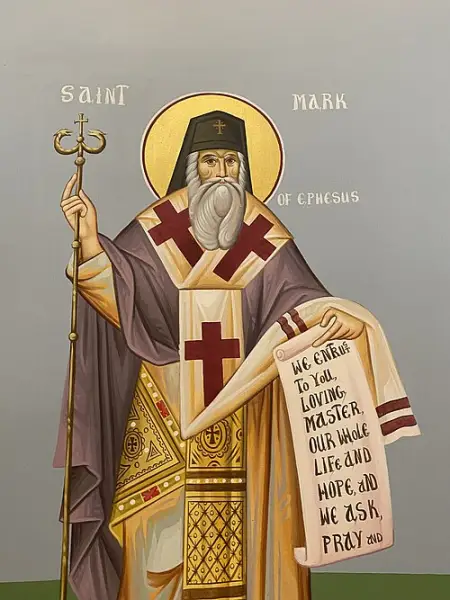
- Long white beard·Vested as a bishop·Scroll in one hand·Cross in the other
- Canonization
- Glorified in 1734 at Constantinople by Patriarch Seraphim I of Constantinople
Prayer
Bibliography
Show 6 sources
- Meyendorff, John (1974). Byzantine Theology: Historical Trends and Doctrinal Themes. Fordham University Press, p. 135.
- Deno J. Georgiou, "Mark of Ephesus and the Council of Florence: The Theological and Ecclesiological Issues," The Greek Orthodox Theological Review, Vol. 17 (1972–1973), pp. 7–38.
- Davies, Ewan (2025). "Mark of Ephesus (1392–1444): Revisiting the Sources on His Life and Work". Journal for Late Antique Religion and Culture. 19 (1): 18–54. doi:10.18573/jlarc.156
- Petrides, Sophronios (1910). Le Synaxaire de Marc d'Éphèse. Paris: Institut Français d'Études Byzantines. pp. 97–107.
- Constas, Nicholas (2002). "Mark Eugenikos". Brepols: Corpus Christianorum. pp. 429–432.
- Demacopoulos, George E.; Papanikolaou, Aristotle (2008). Orthodox Readings of Augustine. Saint Vladimir's Seminary Press. ISBN 978-0-88141-327-4.
Profile text adapted from the Wikipedia article, licensed CC BY-SA 4.0.
Pray with this saint every day
Save St. Mark of Ephesus to your favorites, read the full profile, and get feast-day reminders in the Saints app.
Get the Saints AppFree on the App Store for iPhone and iPad