
c. 12 – c. 68·Feast April 25
St. Mark the Evangelist
Evangelist, interpreter of Peter, founder of the Church of Alexandria
Overview
Mark the Evangelist, also known as John Mark or simply Saint Mark, is the person to whom tradition has ascribed the authorship of the Gospel of Mark and the founding of the Church of Alexandria. Coptic Christian tradition remembers him as a Roman African from ancient Libya, born in Cyrene in the Pentapolis around AD 12. He appears in the New Testament story as a companion of the apostles: Eusebius of Caesarea records that Peter took Mark as his travel companion and interpreter on the way to Rome, and that Mark wrote down Peter's preaching, composing the Gospel that bears his name. After the Council of Jerusalem he sailed to Cyprus with Barnabas. In AD 49 he traveled to Alexandria, where he founded the church that rose to be one of the five great thrones of early Christianity; the Coptic Orthodox, Greek Orthodox, and Coptic Catholic Churches all trace their origins to that community, and aspects of the Coptic liturgy are traced back to Mark himself. Honored as the first bishop of Alexandria and the founder of Christianity in Africa, he handed the see to Anianus in the eighth year of Nero and was martyred in Alexandria around AD 68, dragged through the streets by a rope until he died. His symbol is the winged lion, and Venice honors him as its patron.
The Complete Life
An African Childhood in the Heart of the First Church
Coptic tradition surrounds the earliest years of Mark with memories the other churches do not share. He is said to have been born in Cyrene, a Greek city in the Pentapolis of North Africa in what is now Libya, around AD 12, making him by that account a Roman African rather than a Palestinian Jew. The Coptic Church identifies him with John Mark of the Acts of the Apostles and counts him among the Seventy Disciples whom the Lord sent out to preach in Judea, a listing Hippolytus confirmed. Its tradition places him at the center of the sacred events of the first Pentecost: he is believed to have thrown open his home to the apostles in the days after the crucifixion; John's Gospel shows the risen Christ appearing to them in that very room, and there the Spirit descended on the gathered disciples at Pentecost. Coptic piety goes further still, numbering Mark among the servants at the wedding at Cana who poured out the water that Jesus changed into wine. Whether or not these details can bear historical weight, they show how deeply the African church claimed its founder: a son of Cyrene who, in Coptic memory, was present at the wedding of Cana, at the upper room, and at the birthday of the Church.
§ Biblical and traditional information
Peter's Interpreter and the Writing of the Gospel
The tradition of the authorship of the second Gospel weaves Mark's vocation together with the apostle Peter. According to Eusebius of Caesarea, after Herod Agrippa I executed James the son of Zebedee and imprisoned Peter in the first year of his reign over all Judea, Peter was delivered by angels and escaped the realm, making his way to Antioch and then through Asia Minor, where he visited the churches of Pontus, Galatia, Cappadocia, Asia, and Bithynia. Somewhere along that road Peter encountered Mark and took him as his travel companion and interpreter. Master and interpreter reached Rome together in Claudius's second year as emperor. There Mark did the work for which the Church remembers him: taking down Peter's preaching, he fashioned from it the Gospel that carries his name. Evidence for this authorship reaches back to Papias, the early second-century writer, whose testimony scholars of the Trinity Evangelical Divinity School judge 'almost certain' to refer to John Mark. Most modern critical scholars, by contrast, conclude that the Gospel is anonymous and doubt the traditional attribution; scholarship remains inconclusive, with some accepting John Mark as author, others proposing a different Mark, and defenders of the tradition answering the objections about geography and custom in detail.
§ Identity
Cyprus, Pentapolis, and the Founding of the Church of Alexandria
Mark's missionary career, as tradition tells it, spanned the eastern and southern Mediterranean. Acts records that after the Council of Jerusalem he went to Cyprus with Barnabas, renewing the partnership that Paul's early objections had interrupted. The Coptic narrative then sends him east and west: sent by Paul to Colossae and remembered as serving with Paul in Rome, he made his way to Pentapolis in his native North Africa before turning at last to Alexandria. In AD 49, about sixteen years after the Ascension, Mark reached Alexandria and planted the church that bears the city's name, after years of earlier work on Egyptian soil. Three communions claim descent from that first community—the Coptic Orthodox Church, the Greek Orthodox patriarchate of Alexandria, and the Coptic Catholic Church—and parts of the Coptic liturgy are traced all the way back to Mark. Later Christian tradition honors him as the first bishop of Alexandria—the first in the line of popes and patriarchs of that see—and as the founder of Christianity in Africa. The episcopal seat he planted rose to stand among the five great thrones of early Christianity, a school and a patriarchate whose influence on the doctrine of the whole Church would be immense.
§ Identity
Martyrdom in Alexandria
Mark's last years belong to Alexandria. Eusebius records that in the eighth year of Nero, around 62 or 63, Anianus succeeded him as bishop of the city—probably, though not certainly, because his death was approaching. The Coptic tradition fixes the end itself: Mark was martyred in 68. The hostility that cost him his life grew out of his success. Alexandria's pagan populace chafed at a preacher who was drawing worshippers away from the temples of the old gods, and in 68 their fury found its instrument: seizing the evangelist, they fastened a rope about his throat and hauled his body along the streets until life had left it. The first bishop of Alexandria thus died as he had lived, a preacher of Christ in a city of ancient temples, sealing with blood the church he had founded on African soil. Christian art would later remember this end in a striking attribute—a halter drawn around the evangelist's neck—and the medieval books of hours pictured the martyrdom of Saint Mark beside those of the other apostles. The see he founded passed to Anianus, and the patriarchal line of Alexandria counts him as its first occupant, from 43 to 68.
§ Biblical and traditional information
Feast and Veneration
Veneration of Mark arose wherever his memory touched the Church, and it has never been confined to one rite. The Catholic and Eastern Orthodox churches observe his feast on April 25; for those using the Julian calendar that date corresponds to May 8 on the Gregorian reckoning through the year 2099. The Coptic Orthodox Church keeps his feast on 30 Parmouti of the Coptic calendar, which likewise always aligns with April 25 Julian or May 8 Gregorian. Where tradition distinguishes John Mark from Mark the Evangelist, the Roman Martyrology celebrates John Mark on September 27 and the Evangelist on April 25. The Church of England and much of the Anglican Communion keep a Festival on April 25, a day so woven into the agricultural year that it gave its name to the rogation observances of spring. His chief shrines declare the breadth of his cult: St Mark's Basilica in Venice and Saint Mark's Coptic Orthodox Cathedral in Alexandria stand as the two great centers, joined by Saint Mark's Church in Belgrade, the Coptic cathedral in Cairo, St. Mark's Church in-the-Bowery in New York, and parishes in the Philippines. He is venerated in all Christian churches that venerate saints.
§ Veneration
The Winged Lion of Saint Mark
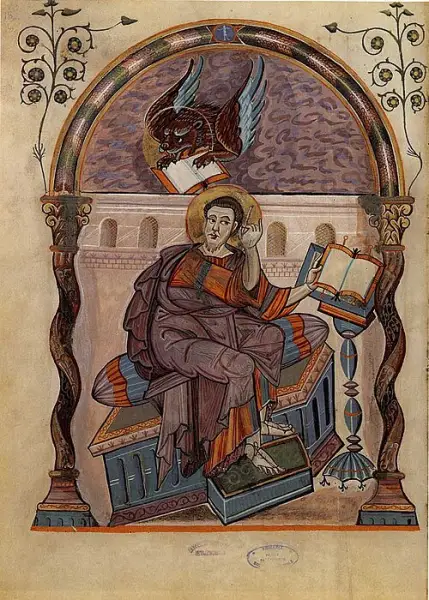
In art Mark is most often shown writing or holding his gospel, and his symbol—the winged lion, the Lion of Saint Mark—has become one of the most famous emblems in Christendom. On the lion runs the motto PAX TIBI MARCE EVANGELISTA MEVS—in English, peace be upon you, Mark, my evangelist—and this same lion doubles as the emblem of the city of Venice, whose merchants, aided by two Greek monks, were depicted by Tintoretto carrying the evangelist's body to their city. The range of his iconography is wide: a lion in the desert; a bishop enthroned above decorated lions; a man helping Venetian sailors; a figure holding a book inscribed with the words of peace, or a palm and book; a rescuer of Christian slaves from Saracens. Medieval tradition even connected the lion with Christ's Resurrection, since lions were believed to sleep with their eyes open, an image of the watchful Lord in the tomb. From Mantegna and Donatello to Coptic icons and Armenian Gospel manuscripts, artists have returned to him for a millennium and a half. As patron of barristers, Venice, Egypt, the Copts, Podgorica, Mainar, and Pangil in Laguna, he remains one of the few first-century figures honored across every continent of the Christian world.
§ In art
Timeline
- 12
Born in Cyrene in the Pentapolis of North Africa, according to Coptic tradition.
§ Biblical and traditional information
- 41
Eusebius links his story to the year Herod Agrippa put James to the sword and seized Peter, whose angelic deliverance allowed him to slip out of Judea.
§ Identity
- 42
Met Peter on his journey, who took him as travel companion and interpreter; Peter reached Rome in the second year of Emperor Claudius.
§ Identity
- 43
Wrote down Peter's preaching and so produced the Gospel that bears his name, departing for Alexandria in Claudius's third year, as Eusebius records.
§ Identity
- 49
Traveled to Alexandria and founded the Church of Alexandria, about sixteen years after the Ascension, having already labored in Egypt for several years.
§ Identity
- 62
Handed the Alexandrian see to Anianus—Eusebius dates the change to Nero's eighth year—with death perhaps already drawing near.
§ Identity
- 68
Martyred in Alexandria: pagans hostile to his preaching placed a rope around his neck and hauled him through the streets until he died.
§ Biblical and traditional information
In Their Own Words
PAX TIBI MARCE EVANGELISTA MEVS
The Record
- Major works
- Gospel of Mark (attribution traditional; most modern scholars hold the text to be anonymous)·Foundation of the Church of Alexandria·Elements of the Coptic liturgy traced to him
- Patron of
- Barristers·Venice·Egypt·Copts·Mainar·Podgorica·Pangil, Laguna
- Symbols
- Winged lion·Gospel book bearing the words 'Pax tibi Marce'·Palm of martyrdom·Bishop on a throne decorated with lions·Halter around his neck·Rescuing Christian slaves from Saracens
- Canonization
- Pre-congregation; venerated as a martyr from the earliest Christian era by all churches that venerate saints
Prayer
Bibliography
Show 7 sources
- Lane, William L. (1974). "The Author of the Gospel". The Gospel According to Mark. New International Commentary on the New Testament. Grand Rapids: Eerdmans. pp. 21–23. ISBN 978-0-8028-2502-5.
- Ehrman, Bart D. (2004). The New Testament. Oxford University Press. pp. 58–59. ISBN 0-19-515462-2.
- Finegan, Jack (1998). Handbook of Biblical Chronology. Peabody, Massachusetts: Hendrickson. p. 374. ISBN 978-1-56563-143-4.
- Bunson, Matthew; Bunson, Margaret; Bunson, Stephen (1998). Our Sunday Visitor's Encyclopedia of Saints. Huntington, Indiana: Our Sunday Visitor Publishing Division. p. 401. ISBN 0-87973-588-0.
- Hatina, Thomas R. (2014). "Gospel of Mark". In Evans, Craig A. (ed.). The Routledge Encyclopedia of the Historical Jesus. Taylor & Francis. p. 252. ISBN 978-1-317-72224-3.
- Reddish, Mitchell (2011). An Introduction to The Gospels. Abingdon Press. ISBN 978-1-4267-5008-3.
- Kok, Michael (2015). The Gospel on the Margins: The Reception of Mark in the Second Century. Fortress Press. pp. 85–87. ISBN 978-1451490220.
Profile text adapted from the Wikipedia article, licensed CC BY-SA 4.0.
Pray with this saint every day
Save St. Mark the Evangelist to your favorites, read the full profile, and get feast-day reminders in the Saints app.
Get the Saints AppFree on the App Store for iPhone and iPad