
14th century·Feast July 22
St. Markella
Virgin-martyr of Chios slain by her father
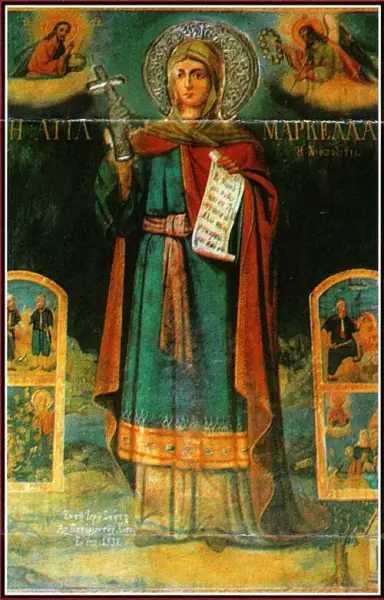
Overview
Markella, also called Marcella, was a young woman of fourteenth-century Chios who died a martyr's death at the hands of her own father and became the most beloved saint of that Greek island. Born in the village of Volissos, her mother taught her the Christian faith and raised her in devotion, and when that mother died early she continued to study the Bible and to live by what she had been taught. Around her eighteenth birthday her father's violent anger forced her to flee, whether because, as one account says, he demanded she abandon her faith for idolatry, or because, as the tradition more commonly holds, he was consumed by incestuous desire for his own daughter. She hid in the mountains until her father and a local herdsman tracked her down and set fire to the bush where she concealed herself. Running toward the sea, she was struck and wounded by an arrow from her father's bow; her blood was believed to have dyed the rocks. In her final moments she prayed that the rock would open to hide her, and her body was received into the stone, but her head remained exposed and was cut off. Her severed head floated across the water to the beach of Komi, where centuries later Italian sailors found it shining amid upright floating candles and carried it away in reverence. The rock of her martyrdom still springs holy water, and pilgrims flock there every 22 July.
The Complete Life
A Daughter of Volissos
Markella belonged to the fourteenth century, during most of which the island of Chios lay under Genoese rule, a Greek Christian population living beneath a Latin commercial aristocracy. By the tradition that took shape in the nineteenth century, she was born and lived in Volissos, a village in the northwestern part of the island. Her formation in the faith came from her mother, who raised her as a devout Christian in an age when a girl's religion was learned chiefly in the home. The fathers of later accounts sometimes describe her father as a pagan, a detail that sits awkwardly with the fourteenth century, by which time paganism had long been extinct in Greece, and the old records say almost nothing firm about the family. What the tradition preserves with confidence is the shape of her early life: a mother's devout teaching, and then, while Markella was still young, the death of that mother. The orphaned girl continued on the path she had been given, studying the Bible, praying to God, and living according to what she had been taught. Such was her character as she approached womanhood, a virtuous and pious young Christian on an island whose documented memory of her would later prove strangely thin, even as its devotion to her never wavered.
§ Life
Flight from Her Father's House
Scarcely had she passed her eighteenth birthday when the life Markella had built was torn apart, and she was forced to run from the wrath of her violent father. Why she feared him is told in two variant accounts. In one version, her late mother had been a Christian but her father bowed to idols and strove with all his might to bend his daughter to the same worship, a persecution of faith handed down within her own household. This version, however, seems anachronistic for the fourteenth century. The other and more widespread account is darker: the girl's own father had been seized by an incestuous passion for her, and at the first utterance of his desire she ran from the house in horror. This is the version given in the account of the Orthodox Church in America, which honors her as Martyr Marcella of Chios. Whatever the precise reason she dreaded her father, Markella made for the nearby mountains and concealed herself in a bush. But the searchers tracked her down, among them a herdsman of the neighborhood, and the men kindled a fire beneath the bush to smoke their quarry into the open. Driven from her hiding place by the flames, the girl raced for the sea, the last refuge of an island child, with her father behind her, and there the pursuit reached its terrible conclusion on the rocks above the water.
§ Life
Martyrdom on the Rocks
She raced for the shoreline, and her father, drawing his bow, shot and wounded her as she fled. The people of Chios have believed ever since that the martyr's blood stained the rocks where she fell, and to this day, during the festivities for her feast, that blood is said to reappear on the stones at a fixed hour for all the faithful who come to see. Wounded and hunted, Markella spent what remained of her strength in prayer, begging Christ to split the rock before her and give it to her for shelter. Her petition was answered in a manner half-hidden and half-revealed: the stone opened and took in her whole body, but her head remained exposed. Her father struck off the head that the rock could not shield and flung it into the waves. It floated to the nearby beach of Komi, and for many years the islanders could not find it. Then one day an Italian warship, presumably Genoese, anchored in those waters. In the evening a strange radiance showed far out on the water, and the sailors, drawing closer, made out a human head riding the waves, ringed by candles standing upright upon the sea. Recognizing at once that they had witnessed a sacred miracle, they carried the holy relic home with them to their own country, and it left Chios as her body had entered the rock, by mystery and by sea.
§ Life
Cult, Records, and an Elusive History
Markella was canonized by the Greek Orthodox Church, and her feast is celebrated on 22 July. Yet the historical record of her life is unusually elusive, and the church's own books acknowledge it. Leo Allatius mentioned her in 1648 without attributing anything to her identity, and he was born in 1586, when memories of her life would still have been fresh. The synaxarium printed in 1810 confessed that nothing certain was known of her life and martyrdom, and its successor of 1868 offered little beyond notes on how Chios worshiped her. Only in the 1860s did a date of birth, around the year 1500, appear for the first time, in Argirios S. Karavas's topography of Chios, a chronology that does not agree with the earlier accounts and probably pushes the real events of her life further back in time. The tradition followed by the Orthodox Church has instead settled on the fourteenth century, and on the narrative of the virgin-martyr of Volissos that has been handed down on the island. The veneration, in other words, ran ahead of the documentation: Chios kept her feast, sang her hymn, and prayed at her rocks for centuries, while the written lives remained almost empty, a rare case of a cult sustained almost entirely by living memory and pilgrimage.
§ Life
Holy Water and the Boiling Sea
The rocks where Markella died remain the heart of her cult. Local tradition holds that a spring of holy water rises from the stone where she was put to death, and pilgrims come to the site every year on 22 July for the commemoration services. A custom teaches that devout visitors find the pool among the rocks burning with heat beneath the hand. On her nameday the sea itself is said to boil, and her blood is said to show itself again on the stones for those who come to look. A church now stands on the cave of St. Markella, and her icon ranks among the island's holiest treasures, with a name for working wonders. In iconography she carries the palm branch, the cross, and the scroll of the martyrs, and is occasionally shown in the very act of her death, cut down by the hand that had begotten her, an image of almost unique horror transformed into triumph. As patroness of Chios she gives her name and protection to the whole island, and the Orthodox liturgy keeps for her a special Apolytikion, a hymn that greets her as piety's rose and Chios's own sprout, put to death by a parent's hand while she kept Christ's commandments, and that gives glory to Him who through her works cures for all the faithful.
§ Religious significance
Timeline
- 1648
Leo Allatius mentioned her, though without attributing any details to her identity.
§ Life
- 1810
The synaxarium of that year confessed that nothing certain was known of her life and martyrdom.
§ Life
- 1866
A date of birth around 1500 appeared for the first time in Argirios S. Karavas's topography of Chios.
§ Life
- 1868
The synaxarium issued that year confined itself to a few notes on how the people of Chios worshiped her.
§ Life
In Their Own Words
Rose of piety and sprout of Chios, we honour with canticles Saint Markella who was beheaded by her father's hand, as she guarded the commands of Christ, give strength and save from danger, us who cry unto you. Glory to Him who gave you strength, glory to Him who crowned you. Glory to Him who works through you, healings for all the faithful.
The Record
- Patron of
- patroness of Chios
- Symbols
- palm branch·cross·scroll·depicted being beheaded by her father
- Canonization
- Canonized by the Greek Orthodox Church; feast kept on 22 July
Prayer
Bibliography
Show 4 sources
- Mauricius, Diaconus graece (1819). Synaxaristes ton dodekomenou tu eniavtu. Vol. 1-3 (in Greek). de Janina.
- Hagiorite, Saint Nicodemus (1868). Synaxaristēs tōn dōdeka mēnōn tou eniautou (in Greek). Ch. Nikolaou Philadelpheōs.
- Allacci, Leone; Nihus, Barthold (1648). Leonis Allatii De ecclesiæ occidentalis atque orientalis perpetua consensione, libri tres (in Latin). Kalckhoven.
- Karavas, Argirios S. (1866). Τοπογραφια της νησου Χιου (in Greek).
Profile text adapted from the Wikipedia article, licensed CC BY-SA 4.0.
Pray with this saint every day
Save St. Markella to your favorites, read the full profile, and get feast-day reminders in the Saints app.
Get the Saints AppFree on the App Store for iPhone and iPad