
c. 1588 – 1619·Feast September 7
St. Marko Krizin
Croatian priest and martyr of Košice
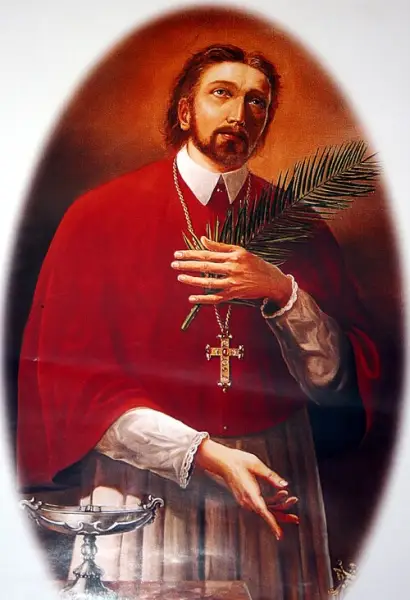
Overview
Marko Stjepan Krizin, known in Hungarian as Kőrösi Márk or Mark of Križevci, was a Croatian Roman Catholic priest, professor of theology, and missionary of the early seventeenth century. Born in Križevci in the Kingdom of Croatia, he studied at the Jesuit college in Vienna and at the University of Graz, where he took a doctorate in philosophy under Péter Pázmány, before completing his formation in Rome at the Collegium Germanicum et Hungaricum and the Pontifical Gregorian University. Ordained for the Diocese of Zagreb, he was soon called by Cardinal Pázmány to serve as rector of the seminary in Trnava and as a canon of the cathedral chapter. In 1619 a new posting took him to oversee the lands of the old Benedictine abbey at Széplak near Kassa, in a Hungary torn by war between the Catholic Habsburgs and the Calvinist Prince Gábor Bethlen. When the Calvinist army seized the city that September, Marko was arrested alongside two Jesuit priests, István Pongrácz and Melchior Grodziecki. Offered a church estate if he would convert to Calvinism, he refused, and after torture the three priests were beheaded on 7 September 1619. Beatified by Pope Pius X in 1905, they were canonized by Pope John Paul II in Košice in 1995.
The Complete Life
From Križevci to the Universities of Europe
Marko Stjepan Krizin was born around 1588 in Križevci, a town in the Kingdom of Croatia within the Habsburg monarchy. His talent carried him far from home at an early age. He began his studies at the Jesuit college in Vienna and went on to the University of Graz, where he studied under Péter Pázmány, the great Catholic controversialist and educator of Hungary, and earned the degree of Doctor of Philosophy. Recognized as a candidate for Holy Orders by the Diocese of Zagreb, he then moved to Rome to complete his formation for the priesthood. There he lodged at the Collegium Germanicum et Hungaricum, the college founded for German and Hungarian students, while attending lectures at the Pontifical Gregorian University from 1611 to 1615. In the college archives a document survives in which he personally recorded his nationality as Croatian—a small notation that marks him as one of the earliest Croatian students of the Roman colleges whose self-identification can still be read. Contemporaries described him as a student who was both intelligent and considerate, qualities that would shape the priest: a scholar formed in the best schools of central Europe and Rome, yet never detached from the Croatian diocese that first sent him forth.
§ Early life
Priest, Professor, and Rector
After his ordination, Krizin returned to his home diocese of Zagreb, though he remained there only a short while. Cardinal Péter Pázmány, Archbishop of Esztergom, had been governing his vast see from Nagyszombat—present-day Trnava—because continuing Ottoman occupation kept much of Hungary unsafe. From Zagreb the cardinal called the young priest and gave him two offices at once: the rectorship of the seminary and a canonry in the cathedral chapter. The double appointment shows the esteem in which his learning and character were held; the seminary and the chapter were the two institutions on which the rebuilding of Catholic life in Upper Hungary depended. Krizin thus spent the first years of his priesthood forming the next generation of clergy and sharing in the governance of a diocese on the military frontier of Christendom. In early 1619 he received a further assignment, one that would decide his fate: the administration of the estate of the former Benedictine Abbey of Széplak, near Kassa in the Kingdom of Hungary. The region had just been thrown into upheaval by the nationalist uprising of Gábor Bethlen, the Calvinist Prince of Transylvania, against the Austrian Habsburgs who ruled Hungary.
§ Ministry
Kassa and the Gathering Storm
Kassa, now Košice in Slovakia, was in that decade a stronghold of Calvinism for Hungary, and its Catholic minority depended on outside protection. To sustain them, Andrija Dóczi, the city's Catholic governor appointed by Emperor Matthias, secured two Jesuit priests for Kassa, István Pongrácz and Melchior Grodziecki, whose arrival unsettled the city's Calvinist majority. Marko, newly arrived to manage the Széplak estate, was staying at the Holy Trinity church then in Jesuit hands, in the company of the two priests serving the city's Catholics. In September 1619 the crisis broke. The army of George I Rákóczi, commander of the Calvinist forces, laid siege to the city, and on 5 September Dóczi was betrayed by the very mercenary troops he had hired; the city authorities handed him over, and Bethlen's Protestant supporters proclaimed their prince head of Hungary and protector of the Protestants. The three priests were arrested at once and confined without food or water for three days while the fate of the city's Catholic population was debated. A Calvinist minister named Alvinczi pressed the city council's head, Reyner, to demand the execution of all Catholics, but the majority of the Protestant townspeople refused a general slaughter—approving, instead, only the deaths of the three priests.
§ Martyrdom
The Price Refused and Paid
Facing death, Marko Krizin was offered a way out. The commander promised him a church estate if he would renounce the Catholic Church and convert to Calvinism. He refused, and with that refusal the bargain—and his life—was closed. All three priests were tortured and then beheaded in the days that followed, Marko dying on 7 September 1619 at about thirty years of age. News of the martyrdom swept across Hungary, shocking Catholics and Protestants alike, so indiscriminate was the horror of the killing. Yet the martyrs' humiliations did not end with death. Prince Gábor Bethlen refused, despite many pleas, to allow the three bodies burial in consecrated ground. Only six months later, when Countess Katalina Pálffy interceded on their behalf, was a proper burial permitted. Marko's remains were eventually laid to rest with honor, and today lie in several places, among them the great basilica of Esztergom and Trnava's Ursuline church of Saint Anna; a statue of the martyr stands in Varaždin Cathedral in his native Croatia. The priest who had spent his life serving the Church's institutions died possessing nothing of them, having judged a single act of apostasy too high a price for any estate.
§ Martyrdom
Raised to the Altars
Veneration of the Košice martyrs grew steadily through the centuries that followed, especially in Hungary and Croatia. The cause reached its first fulfillment on 15 January 1905, when Pope Pius X beatified Marko, István Pongrácz, and Melchior Grodziecki in St. Peter's Basilica in Rome. Nine decades later, on 2 July 1995, Pope John Paul II proclaimed their canonization in Košice itself, the city where they had died, returning their memory in triumph to the place of their bloodshed. With that act Marko Krizin became the third Croat to be declared a saint by the Catholic Church, a distinction that fixed his name in the national roll of honor beside figures such as St. Nicholas Tavelic and St. Leopold Mandić. His feast day is kept on 7 September, the anniversary of his martyrdom, and in Križevci the observance has grown into a week of festivities each year, testifying to the attachment of his home town to its greatest son. Relics of the Košice martyrs rest at the Esztergom Basilica and the Church of the Holy Trinity in Košice, where pilgrims continue to honor the priest who would not trade his faith for land.
§ Legacy
A Saint for Croatia and Hungary
Marko Krizin's martyrdom has made him a bond between peoples. A Croat by birth and formation, a priest of Zagreb raised to the dignity of a Hungarian cathedral chapter, and a victim of the confessional wars that scarred seventeenth-century Central Europe, he belongs to both nations that claim him—celebrated in Hungarian as Kőrösi Márk, Mark of Križevci, and venerated in Croatia among its canonized saints. His story is remembered as one of the Košice martyrs, a trio whose fidelity under torture became a rallying memory for Catholics of the region through the centuries of upheaval that followed. The canonization of 1995, celebrated in Košice by Pope John Paul II shortly after the fall of communism, presented the three priests anew as witnesses whose loyalty to Christ transcended every political and ethnic frontier. In Križevci the annual week of festivities around his feast keeps his memory alive in the town of his birth, while the relics at Esztergom and Trnava anchor his cult in the Hungarian lands where he served and died. For seminarians, priests, and scholars, his life remains a reminder that learning and courage belong together, and that a faith formed in universities may be proven in a prison.
§ Legacy
Timeline
- 1588
Born in Križevci in the Kingdom of Croatia, then part of the Habsburg monarchy.
§ Early life
- 1611
Went to Rome to prepare for priestly ordination for the Diocese of Zagreb, resident at the German-Hungarian college while following courses at the Gregorian University.
§ Early life
- 1615
Completed his studies in Rome after four years at the Gregorian University.
§ Early life
- 1619
Sent in early 1619 to administer the estate of the former Benedictine Abbey of Széplak, near Kassa in the Kingdom of Hungary.
§ Ministry
- 5 Sep 1619
Arrested at the Jesuit Church of the Holy Trinity in Kassa alongside Jesuits István Pongrácz and Melchior Grodziecki after the city was handed to George I Rákóczi.
§ Martyrdom
- 7 Sep 1619
Refused to renounce the Catholic faith for Calvinism and was tortured and beheaded with his two companions.
§ Martyrdom
- 15 Jan 1905
Beatified with the other Košice martyrs by Pope Pius X in St. Peter's Basilica in Rome.
§ Legacy
- 2 Jul 1995
Canonized with his companions by Pope John Paul II in Košice.
§ Legacy
The Record
- Canonization
- Canonized 2 July 1995 in Košice by Pope John Paul II
Prayer
Bibliography
Show 5 sources
- "Saint Mark (Marko) of Križevci", Archdiocese of Zagreb
- Schäfer, Joachim. "Markus Stephan Crisinus", Ökumenischen Heiligenlexikon
- "sv. Marko Križevčanin-život, zivot". Križevci.net
- "San Marco Crisini (Krizevcanin)". Santi e beati
- "Trnava Historical Monuments"
Profile text adapted from the Wikipedia article, licensed CC BY-SA 4.0.
Pray with this saint every day
Save St. Marko Krizin to your favorites, read the full profile, and get feast-day reminders in the Saints app.
Get the Saints AppFree on the App Store for iPhone and iPad