
died c. 625·Feast October 25
St. Marnock
Celtic monk-bishop of Iona and Kilmarnock
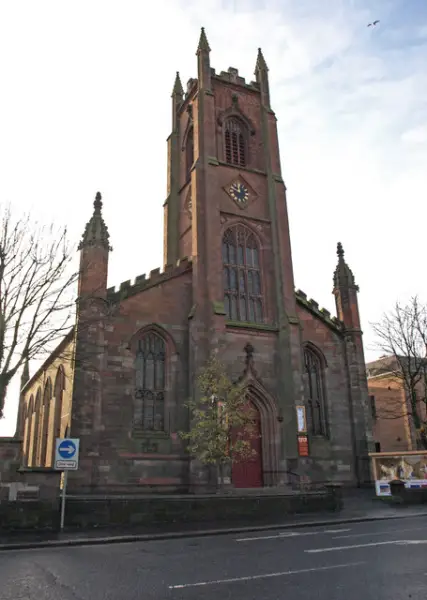
Overview
Marnock, also called Marnocus, Marnan, Marnanus, and originally Ernin from the Irish Mo-Ernin-og, was an Irish-born monk and bishop of the great age of Celtic monasticism who died around the year 625. Born in Ireland most likely in the late sixth century, he crossed the sea to Iona, the monastery founded by Columba among the islands of the Inner Hebrides, and there became a monk, a student, and a disciple of Columba himself. From Iona he went out to the Scottish mainland as a missionary bishop, carrying the monastic and pastoral tradition of the great abbey into new territory. He died at Annandale in Strathclyde in 625, though at least one account places his death and burial at Inchmarnoch near Aboyne in Aberdeenshire, where he had established a chapel on an island of the River Dee. After his death a strong cult grew up around his memory, particularly in the Scottish Borders. His head became the prized relic of Kilmarnock, where each Sunday it was solemnly bathed and the water carried off to the sick as medicine. The density of places named for him across Scotland and Ireland testifies to how deeply his cult took root.
The Complete Life
From Ireland to Iona
Ireland gave Marnock his birth, probably toward the close of the sixth century, in the era when the monastic movement that reshaped northern Christianity was sending its sons across the Irish Sea. His original name, preserved in the Irish form Mo-Ernin-og, meaning 'my little Ernin', belongs to a distinctive class of Celtic hypochoristic names, and the many forms under which he is later known—Marnock, Marnocus, Marnan of Narnach, Marnanus—show how his cult evolved as it spread through different regions and tongues. As a young man he left Ireland for Iona, the abbey founded by Columba on a small island of the Inner Hebrides that had become the spiritual powerhouse of the Celtic church. There he took the monastic habit and became a student and disciple of Columba himself, absorbing the severe discipline, scriptural scholarship, and missionary zeal of that community. To have trained at Iona under its founder was the finest formation the Celtic church could offer, and it marked Marnock out for leadership. From this island schoolhouse of saints he would go forth, as so many Iona monks did, to carry the Gospel to new shores.
§ Biography
Missionary Bishop on the Mainland
Leaving the monastery of his formation, Marnock crossed to the Scottish mainland to serve as a missionary bishop, one of those monastic bishops who combined the governing office of the episcopate with the itinerant evangelization characteristic of the Celtic church. His missionary career left traces in the landscape that survive to this day. On the River Dee in Aberdeenshire he established a chapel on an island that still bears his name, Inchmarnoch, near Aboyne; the chapel site is recorded by the royal inventory of Scotland's ancient monuments, and by some accounts it was there, not at Annandale, that he died and was buried. His name also clings to Inchmarnock, an island at the northern end of the Sound of Bute, to Dalmarnock in Glasgow and to a Dalmarnock farmstead near Dunkeld with its salmon fishery on the River Tay, and to Ardmonoch within Kilfinan in Argyll and Bute. These dedications sketch the orbit of his work: the western isles, the lands of the southern Picts around Dunkeld and Aberdeenshire, and finally Annandale in Strathclyde, where he died. They picture a churchman at home both on island chapels and in the great river valleys of the north.
§ Biography
Death and Burial
The accounts agree that Marnock died around the year 625, but the place of his death is a matter of differing tradition. The widely accepted account holds that he died at Annandale in Strathclyde, in the south-west of what is now Scotland, and his death there is fixed in the calendars of the Scottish saints. A second tradition, preserved in connection with the chapel he founded on the River Dee, gives his place of death and burial as Inchmarnoch near Aboyne in Aberdeenshire, suggesting that the island chapel where he had labored became his last resting place. Such double traditions are common among the Celtic saints, whose relics were often claimed and contested by the very communities they had founded. Whichever place held his body, his death closed a career that had carried him from an Irish boyhood to the school of Columba, through the isles and glens of western and northern Scotland, to the border lands of Strathclyde. The calendars of the ancient Scottish church mark the bishop Marnan among the saints of the age of Columba's heirs, and his passing was followed by a cult whose strength surprised even the later medieval world.
§ Biography
The Cult of Saint Marnock
After his death, a strong cult of veneration developed around Marnock, particularly in the region of the Scottish Borders. Its most remarkable expression was at Kilmarnock, the Ayrshire town that bears his name—Kill Marnock, the church of Marnock—of which he became the patron. There his head was kept as a relic, and a custom grew up of bathing it each Sunday, and the water from these washings was carried to the ill as a medicine believed to work miraculous cures—a devotion binding the relic of the saint to the daily hope of the townspeople. The reach of his cult is measured by the sheer number of places named in his honor across Scotland and Ireland: Kilmarnock and Marnoch parish in Aberdeenshire, Dalmarnock in Glasgow and near Dunkeld, Inchmarnoch on the Dee, Inchmarnock in the Sound of Bute, Ardmonoch in Argyll, and across the Irish Sea Portmarnock in Fingal, where a local school and the GAA club Naomh Mearnóg still carry his name. In modern times his memory has even reached the North Sea, where the Marnock Oil Field, 150 miles east of Aberdeen, perpetuates a saint's name in the geography of another age. Few early Celtic saints can show so dense a map of remembrance.
§ Veneration and legacy
The Record
- Major works
- Chapel on the island of Inchmarnoch on the River Dee
- Patron of
- Patron of Kilmarnock, Scotland
- Symbols
- Bishop's vestments·Head relic at Kilmarnock
- Canonization
- Pre-congregation
Prayer
Bibliography
Show 6 sources
- "Blog Archive » Saint Marnock". CatholicSaints.Info. 26 February 2010. Retrieved 29 February 2020.
- "Saints in Scottish Place-Names - Marnock of Kilmarnock". Saintsplaces.gla.ac.uk. Retrieved 29 February 2020.
- "Blog Archive » Calendar of Scottish Saints – Saint Marnock or Marnan, Bishop, A.D. 625". CatholicSaints.Info. 2 February 2014. Retrieved 29 February 2020.
- "Celtic and Old English Saints - 1 March". Celticsaints.org. 20 January 2018. Retrieved 29 February 2020.
- "Inchmarnoch, Chapel Of Inchmarnock". Canmore. Retrieved 29 February 2020.
- Cooper, J., 1996, Dictionary of Christianity, Rutledge Books
Profile text adapted from the Wikipedia article, licensed CC BY-SA 4.0.
Pray with this saint every day
Save St. Marnock to your favorites, read the full profile, and get feast-day reminders in the Saints app.
Get the Saints AppFree on the App Store for iPhone and iPad