
died April 23, 423·Feast April 23
St. Marolus
Archbishop of Milan in the age of invasion
Overview
Marolus, in Italian Marolo, was Archbishop of Milan from 408 to 423 and is honored as a saint by the Catholic and Eastern Orthodox Churches. His life, as recorded by the sixth-century bishop Ennodius of Pavia, began far from the see he would govern: he was born on the banks of the Tigris in Mesopotamia, and probably to escape the persecutions of the Persian king Shapur II he moved before the year 380 to Syria, where he grew up. In time he made his way to Rome, where he became a friend of Pope Innocent I, and finally to Milan, whose episcopal throne he ascended in 408 as the successor of Saint Venerius. His fifteen years as archbishop fell in a dark hour for northern Italy, when Visigothic armies swept through the peninsula, and Marolus won his people's gratitude by aiding the victims of the invasion. He is remembered also as a gatherer of relics: he probably brought from Antioch to Milan the remains of Saints Babylas of Antioch and Romanus of Caesarea, and to house them he founded the Basilica Concilia Sanctorum, also called the church of San Romano, near the present church of San Babila. He died on April 23, 423, and was buried in the Church of Saint Nazarius and Celsus in Milan.
The Complete Life
From the Tigris to Rome
Marolus's story began in Mesopotamia, where he was born on the banks of the Tigris, a detail preserved for posterity by Ennodius, the bishop of Pavia who wrote of him in the early sixth century. His childhood was shadowed by the Persian empire's hostility to its Christian subjects: probably because of the persecutions under Shapur II, whose long reign saw fierce repression of the churches of Persia's Mesopotamian provinces, Marolus left his birthplace before the year 380 and settled in Syria, where he grew up. The migration made him a man of three lands—born a subject of Persia, raised in Syria, and formed in the Latin West. From Syria he eventually traveled to Rome, the seat of the papacy, and there he came to know Pope Innocent I, becoming his friend. That friendship with the pope of the day placed the Mesopotamian exile within the highest circle of the Western church and marked him as a man of learning and trust. From Rome his path led north to Milan, the great imperial city of the West, where the church he would one day lead had been illustrious in the memory of Ambrose and was now shepherded by Saint Venerius, whose death in 408 opened the way for Marolus's election.
§ Life
Archbishop in a Time of Invasion
Marolus took up the archbishopric of Milan in 408, the very year the western Roman world was convulsed by the advance of the Visigoths into Italy. Throughout much of his episcopate the peninsula suffered invasion, and Milan, so often the residence of emperors, lay in the path of the storm. The chroniclers of the Milanese church remember Marolus chiefly for what he did in that crisis: he helped the victims of the invasion, extending the charity of the church to the dispossessed, the wounded, and the refugees whom the war had cast upon the city. Alongside this works of mercy he undertook a quieter labor with consequences for centuries of Milanese devotion. He probably brought from Antioch to Milan the relics of two martyrs of the East, Babylas of Antioch and Romanus of Caesarea, translations that joined the Milanese church to the witness of the persecuted churches from which Marolus himself had come. To honor these relics he built a church in Milan known as the Basilica Concilia Sanctorum, or church of San Romano, erected near the spot where the present church of San Babila stands. Though that basilica no longer survives, its foundation made the Persian-born archbishop a builder of Milan's sacred topography.
§ Life
Death and Burial
Marolus governed the see of Milan for fifteen years, from 408 until his death on April 23, 423. He passed the archbishopric to his successor Martinianus, continuing the unbroken line of holy bishops—Ambrose, Simplician, Venerius, Marolus—that the Milanese church treasured as its inheritance. He was buried in the Church of Saint Nazarius and Celsus in Milan, resting among saints whose cult was ancient in the city: Nazarius and Celsus, the martyrs whose feast Ambrose himself had honored, kept the Persian-born archbishop in their company. The date of his death, April 23, became the day of his feast, observed from early times in both the Catholic and Eastern Orthodox Churches, and his name was entered in the catalogues of the bishops of Milan among the saints of that ancient succession. The record of his life comes down through the testimony of Ennodius of Pavia and the historians of the Milanese episcopate, and though it is brief, it preserves the essential portrait: a refugee from persecution who became a friend of popes, an archbishop who fed the victims of war, and a builder who gave the city relics and a church in their honor.
§ Life
Timeline
- 380
Left Mesopotamia for Syria, probably because of the persecutions of Shapur II, and grew up there.
§ Life
- 408
Became Archbishop of Milan, succeeding Saint Venerius.
§ Life
- 23 Apr 423
Died in Milan after fifteen years as archbishop and was buried in the Church of Saint Nazarius and Celsus.
§ Life
The Record
- Major works
- Basilica Concilia Sanctorum (church of San Romano), Milan
- Symbols
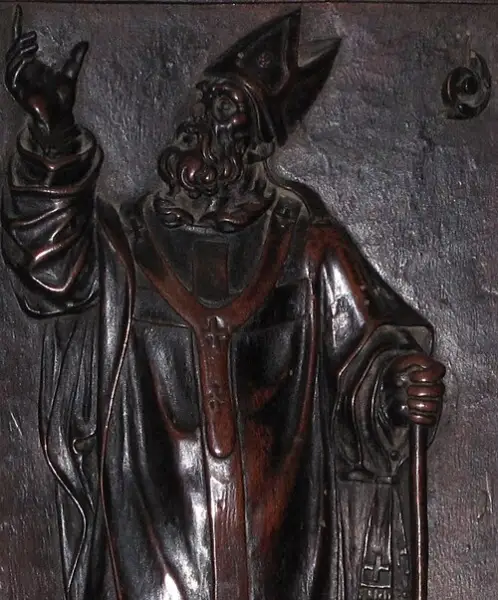
- Bishop's vestments
- Canonization
- Pre-congregation; venerated as a saint from antiquity in the Catholic and Eastern Orthodox Churches
Prayer
Bibliography
Show 4 sources
- Ruggeri, Fausto (1991). I Vescovi di Milano. Milano: NED. p. 14. ISBN 88-7023-154-2. (in Italian)
- Apeciti, Ennio. "San Marolo di Milano". Santi e Beati. Retrieved 25 Sep 2011. (in Italian)
- Tolfo, Maria Grazia. "L'area sacra di Porta Orientale". Storia di Milano. Retrieved 25 Sep 2011. (in Italian)
- Cazzani, Eugenio (1996). Vescovi e arcivescovi di Milano. Milano: Massimo. p. 25. ISBN 88-7030-891-X. (in Italian)
Profile text adapted from the Wikipedia article, licensed CC BY-SA 4.0.
Pray with this saint every day
Save St. Marolus to your favorites, read the full profile, and get feast-day reminders in the Saints app.
Get the Saints AppFree on the App Store for iPhone and iPad