
340 – 410·Feast February 9
St. Maron
Hermit Father of the Maronite Church
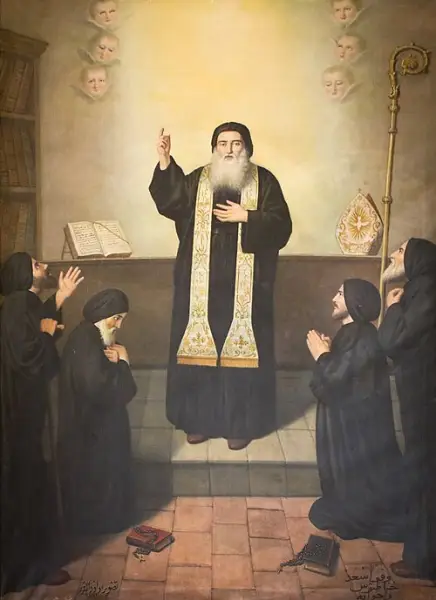
Overview
Maron, also called Maroun or Maro, was a fourth-century Syriac Christian priest who embraced the solitary life as a hermit in the Taurus Mountains near Cyrrhus, close to Antioch. His holiness and reputation for healing drew crowds of followers and won him attention across the Roman Empire. He lived in the open air beside a pagan temple he had converted into a church, exposing himself to sun, rain, hail and snow in a form of asceticism that Theodoret of Cyrrhus described as new to Syria and Lebanon. Around the year 405 John Chrysostom wrote to him from exile, professing his love and asking for his prayers. After Maron died in 410, his disciples carried his teaching forward; one of them, Abraham of Cyrrhus, later brought the movement to Mount Lebanon, earning the title Apostle of Lebanon. The community that grew from his example became the Maronite Church, which remains in full communion with the Holy See. He is honored as its father and as a patron of the Maronite people throughout the world.
The Complete Life
A Priest of Coele Syria
Maron was born in the middle of the fourth century in Coele Syria, a province of the Eastern Roman Empire whose territory lies within modern Syria. He was ordained a priest, and is believed to have studied at the great Christian learning center at Antioch, then the third largest city of the Roman Empire, where he may have been a fellow student of John Chrysostom. Rather than pursue an ecclesiastical career in the city, he went out to the Taurus uplands above Cyrrhus, northwest of Aleppo, choosing the hermit's life. The choice placed him among the ascetics for whom Syria was becoming famous, yet his manner of life proved distinctive. He settled beside a former pagan temple which he had transformed into a church, and there he made his dwelling in the open air. His unaffected manner and his remarkable longing to find God within everything became the hallmark of his name, and word of him ran through the whole empire. Though he held no office in the hierarchy of Antioch, his priesthood shaped all that followed: the mountain solitary never ceased to be a priest, and the holiness of his life became part of the fame that drew the empire's attention.
§ Life
Called to the Mountain
Maron's calling was a hidden one, pursued among the lonely heights north-west of Aleppo. He gave himself to prayer and contemplation beneath the open heavens, believing that the physical world, far from being an obstacle, could carry him deeper into the love of God. Contemporaries understood this as a new type of asceticism: unlike the hermits who shut themselves in caves or pillars, Maron remained in the open, weathering sun, rain, hail and snow beside his converted temple. Word of his holiness and of the miracles attributed to his intercession spread widely, and followers gathered around him, seeking his counsel and his blessing. Among the spirits drawn to his example was John Chrysostom, who around the year 405 sent the recluse a letter professing his great love and respect and begging Maron to remember him in prayer. The correspondence testifies to the esteem in which the mountain solitary was held from the imperial capital itself. Pilgrims and neighbors climbed to his dwelling in search of counsel, blessing and healing, and he received them with the courtesy of a man who saw Christ in every visitor. What looked like flight from society was in truth another form of service.
§ Life
Missionary of the Lost Souls
Maron's withdrawal from the world did not make him indifferent to it. He preached Christ eagerly, determined to hand on his message to every soul he met, seeking not only to heal bodily ailments but also to nurture and heal what his tradition called the lost souls of his time, both pagan and Christian. His missionary labor bore visible fruit in the mountains when he converted a temple in Kafr Nabu into a Christian church, an act that marked the beginning of the region's conversion and would eventually influence the ancient region of Mount Lebanon. The work outlived him through his disciples. His first follower, Abraham of Cyrrhus, known as the Apostle of Lebanon, found many non-Christians in Mount Lebanon and set out to convert them by introducing them to his master's teaching. The faith they planted took root so firmly that the Maronite community has endured in Lebanon ever since. For Maron the cure of bodies was never separate from the cure of hearts, and his contemporaries remembered both: he was famed as a healer whose prayers brought recovery to the sick.
§ Missionary
All Connected to God
Maron's spirituality was thoroughly monastic, centered on prayer and self-denial. Nothing in his eyes lay outside God, and God stood within all things: he refused to split the material from the spiritual, treating the visible world instead as a ladder by which faith and experience of the divine could climb. Prayer was his passion, and in its fervor he shook off every attachment to material things and rose into a loving communion with God. Living in the open air next to the temple he had made into a church, he spent his days in prayer and meditation beneath sun, rain, hail and snow. Theodoret of Cyrrhus, writing his Religious History around the year 440, judged this open-air exposure to be a new form of asceticism, and observed that the practice was quickly imitated across Syria and Lebanon; the bishop named fifteen men and three women who lived this way, most of them formed or directed by Maron. Christendom regards him as the founding father of the monastic and spiritual current that bears the name Maronite Church. His example proved contagious, and the openness of his dwelling mirrored the openness of his spirit.
§ Monastic spirituality
Death and Burial
Maron died in the year 410 at Kalota in Coele Syria, at about the age of seventy, leaving behind a company of disciples who carried his spirit and teaching into the following generations. The exact place of his burial has long been debated. Some Lebanese sources, among them the scholar Giuseppe Simone Assemani and the Maronite bishop Yusef al-Dibs, held that he was laid to rest at Arethusa, modern al-Rastan, along the Orontes River. Others, such as the Jesuit priest Henri Lammens, argued for the village of Brad to the north of Aleppo. The uncertainty of the grave has never dimmed the memory of the man. His movement reached Mount Lebanon through Abraham of Cyrrhus, and his relics, after long preservation in the little village of Volperino in Italy following their arrival at Sassovivo Abbey in Foligno, were eventually transferred to the cathedral of Saint Felicianus in Foligno, where they remain an object of veneration far from the Syrian hills of his birth. Whichever account is true, both memorials lie within the orbit of his apostolate, in the Syriac-speaking countryside where his name was first spoken.
§ Missionary
Veneration East and West
Maron was never formally canonized by a pope; his cult arose in the first generations after his death, and he has been venerated since antiquity in both the Catholic Church, especially in the Maronite Church, and the Eastern Orthodox Church. The Maronite Church keeps his feast on February 9, while the Orthodox churches commemorate him on February 14. He was renowned in life for the gift of healing, and his intercession has been invoked for the healing of bodies and of souls alike. Devotion to him has been marked by striking gestures of recognition in modern times: on February 23, 2011, Pope Benedict XVI unveiled a fifteen-foot statue of Maron by the Spanish sculptor Marco Augusto Dueñas on the outer wall of Saint Peter's Basilica, occupying the final free niche along the basilica's outer wall, and bestowed his apostolic blessing on the assembled faithful. The sculpture shows the saint holding a miniature church in the Maronite style, beneath an inscription in Syriac taken from the Psalms. Such gestures confirm a cult that has flourished unbroken for more than sixteen centuries.
§ Veneration
Father of a Church
No other hermit of fourth-century Syria left a name so enduring. The disciples who gathered in the mountains of Cyrrhus carried their teacher's ascetic and missionary spirit south and west, and the religious movement founded after his death grew into the Maronite Church, an Eastern Catholic church in full communion with the Holy See, whose members are the modern Maronites. The community took root permanently in Mount Lebanon, where Abraham of Cyrrhus preached, and it spread with the Lebanese diaspora to eparchies in Brooklyn, Canada, Australia and across the world. A medieval chronicler's attempt to tie the Maronites to a heretical Maro of the monothelite controversy has been judged by scholars most likely a confusion with another man, and Maronite historians maintain that their church has always remained in communion with Rome. Beyond his own church, the saint's memory is honored in places as distant as the town of Volperino in Italy, and in June 2012 a painting of Maron was installed and dedicated at the National Shrine of the Immaculate Conception in Washington, attended by Cardinal Donald Wuerl. Few hermits have founded so much by wanting so little.
§ Life
Timeline
- 340
Born in Coele Syria in the Eastern Roman Empire, in territory of modern-day Syria
§ Introduction
- 405
Receives a letter from John Chrysostom expressing deep affection and asking for his prayers
§ Life
- 410
Dies aged about seventy at Kalota in Coele Syria; his disciples continue his teaching
§ Missionary
- 440
Theodoret of Cyrrhus records fifteen men and three women practicing Maron's open-air asceticism
§ Monastic spirituality
- 23 Feb 2011
Pope Benedict XVI unveils a statue of Maron on the outer wall of Saint Peter's Basilica
§ Notable recognitions
- 23 Sep 2012
An impressionist painting of Maron is dedicated at the National Shrine of the Immaculate Conception in Washington
§ Notable recognitions
The Record
- Major works
- Conversion of the temple at Kafr Nabu into a Christian church·Spiritual and monastic movement that became the Maronite Church
- Patron of
- Maronites and the Maronite Church·Volperino, Italy·Eparchy of Saint Maron of Brooklyn·Eparchy of Saint Maron of Canada·Eparchy of Saint Maron of Australia
- Symbols
- black monastic habit with a hanging stole·long crosier surmounted by a globe and cross
- Canonization
- Pre-congregation; venerated since antiquity by the Catholic and Eastern Orthodox churches
Prayer
Bibliography
Show 6 sources
- "The Divine Office for Lent". World Digital Library. Retrieved 2018-11-18.
- "Saint Maroun, Father of the Maronite Catholic community". Saint of the Month Archive. International Catholic Stewardship Council. Archived from the original on 2016-08-18.
- "Who is Saint Maron?". St. Elias Maronite Catholic Church. Retrieved 2018-11-18.
- Najem, Tom; Amore, Roy C.; Abu Khalil, As'ad (2021). Historical Dictionary of Lebanon (2nd ed.). Rowman & Littlefield. p. 205. ISBN 978-1-5381-2043-9.
- Moosa, Matti (2005). The Maronites in History (2nd ed.). Gorgias Press LLC. ISBN 1-59333-182-7.
- Crawford, Robert W. (1955). "William of Tyre and the Maronites". Speculum. 30 (2): 222–228. doi:10.2307/2848470.
Profile text adapted from the Wikipedia article, licensed CC BY-SA 4.0.
Pray with this saint every day
Save St. Maron to your favorites, read the full profile, and get feast-day reminders in the Saints app.
Get the Saints AppFree on the App Store for iPhone and iPad