
1st century·Feast July 29
St. Martha of Bethany
Hostess of the Lord and Tamer of the Tarasque
Overview
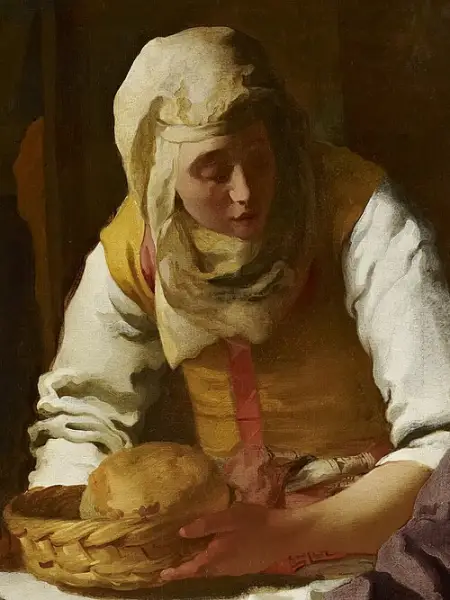
Martha is a biblical figure whose name in Aramaic means the mistress or the lady. She lived at Bethany near Jerusalem with her sister Mary and her brother Lazarus, and the Gospels of Luke and John present her as a close friend of Jesus, who is said to have loved her, her sister and her brother. In Luke she bustles with the service of hospitality while Mary sits at the Lord's feet, and receives his gentle correction. In John she stands at the center of the greatest of Jesus' signs: when Lazarus dies, Martha goes out to meet Jesus, laments his delay, and confesses him boldly as the Christ, God's own Son, sent into the world — and receives from him the great promise concerning resurrection and life. She serves again at the meal in Bethany before Jesus' Passion. Medieval tradition carried her to Provence after the Resurrection, where legend makes her the conqueror of the Tarasque at Tarascon; the East remembers her among the Myrrh-bearing Women and as a companion of Lazarus in Cyprus. She is patroness of cooks, servants and homemakers.
The Complete Life
The Lady of Bethany
Martha's name is a Latin transliteration of the Greek Martha, itself rendered from the Aramaic Mârtâ, meaning the mistress or the lady, the feminine of the word for master. The Aramaic form is attested outside the Gospels on a Nabatean inscription unearthed at Puteoli, today in the Naples museum, which is dated to the year 5, and in a Palmyrene inscription whose Greek translation gives the form Marthein. The woman who bore this dignified name lived in the village of Bethany near Jerusalem with her sister Mary and her brother Lazarus. Luke's Gospel describes a visit of Jesus to the home of the two sisters: Martha opened her home to him and threw herself into the preparations, distracted by all that had to be done, while Mary sat at the Lord's feet listening to his teaching. When Martha asked Jesus to send her sister to help, he answered with the memorable rebuke that only one thing is needed, and that Mary had chosen the better part, which would not be taken from her. The scene fixed Martha forever as the type of the active hostess.
§ Etymology of the name
Confessor at the Tomb
John's Gospel gives Martha her fullest portrait in the story of Lazarus being raised. John tells his readers that the Lord loved Martha, her sister and her brother. At Lazarus's death, with Jesus still on the road, both sisters grieve that his absence has cost their brother's life. But it is Martha, described by commentators as the more aggressive sister, who goes out to meet Jesus on the road while Mary stays home. Her lament becomes a confession: she declares that even now God will give whatever Jesus asks, and when he tells her that her brother will rise again, she answers with the hope of the resurrection at the last day. To her, uniquely in this narrative, Jesus unveils his claim to be resurrection itself, life itself, and asks whether she believes. Her answer — Lord, I believe; you are the Christ, God's Son, the one the world awaited — ranks among the great confessions of Scripture, uttered by a woman at her brother's grave. Mary stays at home until she is called, and then it is Martha who summons her sister quietly: the Master is here, and he asks for you.
§ Biblical references
Witness and Servant
After the raising of Lazarus, Martha appears once more in the Gospels, serving at a meal given in Jesus' honor at Bethany at which Lazarus is a guest and her sister Mary anoints the Lord with costly perfume. John's account of the meal at Bethany, and Luke's picture of the busy hostess, together shaped the memory of the Church: the Fourth Gospel itself records that Jesus loved her, and ancient commentators remarked the harmony between the two evangelists' portraits of her service and her faith. In the Eastern Orthodox tradition Martha, though not named among them in the Gospels, is numbered with the Myrrh-bearing Women, the faithful followers who stood at Golgotha during the Crucifixion and came to the tomb at dawn after the Sabbath with myrrh to anoint the Lord's body, becoming the first witnesses of the Resurrection. Orthodox tradition adds that after Stephen's martyrdom, in the persecution then loosed on the Jerusalem church, Lazarus was expelled from the city, Martha fled Judea with him, helping him to proclaim the Gospel in various lands, and came with him at last to Cyprus.
§ Eastern Orthodox tradition
Service Sanctified
From the earliest centuries Martha's two Gospel scenes were read together as a lesson on the union of action and contemplation. Her bustling service, and the Lord's words about the one thing necessary, became a founding text for the idea that the active life must be inwardly ordered toward God. As her cult deepened over the centuries, artists and writers stressed above all her maturity, her strength, her sound judgment, and her watchful care for those around her. The medieval West, identifying her sister with Mary Magdalene, wove richer legends around her: the Golden Legend presents her as a noble hostess, born of ducal lineage in Syria, who ministered to the Lord and wished her whole household to serve him, judging that all the world was not sufficient for such a guest. After the Ascension, the legend says, she and her siblings were set adrift by unbelievers and landed at Marseille, where Martha proved facund of speech, courteous and gracious to the people, converting the territory of Aix to the faith before withdrawing to Tarascon to a life of daily prayer and fasting.
§ Western traditions
The Taming of the Tarasque
The most famous legend of Martha's later life belongs to Tarascon in Provence. There, the Golden Legend relates, a monster called the Tarasque — a great dragon from Galatia, half beast and half fish, larger than an ox and longer than a horse, with teeth like swords, horns on either side, the head of a lion and the tail of a serpent — ravaged the land between Arles and Avignon. Martha went out to the beast holding a cross in her hand, sprinkled it with holy water, and placed her sash around its neck. Thus tamed, the dragon was led through the village. The town has cherished her memory ever since: her remains were identified among relics found in the Collegiate Church during a reconstruction in 1187 and reburied in a new shrine, and in the crypt stands a late fifteenth-century Gothic cenotaph carved by the Croatian sculptor Francesco Laurana, commissioned by King René, its reliefs showing Martha and the Tarasque, Mary Magdalene borne by angels, and Lazarus as a bishop. There she is honored as patroness, and the Feast of Moors and Christians at Villajoyosa in Spain likewise commemorates her legendary rescue of the town from Berber pirates.
§ St. Martha in Tarascon
Pre-Congregation Honor
Martha belongs to the saints of the earliest age, honored from the time of the apostolic Church without any formal process of canonization; her cult is accordingly classed as pre-congregation. The Catholic Church and the Orthodox East both rank her among the saints, and Lutheran and Anglican calendars likewise keep her memory. The Latin Church kept her feast on July 29 for centuries: it stood as a semi-double feast in the Tridentine calendar, became a simple feast under Pope Pius XII, a third-class feast in the calendar of 1960, and finally a memorial. Until 2021 the liturgical celebration was of Martha alone, a restriction traceable to the old confusion of her sister with Mary Magdalene; in that year Pope Francis decreed that the memorial should commemorate Martha with Mary of Bethany and Lazarus together. The Eastern churches keep her with her sister on June 4, remember them among the Myrrhbearers on the third Sunday of Pascha, and honor her brother on Lazarus Saturday before Palm Sunday. Few saints of the New Testament are kept so widely across the separated churches of East and West.
§ Feast days
Patroness of Servers
Martha's association with the service of the table and the keeping of the household made her the natural patroness of all who work in them: butlers, cooks and dieticians, domestic servants, housemaids and housewives, hotel-keepers and innkeepers, laundry workers, servers, and single laywomen, as well as travellers. Communities of women have taken her name, among them the Sisters of Saint Martha founded at Antigonish, Nova Scotia, in 1894. Churches dedicated to her stand on several continents, from the Collegiate Church at Tarascon and St Martha-on-the-Hill in Surrey to parishes across the United States, and in the Philippines, where the Diocesan Shrine of St. Martha at Pateros is the only shrine in southeast Asia devoted to her. There local tradition recounts that in the nineteenth century she appeared on the banks of the river in a halo of light, and the crocodile that plagued the town's duck farms vanished, restoring the people's livelihood; a fluvial procession in her honor has been held every year since. In art she is shown with a broom, keys, or the vanquished Tarasque at her feet, the active disciple transfigured by faith.
§ Patronages
Timeline
- 5
Her Aramaic name appears in its feminine form on a Nabatean inscription at Puteoli dated to this year
§ Etymology of the name
- 48
By Provençal legend she leaves Judea after the Resurrection and sails with her siblings to Marseille
§ The Golden Legend
- 1187
Bones uncovered while the Tarascon collegiate church is rebuilt are recognized as hers and given a new shrine
§ St. Martha in Tarascon
- 1538
Villajoyosa credits her with a flash flood that destroyed Berber pirate ships attacking the coast
§ St. Martha and Villajoyosa
- 1894
The Sisters of Saint Martha are founded at Antigonish, Nova Scotia
§ Patronages
- 2021
Pope Francis extends the July 29 Roman Calendar observance to commemorate Martha with Mary and Lazarus
§ Feast days
In Their Own Words
Martha, Martha, you are worried and upset about many things, but only one thing is needed. Mary has chosen what is better, and it will not be taken away from her.
I am the resurrection and the life. He who believes in me will live, even though he dies; and whoever lives and believes in me will never die. Do you believe this?
The Record
- Patron of
- butlers·cooks·dieticians·domestic servants·homemakers·hotel-keepers·housemaids·housewives·innkeepers·laundry workers·maids·servants·single laywomen·travellers·Tarascon, France·Villajoyosa, Spain·Pateros, Philippines
- Symbols
- broom·keys·the Tarasque
- Canonization
- Pre-congregation
Prayer
Bibliography
Show 6 sources
- Pope, Hugh (1919). "St. Martha". The Catholic Encyclopedia. Vol. 9. New York: Robert Appleton Company.
- "DECREE on the Celebration of Saints Martha, Mary and Lazarus in the General Roman Calendar (26 January 2021)". www.vatican.va.
- Butler, Alban; Paul Burns (2000). Butler's lives of the saints. Continuum International Publishing Group. ISBN 978-0-86012-256-2. p. 235.
- Martyrologium Romanum (Libreria Editrice Vaticana 2001, ISBN 978-88-209-7210-3), p. 398.
- "The Life of Saint Martha". text from the Golden Legend. Archived from the original on 2010-03-30.
- Tenney, Merrill C. Kenneth L. Barker & John Kohlenberger III (ed.). Zondervan NIV Bible Commentary. Grand Rapids, Michigan: Zondervan Publishing House.
Profile text adapted from the Wikipedia article, licensed CC BY-SA 4.0.
Pray with this saint every day
Save St. Martha of Bethany to your favorites, read the full profile, and get feast-day reminders in the Saints app.
Get the Saints AppFree on the App Store for iPhone and iPad