
4th century
St. Martha
Holy woman of Langres and wife of Amator
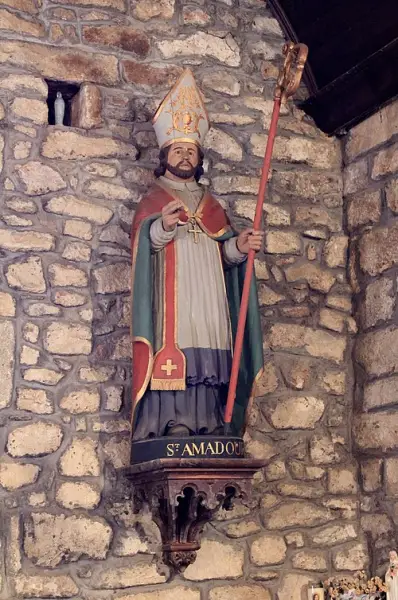
Overview
Martha, venerated locally as a saint at Langres, was a holy woman of that Burgundian city in the age when Christianity was still establishing itself across Gaul. She entered history through her marriage to Amator, a wealthy young man of Auxerre who studied theology under Valerian, Bishop of Auxerre, but took a wife in order to please his parents. The wedding became the turning point of two lives. Yet at the altar where the two came for their marriage blessing, the bishop's lips, by accident or by the quiet steering of heaven, spoke over them the formulas of consecration instead of the words appointed for bride and groom. The couple took the words as heaven's own verdict. They resolved to dwell under one roof thereafter as brother and sister, and the consecrated marriage bore its fruit in two religious vocations: Martha entered the convent as a nun, while her husband's hair was clipped in the clerical tonsure and went on to become Bishop of Auxerre in 388, governing that see for thirty years until his death in 418. Martha's own later years are unrecorded, but her sanctity was remembered at Langres, where she was honored locally as a saint, and she must always be distinguished from Martha of Bethany, the biblical figure to whom the medieval legends of France are devoted.
The Complete Life
A Holy Woman of Langres
Martha came from Langres, the ancient fortified city of Gaul set on its plateau between the lands of Burgundy and Champagne, and the tradition of the region remembers her simply and tellingly as a holy woman. Of her family, her childhood, and the circumstances that formed her character, the old accounts say nothing; her place in sacred memory rests not on documented deeds but on the reputation for sanctity that clung to her name among the people of her city. She lived in the generation after the great persecutions, when the church in Gaul was moving from a community under threat to an institution of public standing, and when bishops such as Valerian of Auxerre were shaping its clergy and its worship. It was into this world of earnest, upwardly mobile Christian families that her path crossed that of Amator, a young man of a wealthy and upper-class family in Auxerre who studied theology under Bishop Valerian. Amator's vocation was not in doubt to anyone but his parents, who wanted the security of marriage for their son. To please them, he sought a bride, and the bride chosen for him was Martha of Langres, a union of two devout young people that neither of them expected to end in the cloister.
§ Amator of Auxerre
A Wedding Changed into a Consecration
Everything turned on a single liturgy. When the young couple presented themselves in church for the blessing of their marriage, Valerian's voice, whether through a slip of memory or, as pious readers have preferred to believe, through God's own quiet steering, gave them not the wedding oration but the solemn form by which men and women were set apart for the Lord's service. Martha heard the words and bent her will to them. Husband and wife resolved to dwell under one roof as brother and sister, renouncing the marriage that had brought them together while honoring a bond that now carried a different meaning. From that shared resolve came two distinct religious vocations. Martha entered religious life as a nun, giving herself to the convent and its observance, while Amator's hair was clipped in the clerical tonsure and he rose in time to the episcopate, succeeding Eladius as Bishop of Auxerre in 388. The story endured in the tradition of the church as a favorite example of providence working through human error, and Butler's eighteenth-century Lives of the Saints retold it as the doorway through which a saintly bishop entered the clerical state, the other half of which was the nun of Langres.
§ Amator of Auxerre
Remembered at Langres
Martha's memory survived in the place that knew her, and Langres kept her name with local honors as a saint, a cult sustained by the city's own devotion rather than by any wider process. Her story is preserved chiefly through the biography of her husband, who governed Auxerre for thirty years, from 388 down to his death at the beginning of May in 418, and whose story carried the tale of their consecrated wedding into the written lives of the saints; Germanus, his successor, wrote a life of Amator, and Alban Butler and the compilers of the old cyclopedias repeated the episode of the mistaken benediction. Martha herself must not be confused with the far more famous Martha of Bethany, the sister of Mary and Lazarus, whose medieval legends placed her in France and whose cult inspired the sanctuary of Rocamadour; those traditions belong to the biblical saint, and the woman honored at Langres is a separate and distinct figure of the Gallic church. In an age that recorded the deeds of bishops and left the lives of women unwritten, Martha's enduring title is telling: the tradition did not remember her as a bishop's wife but as a holy woman in her own right, a nun whose consent to a consecrated life helped make two saints where the world had planned one marriage.
§ Amator and Rocamadour
Timeline
- 388
Her husband Amator succeeded Eladius as Bishop of Auxerre, beginning an episcopate of thirty years.
§ Amator of Auxerre
- 1 May 418
Her husband Amator died on 1 May and was buried in the church he had built in honor of Saint Symphorian.
§ Amator of Auxerre
The Record
- Canonization
- Pre-congregation; venerated locally as a saint at Langres
Prayer
Bibliography
Show 4 sources
- Butler, Alban. "Saint Amator, Bishop of Auxerre, Confessor". Lives of the Fathers, Martyrs, and Principal Saints, 1866. CatholicSaints.Info. 4 May 2013
- The Cyclopedia of Biblical, Theological, and Ecclesiastical Literature, (James Strong and John McClintock, ed.) Harper and Brothers; NY; 1880
- MacErlean, Andrew. "St. Germain." The Catholic Encyclopedia. Vol. 6. New York: Robert Appleton Company, 1909.
- Clugnet, Léon. "Rocamadour." The Catholic Encyclopedia. Vol. 13. New York: Robert Appleton Company, 1912.
Profile text adapted from the Wikipedia article, licensed CC BY-SA 4.0.
Pray with this saint every day
Save St. Martha to your favorites, read the full profile, and get feast-day reminders in the Saints app.
Get the Saints AppFree on the App Store for iPhone and iPad